On January 9th, Zcash (ZEC) experienced the largest decline among top digital assets, losing about 20% of its value, impacted by a combination of governance conflicts and a wave of leveraged sell-offs.
According to data from CoinPhotn, ZEC dropped to its lowest point in the month, around $382, becoming the most loss-making coin in the Top 100. This performance is completely detached from the broader crypto market, where Bitcoin and Ethereum only saw minor declines during the same period.
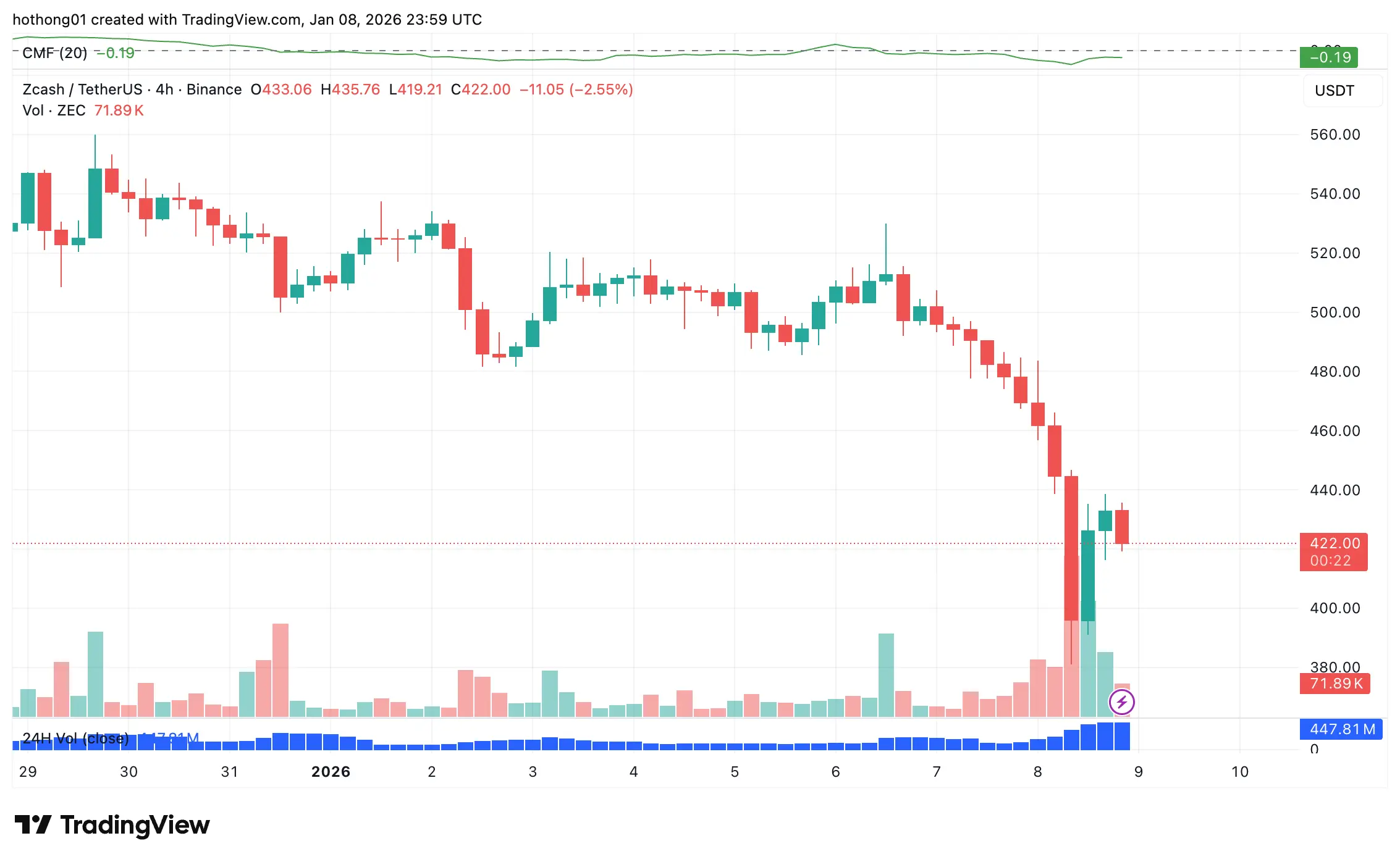 ZEC price is recovering slightly after the shock | Source: TradingView## Cause: ECC team departure
The direct cause of the plunge was the sudden departure of the entire Electric Coin Company (ECC) team — the group responsible for developing the core of Zcash — after negotiations with the nonprofit oversight board of the project failed.
Former ECC CEO, Josh Swihart, announced on X social media that the team had been “constructively terminated” by the Bootstrap board, a 501©(3) nonprofit organization established to manage ECC.
Swihart pointed out that the board members, Zaki Manian, Christina Garman, Alan Fairless, and Michelle Lai (collectively called “ZCAM”), had “completely diverged” from the project’s mission. He emphasized:
“Our working terms have been changed in a way that prevents us from performing our duties effectively and with integrity.”
The ECC team plans to establish a new company to continue the work, aiming to protect the project from “harmful governance actions.”
However, the Bootstrap board countered, asserting that this is not a purge but a measure to safeguard the nonprofit organization’s governance standards. The board stated that the dispute stemmed from a proposal to privatize “Zashi” — a product within the ecosystem.
They emphasized that transferring nonprofit assets for private purposes could lead to legal risks, similar to governance disputes at OpenAI:
“All sponsors could sue. Transactions could be canceled. Good intentions do not replace legal requirements, and urgency does not excuse procedural errors.”
Despite the controversy, Zcash founder Zooko Wilcox-O’Hearn reassured the market about the network’s security:
“The Zcash network is open-source, permissionless, secure, and private; what happens in this conflict cannot change that.”
Leveraged Sell-Off
Beyond governance conflicts, market data shows that the decline was further amplified by an overheated derivatives market. According to CoinGlass, in 24 hours, Zcash futures trading volume reached approximately $4.4 billion, compared to just $1.1 billion in spot trading volume. Open contracts nearing $900 million, along with about $23 million in liquidations, created a feedback loop: as prices fell, leveraged positions were liquidated, pushing selling pressure onto the spot order book, which was not deep enough to absorb the shock, causing prices to “free fall” instead of gradually declining.
This movement was further influenced by a “supply shock” related to shielded ZEC (shielded). In 2025, a positive outlook based on “scarcity-by-shielding” emerged as the number of shielded ZEC increased to about 4.9 million, accounting for 30% of the total supply. However, early January data showed over 200,000 ZEC (1.2% of the circulating supply) had been withdrawn from shielded pools, creating potential selling pressure.
ZEC Outlook
Currently, investors are assessing whether this crisis is temporary or will have long-term impacts on the project’s reputation. Some community experts remain optimistic. Mert Mumtaz commented:
“This is a positive signal; the most capable ECC team is now freed from political constraints of the fund, and the growth potential is enormous.”
Sean Bowe, a developer within the Zcash ecosystem, also expressed hope:
“I am very pleased that the legendary ECC team is reuniting under a new structure, continuing to develop Zcash without being hindered by a broken nonprofit framework. The unlocking potential is huge.”
These views align with the emerging trend of (privacy) security in the crypto market. Venture capital firm a16z and Grayscale Fund both predict that robust security infrastructure will become a key competitive advantage as public blockchains increasingly integrate deeply into financial systems.
Vương Tiễn
Disclaimer: The information on this page may come from third parties and does not represent the views or opinions of Gate. The content displayed on this page is for reference only and does not constitute any financial, investment, or legal advice. Gate does not guarantee the accuracy or completeness of the information and shall not be liable for any losses arising from the use of this information. Virtual asset investments carry high risks and are subject to significant price volatility. You may lose all of your invested principal. Please fully understand the relevant risks and make prudent decisions based on your own financial situation and risk tolerance. For details, please refer to
Disclaimer.


