
Polymarket data shows only a 5% chance that Trump will pardon SBF before 2027. In an exclusive interview with The New York Times, the president explicitly refused to pardon the former FTX CEO, who was sentenced to 25 years in prison for embezzling customer funds. Although the Trump family has profited over $1 billion through cryptocurrency ventures, political considerations have led to a clear stance, with SBF’s only hope remaining an appeal.
Trump Defends Family Crypto Business but Closes Door on SBF
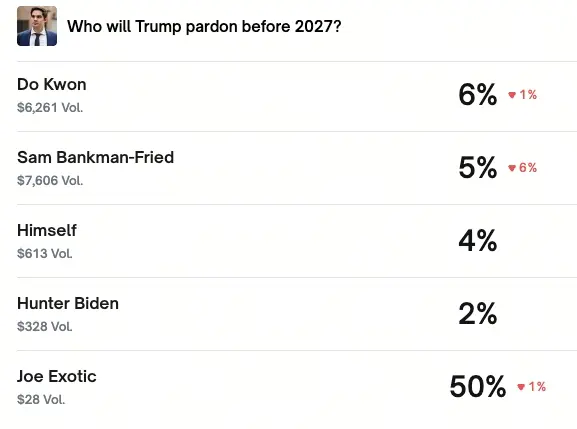
(Source: Polymarket)
In the NYT interview, Trump not only refused to pardon SBF but also explicitly listed him alongside music producer Shawn Combs, former New Jersey Senator Robert Menendez, and others as “not under consideration.” This stance is undoubtedly the heaviest blow to Sam Bankman-Fried, who has been detained since August 2023. At that time, a federal judge revoked his bail before the criminal trial, and SBF has been deprived of his freedom ever since.
However, in the same interview, Trump avoided addressing potential conflicts of interest between himself and the cryptocurrency industry. The president and his family are directly connected to Bitcoin mining company American Bitcoin, the US dollar stablecoin platform World Liberty Financial, and individual virtual currencies like Official Trump. According to a Financial Times investigation, the Trump family has earned over $1 billion in pre-tax profits from these crypto businesses in the past year.
“I gained a lot of votes because of my support for cryptocurrencies, and I’ve grown to like them,” Trump told The Times. This statement precisely reveals the president’s true attitude toward the crypto industry: it is a political tool and a source of wealth, but that does not mean he would turn a blind eye to criminals within the industry. This selective stance has raised questions: why can the family profit from crypto but not pardon SBF, who was jailed for crypto fraud?
In fact, reports suggest that Bankman-Fried may have tried to seek Trump’s pardon by claiming good relations with Republicans and associating with right-wing figures like Tucker Carlson. However, these efforts apparently failed. The 5% probability given by Polymarket says it all—markets hardly expect Trump to pardon SBF.
FTX Executives’ Sentencing Disparities Reflect Judicial Reality
In March 2024, Bankman-Fried was sentenced to 25 years in prison for seven federal crimes related to embezzling customer funds at FTX. This sentence is extremely rare in the history of the crypto industry and marks a zero-tolerance stance from regulators toward crypto fraud. However, the fates of other senior executives involved in the case are vastly different, revealing the enormous power of plea agreements within the US judicial system.
Comparison of Sentences for Core FTX Team Members
Sam Bankman-Fried (SBF): Refused to plead guilty, insisted on innocence, ultimately sentenced to 25 years, becoming a scapegoat
Caroline Ellison (former Alameda CEO): Reached a plea deal with prosecutors, sentenced to only 2 years, to be released on January 21, 2025
Ryan Salame (former FTX Digital Markets Co-CEO): Also significantly reduced his sentence through a plea agreement
This stark difference in sentencing highlights the cost of SBF’s failed strategy. Ellison was the direct executor of FTX’s embezzlement but cooperated with investigations and testified against SBF, resulting in a sentence only one-twelfth of her ex-boyfriend’s. Federal Bureau of Prisons records show that in October last year, Ellison was transferred from the federal detention center in Danbury, Connecticut, to the Reentry Services Office in New York City as part of her transition out of prison.
More notably, the US Securities and Exchange Commission confirmed this year that it has imposed multi-year director bans on Ellison, Salame, and other former FTX and Alameda executives. However, these administrative sanctions are insignificant compared to SBF’s 25-year sentence. The huge disparity in judicial outcomes fuels SBF’s desire to seek a presidential pardon to change his fate.
Trump’s Selective Pardon History Reveals Political Logic
Trump has indeed pardoned some individuals related to the cryptocurrency industry, but the criteria for these cases clearly reflect political considerations. In January this year, shortly after taking office, Trump pardoned Ross Ublish, founder of Silk Road, a decision widely praised by libertarians and the crypto community. In October, he pardoned Binance’s former CEO CZ, which also drew widespread attention. However, after serving just four months in prison, Trump later claimed he did not know CZ.
The fundamental difference between these pardons and SBF’s case lies in political costs and benefits. Ublish’s case was portrayed as a symbol of excessive government regulation, and pardoning him could garner support from liberal voters. CZ’s case was relatively minor, and Binance’s influence in the crypto industry made pardoning him a way to gain industry goodwill. But SBF’s situation is entirely different: he embezzled billions of dollars of customer funds, causing countless retail investors to lose everything. Pardoning him would trigger a media storm.
More critically, SBF donated over $40 million to the Democratic Party during the 2022 midterm elections, making him the second-largest Democratic donor after George Soros. Although he claims to have also donated to Republicans, most of these contributions were made through dark money channels and lack public records. For Trump, pardoning a financial criminal who heavily funded his political opponent is politically meaningless and could even anger the Republican base.
Appeal Becomes SBF’s Only Legal Lifeline
Even if Trump does not pardon him, Bankman-Fried can still seek to overturn his conviction and sentence through legal channels. In November last year, the US Court of Appeals for the Second Circuit heard arguments from SBF’s lawyers challenging the verdict. His legal team raised three main issues: bias of Judge Louis Kaplan, flaws in the prosecution’s evidence, and improper jury instructions.
However, legal experts generally believe the chances of success on appeal are very low. As of Thursday, no notices had been posted in the public case docket, but a final ruling is expected. If the court dismisses SBF’s appeal, his last resort is to petition the Supreme Court for review. But the Supreme Court accepts only about 1% of review petitions annually, usually cases involving major constitutional issues or legal conflicts. While SBF’s case involves a large sum, there is nothing particularly unique about it legally.
Disclaimer: The information on this page may come from third parties and does not represent the views or opinions of Gate. The content displayed on this page is for reference only and does not constitute any financial, investment, or legal advice. Gate does not guarantee the accuracy or completeness of the information and shall not be liable for any losses arising from the use of this information. Virtual asset investments carry high risks and are subject to significant price volatility. You may lose all of your invested principal. Please fully understand the relevant risks and make prudent decisions based on your own financial situation and risk tolerance. For details, please refer to
Disclaimer.


