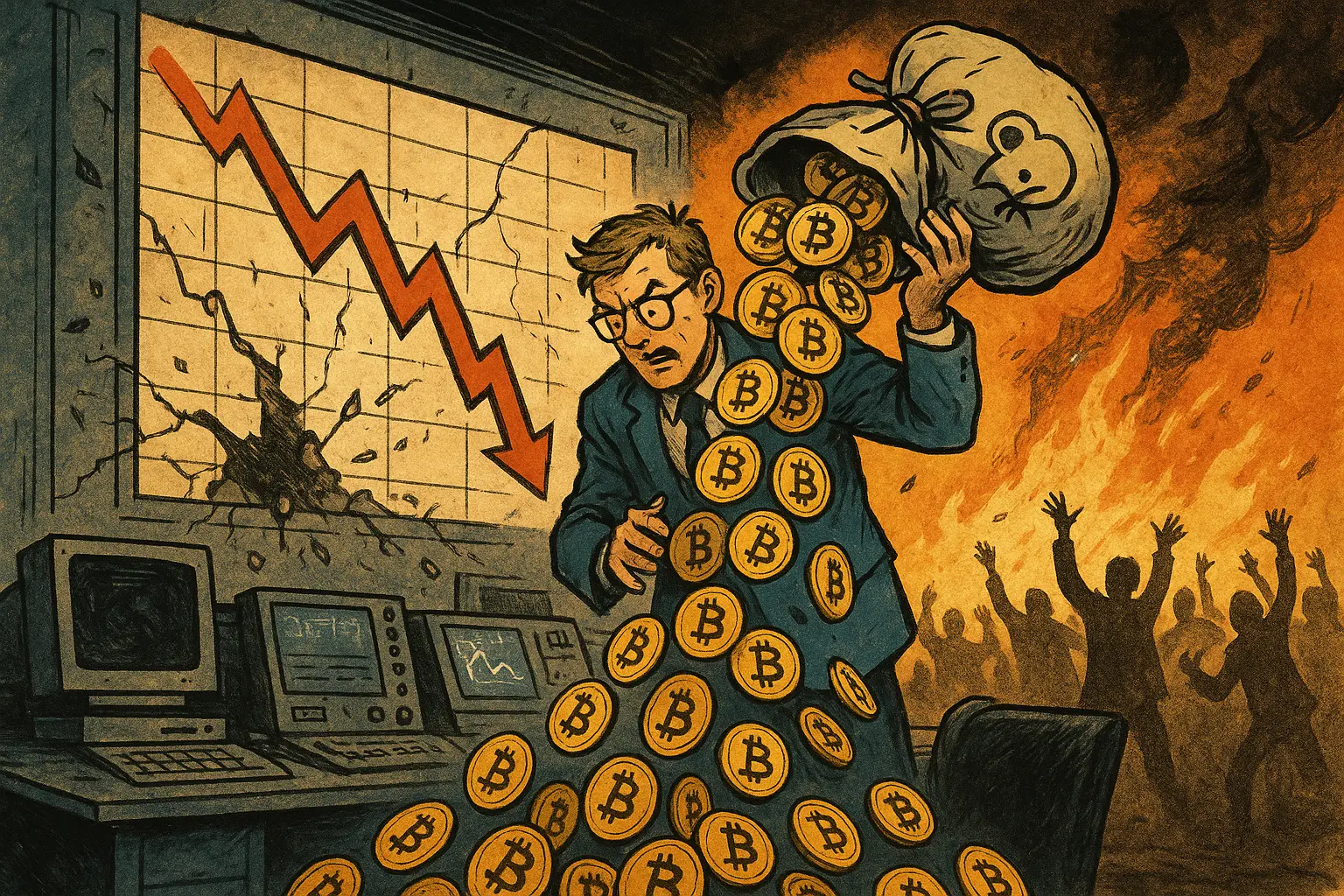
During the 2026 New Year’s Day period, market maker Wintermute net deposited 2654 BTC into exchanges during the thinnest liquidity period, choosing a time in the deep night of Europe and America, creating a liquidity vacuum, which caused Bitcoin to fall from 92,000 to 88,000. The community questioned market manipulation, while the CEO claimed it was inventory management. Wintermute has been involved in continuous controversy recently, transferring 700 million before the October liquidation in 2025.
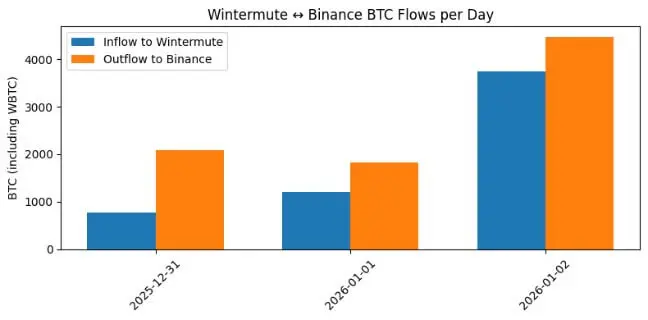
Precise Timing of 2654 BTC Net Inflow Over Three Days of 2026 New Year
At the beginning of 2026, the sharp fluctuations in Bitcoin’s price once again put the crypto market maker Wintermute in the spotlight. During the globally weakest liquidity window of the New Year holiday, Wintermute frequently made large deposits into Binance, sparking strong community suspicion of “institutional secret dumping.”
On New Year’s Eve, December 31, Bitcoin hovered around $92,000. On-chain monitoring data showed that Wintermute net deposited 1213 BTC into Binance that day, worth about $107 million. The transfer occurred precisely when European and American traders entered late-night rest and Asian trading hours were ending, a well-known liquidity vacuum period. Possibly due to this selling pressure, Bitcoin’s price quickly broke below $90,000.
In the following two days, Wintermute maintained high-frequency net inflows. On January 1 and January 2, the institution net deposited approximately 624 BTC and 817 BTC into Binance, respectively. In just three days, it transferred a total of 4709 BTC into Binance, withdrew 2055 BTC, with a net inflow of 2654 BTC. Meanwhile, Bitcoin’s price accelerated downward on January 2, reaching a stage low near $88,000.
The precision of this timing is astonishing. The New Year holiday is one of the periods with the poorest liquidity throughout the year, most institutional traders are on vacation, retail investors are less active, and order book depth significantly decreases. In such an environment, sell orders of the same size can cause price impacts several times greater than usual. Wintermute’s large deposits into exchanges at this time, regardless of subjective intent, objectively exerted significant downward pressure on prices.
Wintermute Fund Flows During the Three Days of New Year
December 31: Net deposit of 1213 BTC ($107 million), BTC drops below $90,000
January 1: Net deposit of 624 BTC, price continues to be pressured
January 2: Net deposit of 817 BTC, BTC hits the $88,000 low
Total over three days: Net deposit of 2654 BTC, withdrawal of 2055 BTC, total inflow of 4709 BTC
History of Wintermute Controversies: From SOL to October Liquidation
In fact, this is not the first time Wintermute has been embroiled in controversy. Looking at its past track record, Wintermute’s funds have appeared multiple times before major market shocks. For example, on October 10, 2025, the crypto market experienced an epic liquidation of up to $19 billion, and just hours before the crash, Wintermute was monitored transferring assets worth $700 million to exchanges.
Additionally, from the SOL crash in September 2025 to the earlier Yearn Finance governance proposal turmoil in 2023, this top market maker has been accused multiple times of “pump and dump.” These repeated “coincidences” of abnormal fund flows before market crashes have led the community to elevate suspicion of Wintermute from individual cases to systemic doubt.
Regarding accusations of market manipulation, Wintermute and its supporters hold very different views. Critics believe that market makers deliberately inject spot liquidity during illiquid holiday windows to create sell pressure artificially, precisely triggering stop-loss chains of retail longs. With deep cooperation with mainstream exchanges and insights into market microstructure, market makers can easily create volatility through large orders during low liquidity periods, profiting from washouts.
However, Wintermute CEO Evgeny Gaevoy dismisses this as a “conspiracy theory.” In interviews, he emphasized that the current market structure is very different from the periods of Three Arrows Capital and Alameda bankruptcy in 2022. The market now has higher transparency and more robust risk isolation mechanisms. Institutional fund movements are mainly aimed at inventory adjustments or hedging risks. Gaevoy states that when order books on exchanges become severely imbalanced, market makers must transfer positions to maintain liquidity provision. This behavior may objectively amplify short-term volatility but is not intended for profit-taking.
The Paradox of Transparency: Visible but Unknowable
In fact, the controversy remains unresolved because the crypto market lacks a universally accepted standard for judgment. In traditional securities markets, using capital advantage to place false orders or manipulate prices is clearly a criminal offense; but in the 24/7, highly algorithmic crypto world, how to prove whether large institutional transfers are for market rescue or arbitrage?
This lack of a clear criterion leaves top market makers like Wintermute in a dilemma of public opinion—seen as the backbone of market liquidity, yet also recognized as an “invisible hand” that cannot be ignored. Exchanges and some industry analysts tend to believe that market makers are a “necessary evil” in the market ecosystem. Without such major players providing two-sided quotes, cryptocurrency volatility could spiral out of control, even triggering systemic slippage disasters.
But to ordinary investors, the advantage of institutions wielding capital, algorithms, and information in a environment lacking rigid rules often becomes a tool for improper profit. The core of blockchain is openness and immutability, but every inflow and outflow of addresses related to BlackRock ETFs, and every transfer from Wintermute to Binance, is like a public performance in a transparent glass house, yet it cannot prove the true intent.
When everyone in the market is watching Wintermute’s wallet addresses, what we are trading may no longer be the value of Bitcoin itself, but suspicion and emotion. Information asymmetry is dead; perception asymmetry is eternal.
Disclaimer: The information on this page may come from third parties and does not represent the views or opinions of Gate. The content displayed on this page is for reference only and does not constitute any financial, investment, or legal advice. Gate does not guarantee the accuracy or completeness of the information and shall not be liable for any losses arising from the use of this information. Virtual asset investments carry high risks and are subject to significant price volatility. You may lose all of your invested principal. Please fully understand the relevant risks and make prudent decisions based on your own financial situation and risk tolerance. For details, please refer to
Disclaimer.


