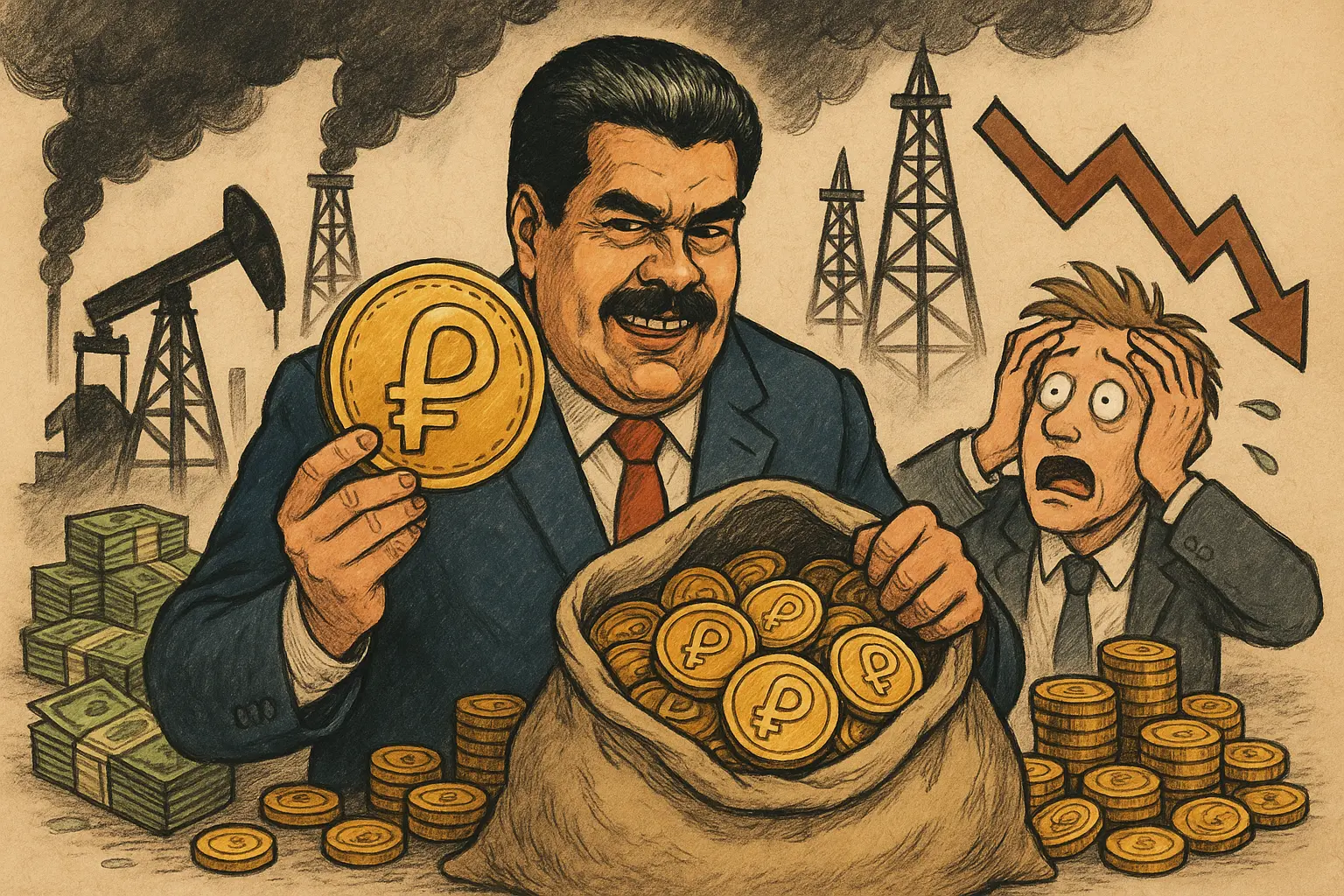
2018 saw Maduro issue the world’s first national-level cryptocurrency, the Petro, claiming each token was backed by one barrel of oil and priced at $60. This experiment to counter U.S. sanctions ended disastrously, with holders losing everything by January 2024. Technical specifications shifted repeatedly from Ethereum to NEM, then to a private chain, all of which were repeatedly delayed, resulting in a fully centralized system that was oil-backed but unredeemable. In 2023, a corruption scandal erupted, with billions of dollars stolen by officials.
Maduro’s Desperate and Absurd Experiment
At the end of 2017, Maduro announced a shocking plan in a nationwide televised speech: we will issue the world’s first cryptocurrency supported by a sovereign government—the Petro. Each Petro is backed by one barrel of Venezuelan crude oil, specifically from the Orinoco heavy oil belt, with an initial price of about $60. Other collateral included oil, gold, and diamonds. It was based on blockchain technology—decentralized, tamper-proof, transparent.
Technical Failures and Critical Flaws of Centralization
When the tech community started analyzing the Petro white paper, they found numerous issues. The official initially claimed it was based on Ethereum, then switched to NEM after a few months, and later said they would build a private chain. It was like a car salesman telling you it’s a Tesla, then the next day claiming it’s a Toyota, and the day after that saying they built their own.
Five Critical Flaws of the Petro
Technical Trust Issues
· Blockchain platform switched from Ethereum to NEM, then to a private chain
· Repeated delays in technical specifications eroded developer trust
· Transactions could not be verified on mainstream blockchain explorers
· Private chains completely violate decentralization principles
Centralization Control Paradox
· Despite being called a cryptocurrency, it is fully controlled by the government
· Cannot be traded on mainstream CEXs
· Only tradable on government-approved platforms, which often go offline
· Exchange rates are arbitrarily manipulated by the government
Asset-Backed Scam
· Claimed each token was backed by one barrel of oil
· In reality, it could never be exchanged for physical oil
· Lacked verifiable reserves and transparent audits
· The backing was just slogans and concepts
Forced Promotion of Tyranny
· Passports required payment of 2 Petro (about $120)
· Some taxes mandated to be paid in Petro
· Government salaries and pensions paid in Petro
· Merchants refused to accept it, treating it as worthless paper
International Sanctions and Blockades
· March 2018, Trump signed an executive order banning U.S. persons from trading
· Major exchanges refused to list it
· International investors avoided it for fear of blacklisting
· Became a government-issued digital token circulating only within Venezuela
Although nominally a cryptocurrency, it was entirely controlled by the Venezuelan government. You couldn’t buy or sell it on major crypto exchanges, only on government-approved platforms. Where is the decentralization? It’s just a government-issued digital token with a blockchain veneer.
The official claim was that each Petro was backed by a barrel of oil, but the problem is: can you exchange Petro for a barrel of actual oil? The answer is no. The so-called backing is just a concept, a slogan. You hold Petro but can never get that barrel of oil. It’s like buying a gold-backed bond and discovering it’s just a promise that it’s valuable, but you can never redeem gold.
Corruption Scandal and the Final Straw
In 2023, the last straw broke the Petro’s back. Venezuela was rocked by a nationwide PDVSA Crypto corruption scandal. PDVSA is Venezuela’s state oil company, and PDVSA Crypto is their department managing oil revenues via cryptocurrency. Investigations revealed that billions of dollars of oil income were embezzled by officials through crypto channels.
These funds were supposed to support the value of the Petro but ended up in the pockets of corrupt officials. The government agency overseeing the Petro, Sunacrip, was purged, with many officials arrested. The Petro immediately fell into disuse. On January 15, 2024, the Venezuelan government officially announced the termination of the Petro project. All remaining Petro tokens were forcibly converted into the severely devalued Bolivar. Holders’ assets were essentially wiped out.
The failure of the Petro exposed a brutal truth: trust is more important than technology. Blockchain, cryptocurrencies, decentralization—no matter how advanced these technologies are, they mean nothing without trust as a foundation. Maduro’s government had already lost the trust of the people. When your fiat currency experiences hyperinflation, when corruption is rampant among officials, and when promises are repeatedly broken, no matter how flashy the technology, it’s useless.
In less than six years from announcement to demise, the Petro failed to help Venezuela bypass sanctions, stabilize its currency, attract international investment, or improve living standards. The only thing it achieved was becoming the biggest joke in cryptocurrency history. Everyone holding Petro lost everything, and those who believed in oil backing eventually realized they were holding only an empty government-issued check.
Disclaimer: The information on this page may come from third parties and does not represent the views or opinions of Gate. The content displayed on this page is for reference only and does not constitute any financial, investment, or legal advice. Gate does not guarantee the accuracy or completeness of the information and shall not be liable for any losses arising from the use of this information. Virtual asset investments carry high risks and are subject to significant price volatility. You may lose all of your invested principal. Please fully understand the relevant risks and make prudent decisions based on your own financial situation and risk tolerance. For details, please refer to
Disclaimer.


