Ethena’s synthetic-dollar stablecoin USDe saw one of its sharpest monthly contractions yet, while fiat-backed stablecoins like USDT, USDC and PYUSD attracted billions in inflows
CoinGecko data showed that Ethena’s USDe stablecoin fell from a market capitalization of $9.3 billion on Nov. 1 to a valuation of $7.1 billion on Nov. 30. The token saw roughly $2.2 billion in redemptions, marking a 24% decline in supply in November
Ethena’s USDe is a synthetic stablecoin that maintains its dollar peg through trading strategies with crypto and futures contracts rather than holding actual dollars. This means that USDe outflows mean that users are either selling USDe on the open market, withdrawing from pools or unwinding their positions on decentralized applications (DApps).
At the time of writing, CoinGecko data shows that the overall stablecoin market cap is at $311 billion. The market remains dominated by US dollar stablecoins, capturing $303 billion of the sector’s total valuation
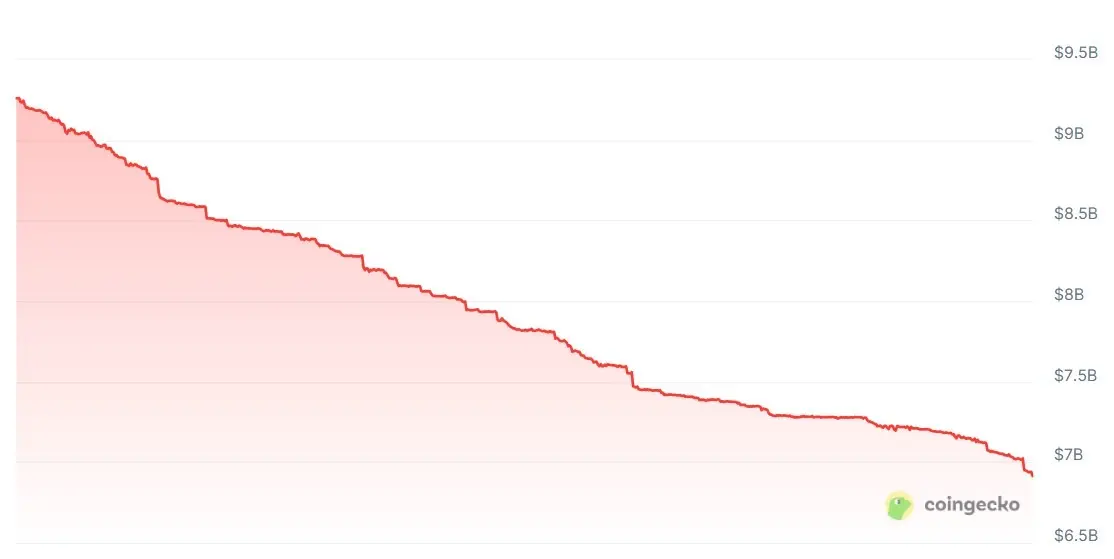 Ethena USDe stablecoin’s 30-day market capitalization chart. Source: CoinGecko## USDe outflows follow October depeg
USDe’s November contraction comes weeks after the synthetic stablecoin suffered a depegging event on the crypto exchange Binance. At the time, USDe briefly plunged to $0.65 on the exchange
Ethena founder Guy Young said that the drop was caused by a Binance-specific oracle issue and not a problem with USDe’s underlying collateral mechanism that backs the asset
Young said that the USDe token’s minting and redemption functions operated “perfectly” during the incident, with approximately 2 billion tokens redeemed across decentralized finance (DeFi) platforms
On Oct. 9, USDe market cap hovered at $14.8 billion, making it the third-largest stablecoin at the time. Since then, the stablecoin lost over 53% of its market capitalization
At the time of writing, CoinGecko data shows that USDe has a total valuation of $6.9 billion, dropping to the fourth spot in the stablecoin market cap rankings
Related: Lawmakers stumble on stablecoin terms as US Congress grills Fed’s Bowman
Fiat-backed stablecoins grew by $3.2 billion in November
While the synthetic-dollar stablecoin struggled during the month, fiat-backed stablecoins recorded modest but steady gains over the same time period
Tether’s USDt (USDT) saw a $1.3 billion increase to $184.6 billion, while Circle’s USDC (USDC) climbed to $76.5 billion, adding roughly $600 million to its supply
PayPal USD (PYUSD) posted the strongest growth among the major dollar-pegged stablecoins, jumping from $2.8 billion to $3.8 billion in November. This marks 1 billion inflow for the month — a 35% month-on-month growth
DefiLlama data showed that since PayPal PYUSD stablecoin grew by over 216% since September, when it had a market cap of $1.2 billion. This represents a $2.6 billion increase in just three months
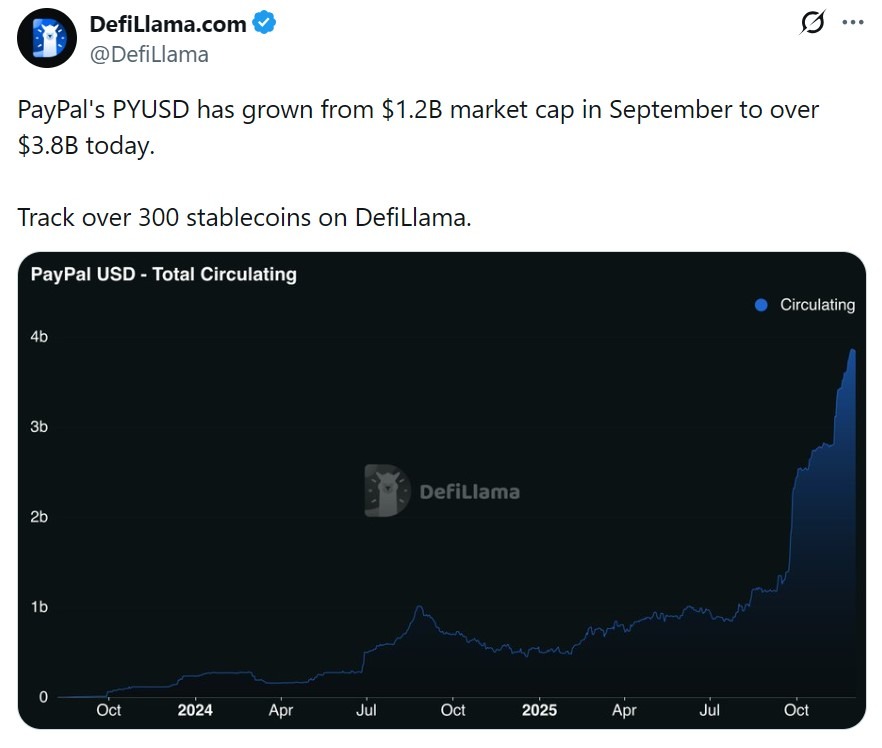 Source: DefiLlamaMeanwhile, Ripple’s (RLUSD) stablecoin, which breached a market capitalization of $1 billion for the first time in November, continued its growth throughout the month.
According to CoinGecko, RLUSD went from a $960 million market cap on Nov. 1 to a market cap of $1.26 billion on Nov. 30, marking a $300 million increase
Magazine: China officially hates stablecoins, DBS trades Bitcoin options: Asia Express
- #Blockchain
- #Cryptocurrencies
- #Circle
- #Binance
- #Tether
- #Stablecoin
- #Data
- #DeFi
Add reaction
![]()
Disclaimer: The information on this page may come from third parties and does not represent the views or opinions of Gate. The content displayed on this page is for reference only and does not constitute any financial, investment, or legal advice. Gate does not guarantee the accuracy or completeness of the information and shall not be liable for any losses arising from the use of this information. Virtual asset investments carry high risks and are subject to significant price volatility. You may lose all of your invested principal. Please fully understand the relevant risks and make prudent decisions based on your own financial situation and risk tolerance. For details, please refer to
Disclaimer.


