Author: 0xTodd; Source: X, @0x_Todd
The core of crypto is to demystify finance.
At first, everyone thought coins were relatively rare, then one-click token issuance was born; later, everyone thought chains were relatively rare, then one-click chain issuance was born; then everyone thought being listed was the real deal, so DEX was created; after that, people felt that without a market maker, it was all pointless, leading to the birth of AMM; and then everyone believed that contracts were the moat for CEX, resulting in the emergence of on-chain perpetual contracts.
Crypto is always proving that finance is a tool, and it is egalitarian and permissionless.
In the past, those grand listings on TV, with things like ringing the bell, equity pledges, and futures deliveries, could only be manipulated by financial giants. Now, even ordinary people can achieve this with a little effort on the blockchain.
Apart from the surging liquidity from retail investors still being a privilege of top exchanges, there are generally low-cost, permissionless alternatives for everything else.
For example, HyperLiquid starts with three HIPs:
- HIP-1 defines what a token is;
- HIP-2 defines how early tokens are traded;
- HIP-3 defines how to issue perpetual contracts.
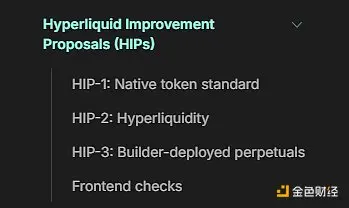
These 3 HIPs have created an on-chain perp, causing CEX bosses to hold meetings every day to figure out how to respond.
It feels a bit like Go, defining the two rules of “straight-line adjacent empty points as liberties” and “when there are no liberties left, it's dead,” this game can be played for two thousand years.
Of course, actually issuing a perpetual contract is not that simple, as it heavily relies on a key infrastructure—(oracles like RedStone).
The biggest difference between perpetual and spot trading is that perpetual relies on spot to provide a benchmark price.
For example, many people do not quite understand the arrangement of certain coins on Binance Alpha + day1 perp. If you can go for day1 perp, why do you still have to go for Alpha?
Because perpetual contracts are essentially betting on the future price of the spot market. It's like participating in a football betting; you can only bet once the game is played. If the game doesn't happen, it doesn't matter how deep the betting market is. PS: The point spread in football betting is actually the perpetual contract fee rate.
Traditional CEX oracles run on their own, for example, the contract of a certain token in Binance may be a weighted average of prices from several other exchanges (such as Binance, Coinbase, OKX, Bybit, Kraken, etc.) after eliminating anomalies.
In the past, CEX was often attacked for reasons related to price manipulation, but the real target of everyone's criticism is the private internal oracles of CEX. Therefore, on-chain perpetual contracts must be very cautious about oracles, as they are challengers to CEX.
Therefore, RedStone has specifically launched an oracle for HyperLiquid that complies with the HIP-3 (Permissionless Permanent Contracts) standard.
For example, its price algorithm must withstand scrutiny, after all, if it loses money, people will come looking for the oracle's issues. Also, it needs to be fast enough; if it's too slow, it can't provide pricing for perpetual contracts.
According to RedStone's disclosure, it currently occupies 99.5% of the market share of the entire HyperEVM ecosystem.
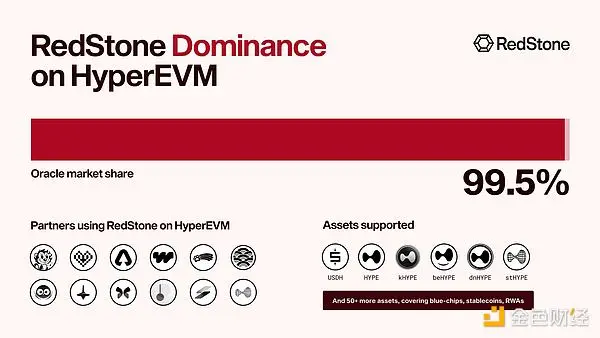
Later, if HIP-3 is fully implemented, perpetual contracts will no longer require review, and the era of an average of two perpetual contracts per person will truly arrive (this point in time may not be too late).
The oracle will undoubtedly generate a considerable cash flow, as every price feed brings in some revenue. Both longs and shorts occasionally win and lose, but only the on-chain perp and oracle continuously extract fees.
Disclaimer: The information on this page may come from third parties and does not represent the views or opinions of Gate. The content displayed on this page is for reference only and does not constitute any financial, investment, or legal advice. Gate does not guarantee the accuracy or completeness of the information and shall not be liable for any losses arising from the use of this information. Virtual asset investments carry high risks and are subject to significant price volatility. You may lose all of your invested principal. Please fully understand the relevant risks and make prudent decisions based on your own financial situation and risk tolerance. For details, please refer to
Disclaimer.


