Visa is piloting a service that allows businesses funded in fiat currency to pay USD stablecoins to cryptocurrency wallets. On Wednesday at the Lisbon Web Summit in Portugal, Visa announced that this pilot program enables users of its digital payment network Visa Direct to send stablecoins like USDC directly to crypto wallets.
How does Visa’s stablecoin payment work?
Visa’s stablecoin payment pilot addresses core issues of traditional cross-border payments: slow speed and high costs. Conventional international remittances typically take 3-5 business days, passing through multiple intermediary banks, each charging fees, with total costs reaching 5-10% of the transfer amount. In contrast, stablecoin payments can be completed within minutes, with fees usually below 1%. The company states that the pilot allows payers to choose to receive funds in stablecoins, and US platforms and businesses can send funds directly from their fiat accounts to users, workers, or employees’ stablecoin wallets.
The process works as follows: a US business initiates a payment instruction from its USD bank account, processed through Visa Direct network. Visa’s partners convert the fiat currency to stablecoins like USDC and send them directly to the recipient’s crypto wallet address (e.g., MetaMask). The entire process completes within minutes. This seamless fiat-to-stablecoin payment experience eliminates the hassle of manual exchange on exchanges for businesses and individuals.
Initially, the pilot targets international businesses and gig economy companies or freelancers that rely on fast digital payments. Visa notes that recent research shows 57% of gig workers prefer digital payment methods for quicker access to funds. This data highlights strong market demand for stablecoin payments.
Three advantages of stablecoin payments
Speed: Reduced from 3-5 days to minutes, greatly improving cash flow efficiency
Cost: Fees lowered from 5-10% to below 1%, significantly reducing corporate costs
Coverage: Anyone with a crypto wallet can receive payments, no bank account needed
The creator economy has long been an early adopter of digital payment technology. Content creators on YouTube, Twitch, Instagram, and other platforms are worldwide, with diverse and cross-border income sources. Traditional bank transfers are slow, expensive, and sometimes inaccessible due to underdeveloped banking systems in certain countries. Stablecoin payments solve these issues, enabling platforms to pay creators globally quickly and at low cost.
Genius Act provides regulatory support for stablecoin payments
Visa’s expansion coincides with the U.S. passing the milestone “Genius Act,” which provides federal guidelines for stablecoins. The Genius Act is the first comprehensive stablecoin regulation passed by Congress, establishing reserve requirements, audit standards, and consumer protection rules for issuers. This regulatory clarity alleviates previous concerns among businesses and financial institutions about compliance.
Before the Genius Act, U.S. stablecoin regulation was uncertain: the SEC considered some stablecoins as securities, CFTC viewed them as commodities, and state laws varied. This regulatory ambiguity hindered large-scale adoption by enterprises wary of future compliance issues. Now, clear federal regulation provides Visa and other payment giants a legal foundation to proceed.
Visa’s latest initiatives reflect its commitment to blockchain-based settlement and stablecoin payments. In July, Visa expanded its stablecoin offerings on its settlement platform, adding Global Dollar, PayPal USD, and Euro Coin on Stellar and Avalanche blockchains. In September, Visa Direct began trialing real-time transfers using USDC and EURC, accelerating inter-company settlement. These ongoing product iterations demonstrate that Visa considers stablecoin payments a core part of its long-term strategy.
Visa states it is currently onboarding “specific partners” and plans to roll out the service to more users by 2026. This phased approach allows Visa to test system stability, user acceptance, and compliance processes on a small scale before broader deployment. The 2026 timeline provides ample time to address technical and regulatory challenges.
Wall Street giants race to adopt stablecoin payments
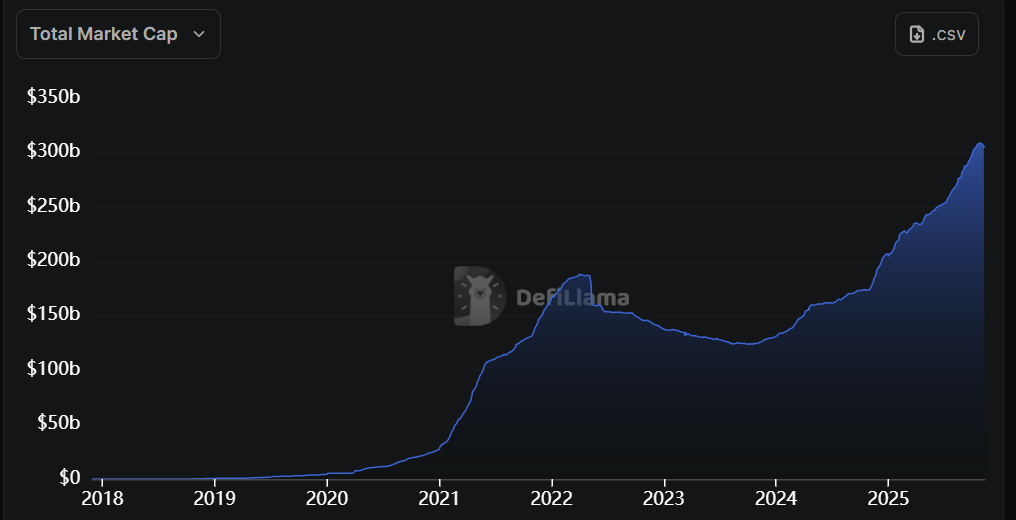
(Source: DefiLlama)
An increasing number of companies are entering the stablecoin payment space. Bank giants like Citigroup are exploring stablecoin payments, while Western Union plans to launch a digital asset settlement system on Solana. Meanwhile, JPMorgan Chase and Bank of America are in early stages of developing their own stablecoins. This industry-wide movement indicates stablecoin payments have shifted from experimental to a strategic focus for mainstream finance.
Citigroup’s exploration centers on cross-border trade settlement, believing stablecoins can significantly reduce settlement times and costs, especially in emerging markets with volatile local currencies and underdeveloped banking infrastructure. Western Union’s deployment on Solana highlights the advantages of high-performance blockchains—its high throughput and low fees make it ideal for large-scale stablecoin payments.
JPMorgan and Bank of America’s plans are more strategic. These banks aim not only to use existing stablecoins but also to issue their own. JPMorgan has operated its JPM Coin on its private blockchain Onyx for years, mainly for large institutional settlements. If these banks’ stablecoins gain regulatory approval and become publicly accessible, they could pose strong competition to USDC and USDT.
Stablecoin startups are also attracting significant venture capital. Recent funding rounds have supported companies active in the stablecoin ecosystem, such as Telcoin, Hercle, and Arx Research. These startups focus on different verticals: Telcoin on mobile cross-border remittances, Hercle on B2B stablecoin settlements, and Arx Research on compliance and risk management tech. The influx of VC funding signals strong investor confidence in the long-term prospects of stablecoin payments.
The global stablecoin market has surpassed $300 billion this year. This milestone shows stablecoins have grown from niche crypto products into systemically important financial tools. The $300 billion market size is comparable to the M2 money supply of a mid-sized country. USDT accounts for about 70% of the market, USDC around 20%, with the rest divided among regional or specialized stablecoins.
Gig economy and creator economy: a perfect match
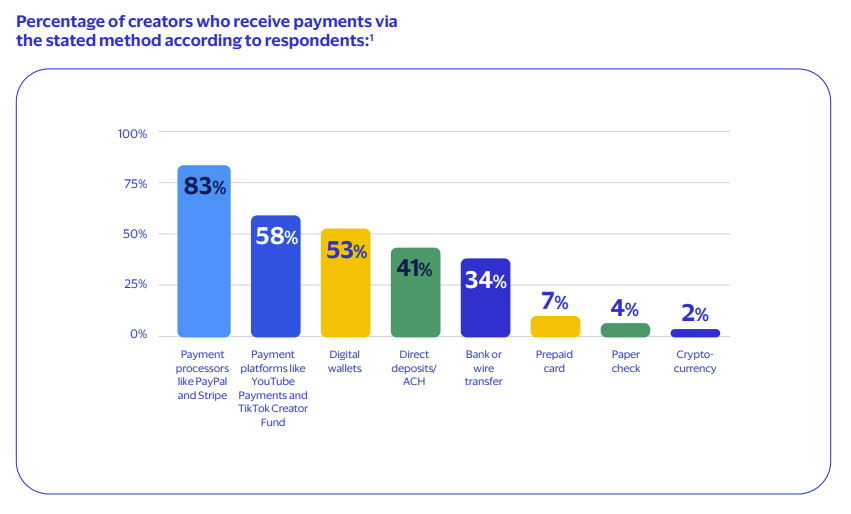
Visa reports that recent studies show 57% of gig workers prefer digital payments for faster access to funds. This underscores the huge potential of stablecoin payments in the gig economy. The gig economy involves short-term contracts or freelance work, including Uber drivers, delivery personnel, freelance designers, and developers. These workers often need quick payouts to maintain cash flow, and waiting 3-5 days for bank transfers can be a real hardship.
The creator economy has also been an early adopter of digital payments. Content creators on YouTube, TikTok, Patreon, and other platforms earn income from dozens or hundreds of sources—ads, sponsorships, tips, merchandise sales. These fragmented, frequent payments are slow and costly via traditional banks, and small transactions may be rejected or incur high fees.
Stablecoin payments offer an ideal solution. Creators can set up a crypto wallet address, and platforms or sponsors can pay stablecoins directly to it. Creators can then convert stablecoins to local fiat or spend them directly. For platforms, using stablecoins reduces payment processing costs, savings that can be shared with creators or reinvested.
International businesses also benefit. Cross-border companies often pay suppliers, contractors, or employees in different countries. Using SWIFT is slow, expensive, and involves complex compliance. Stablecoin payments enable instant, low-cost transfers worldwide, simplifying financial management.


