Aptos (APT) is a next-generation Layer 1 blockchain designed with scalability, safety, reliability, and upgradeability as core principles, empowering decentralized applications to reach billions of users by leveraging the Move language, parallel execution, and modular architecture.
How Aptos Works: Transaction Processing Pipeline
Aptos processes transactions through a pipelined, modular workflow that maximizes efficiency:
- Dissemination: Transactions are broadcast to validators for rapid propagation.
- Block Metadata Ordering: Leaders order metadata to coordinate execution.
- Parallel Execution: Move VM enables concurrent transaction processing without atomicity breaks, supporting complex apps.
- Batch Storage: Results are batched for efficient ledger updates.
- Ledger Certification: Final proofs ensure immutability.
This approach achieves 160,000+ TPS with sub-second latency, using hybrid custodial options and light clients for user safety.
Aptos Consensus and Nodes: Proof-of-Stake with Pipelining
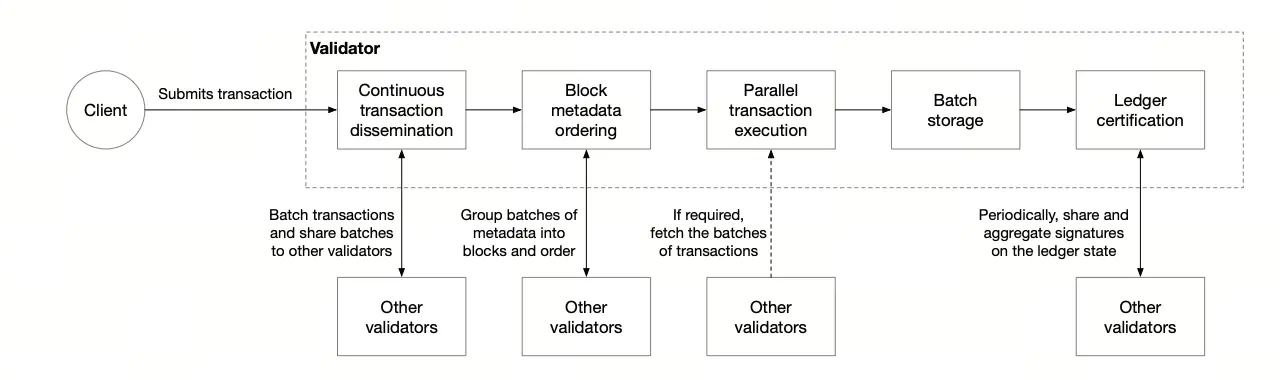
(Sources: APT website)
Aptos employs a Proof-of-Stake (PoS) consensus with pipelined stages for high throughput. Validators stake APT to participate, with committees elected via VRF for randomness. Nodes run the Move prover for formal verification, ensuring contract invariants. The modular design supports sharding and frequent upgrades, with 100+ validators securing the network.
Aptos Roadmap: From Mainnet to Sharding
Aptos’ roadmap prioritizes scalability and innovation:
- Q1 2025: Mainnet launch with Move integration and 10,000 TPS.
- Q2 2025: Pipelined execution for 100,000 TPS; hybrid custody.
- Q3 2025: Sharding experiments for 1M TPS; on-chain upgrades.
- Q4 2025: Web3 use case support; embedded change management.
Future phases include internal sharding and homogeneous state sharding for horizontal scaling.
Aptos Token Sale and Tokenomics: APT for Staking and Governance
APT’s token sale raised $350 million in 2022, with 51% community allocation. Total supply is 1 billion APT, used for:
- Staking: Secure the network; earn 7% APY.
- Governance: Vote on upgrades; 40% DAO-controlled.
- Gas Fees: Pay for transactions; burns for deflation.
Initial circulation was 20%, with vesting for team (15%, 4-year cliff) and investors (25%, 1-year lock). APT’s economics support sustainability, with emissions tied to security needs.
Disclaimer: The information on this page may come from third parties and does not represent the views or opinions of Gate. The content displayed on this page is for reference only and does not constitute any financial, investment, or legal advice. Gate does not guarantee the accuracy or completeness of the information and shall not be liable for any losses arising from the use of this information. Virtual asset investments carry high risks and are subject to significant price volatility. You may lose all of your invested principal. Please fully understand the relevant risks and make prudent decisions based on your own financial situation and risk tolerance. For details, please refer to
Disclaimer.


