
Author: Zen, PANews
Over the past year, the narrative focus of the crypto market has quietly shifted: from simply chasing prices to a institutional competition surrounding “how capital is brought on-chain, how assets are tokenized, and how compliant funds enter.” The processes and rules of traditional finance are being gradually integrated into the world of public chains. Whoever can more quickly connect compliant funds, real assets, and industry flow to the chain will have a better chance of occupying an ecological niche in the next cycle.
Avalanche is one of the most active players in this competition. On one hand, it improves performance and developer experience through the Octane upgrade and Subnet expansion. On the other hand, it introduces a “public company treasury” centered around AVAX exposure and collaborates with RWA (real-world assets on-chain), bridging Wall Street's funds and rules to the chain through tokenization.
AVAX treasury sets sail, with an expected fund size exceeding 1 billion USD
Recently, the small publicly listed company AgriFORCE Growing Systems (NASDAQ: AGRI), which originally engaged in agricultural technology and later transitioned to Bitcoin mining, announced that it would be renamed “AVAX One” and plans to raise approximately $550 million from external investors to acquire AVAX tokens worth over $700 million.
AGRI has successfully raised approximately $300 million in PIPE (Private Investment in Public Equity) to date, with this financing led by Hivemind Capital and involving over 50 institutions and cryptocurrency-native investors, including ParaFi, Galaxy Digital, Digital Currency Group, Kraken, Cypher Capital, Big Brain Holdings, FalconX, Republic Digital, Borderless Capital, Summer Capital, GSR Ventures, FintechCollective, Bastion Trading, CMCC Global Titan Fund, Hypersphere, Fifth Lane Capital, HashKey Capital, and others.
Notably, Matt Zhang, the founder of lead investor Hivemind Capital, is expected to serve as the chairman of the company. Anthony Scaramucci, founder of SkyBridge Capital, will lead AGRI's advisory board to assist the company with fundraising and marketing. The board's members also include Brett Tejpaul, head of Coinbase Institutional, along with other well-known figures in the financial industry to be announced soon.
In addition to AGRI, another publicly listed company that specializes in holding AVAX tokens is expected to be established next month - the Avalanche Foundation was revealed to be pushing for two rounds of financing totaling approximately $1 billion in mid-month, and these two rounds of financing will be used to purchase AVAX tokens at a discount from the Avalanche Foundation to set up two crypto treasury companies in the United States, strengthening the market foundation for AVAX.
The main entity of the first transaction is AGRI, which has already begun raising an additional $250 million in funds. The second transaction is led by the well-known crypto venture capital firm Dragonfly, which will raise funds through a special purpose acquisition company (SPAC), with a scale of at least $500 million.
Can the AVAX treasury strategy be effective?
The treasury company strategy launched by Avalanche has introduced long-term funding and real asset backing for Avalanche. The participation of strong institutional investors in purchasing AVAX shows confidence in the ecosystem and is expected to enhance the influence of AVAX in terms of market capitalization and application.
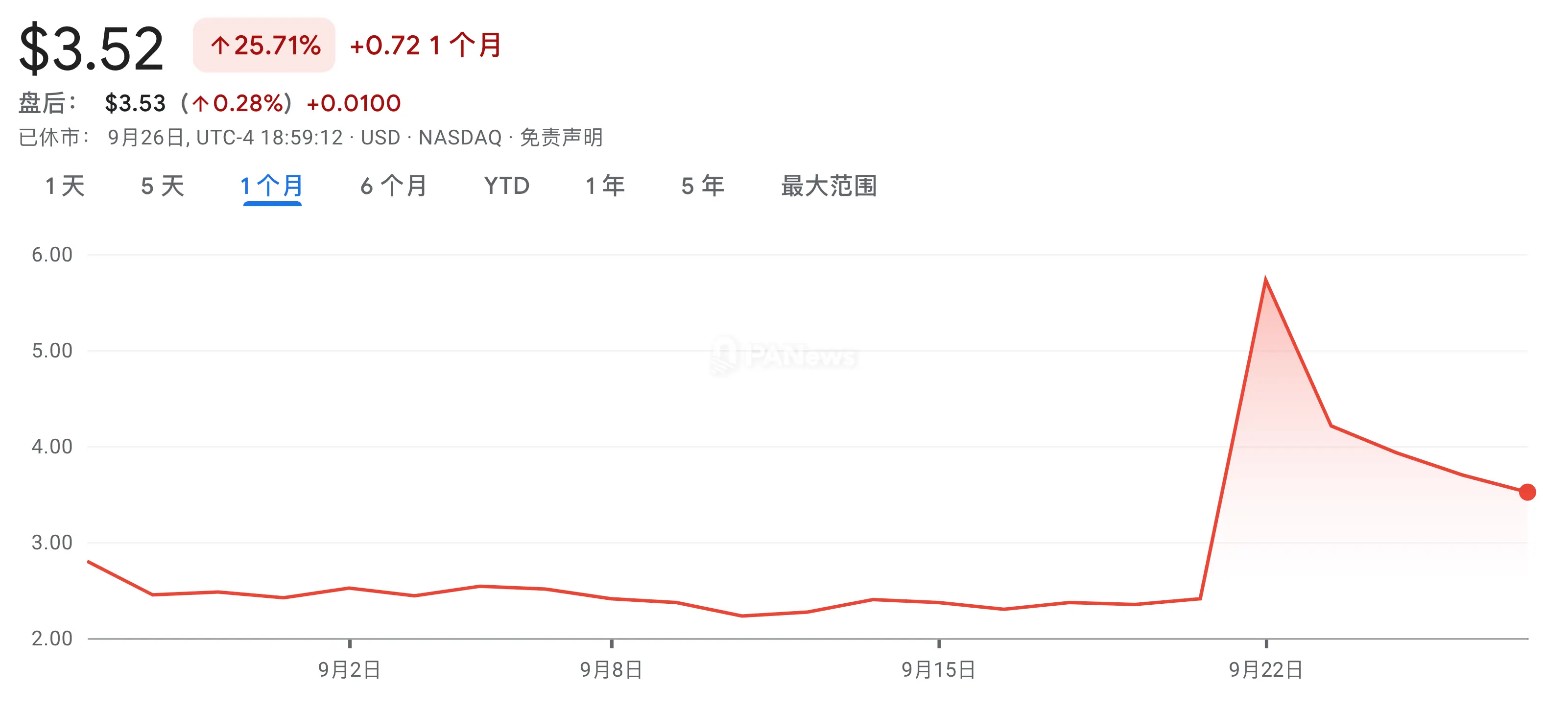
On the other hand, many research institutions and observers have expressed doubts about the sustainability of this strategy. In fact, the surge of AGRI (AVAX One) did not last long. AGRI gapped up on the first trading day after the transformation news was announced, surging as much as 134% during the day, with a closing increase still reaching 142.98%. However, the company's stock price continued to decline thereafter, and as of September 26, its stock price had fallen from $5.73 to $3.52.
K33 Research pointed out in its September report that currently about a quarter of publicly listed companies holding Bitcoin have a market capitalization that is lower than the book value of their crypto assets. K33 analyst Vetle Lunde noted that this situation of “market value being lower than assets” means that companies are issuing new shares to raise funds to buy coins, which is equivalent to selling equity at a discount and may prove unwise in the long run. Due to frequent issuance diluting the rights of existing shareholders, combined with the potential risks of having assets highly concentrated in specific cryptocurrencies, the subsequent financing ability of such treasury companies is often limited.
Data from K33 also shows that as of September, the average premium multiple of the stock price of cryptocurrency treasury companies relative to the assets held, (mNAV), has decreased from 3.76 in April to 2.8. Most small and medium-sized companies have fallen into a discount range, with only leading companies like MicroStrategy still maintaining premium trading. This indicates that the market is becoming more rational towards the “listed companies hoarding coins” model, no longer blindly chasing the concept.
Lunde stated that the recent compression of the premium in the stock prices of treasury companies is a “rational return,” due to the fact that these operations often involve high advisory fees, insider incentives, and complex capital structures, which have exhausted market patience. Unless these companies can integrate their held crypto assets into their main business and create actual earnings, simply hoarding coins does not create new value.
Several analysts in the industry have also reminded investors on social media to be vigilant about some “buying coins to speculate on stocks” financial stories, as their essence is to exploit the heat of the crypto market to arbitrage in the traditional market, possessing high reflexivity and speculative attributes. Once the crypto market reverses, if the company's fundamentals are insufficient to support it, both the stock price and the token price may decline.
In fact, even the industry benchmark MicroStrategy has seen its stock price premium over the net assets held in Bitcoin drop to about 1.26 times, hitting a new low since March 2024. This indicates that even the market recognition of the “Bitcoin treasury” leader is declining, let alone whether the newly emerged AVAX treasury company can gain long-term favor.
RWA leads, Avalanche ecosystem enters the acceleration zone
However, in the past six months, the Avalanche blockchain ecosystem has shown significant growth in areas such as DeFi, on-chain trading, stablecoins, and real-world asset tokenization (RWA). The establishment of crypto treasury companies focusing on the AVAX token has further fueled this momentum.
In the second quarter of this year, Avalanche completed the Octane upgrade, significantly optimizing network performance and costs—C-Chain average transaction fees decreased by approximately 43% quarter-on-quarter. The direct effect of the upgrade was a surge in on-chain activity: the daily average number of transactions in Q2 rose to about 10.1 million, an increase of 169.9% compared to the previous quarter. The daily average number of active addresses exceeded 519,000, with a quarter-on-quarter growth of 210%.
As we enter the third quarter, on-chain transactions and DeFi activities on Avalanche have further increased. In early September 2025, the daily trading volume on Avalanche's decentralized exchanges approached $900 million, setting a new high since March and ranking sixth among all blockchain networks. According to DeFiLlama data, on September 24, the daily trading volume of Avalanche DEX surged to $1.17 billion.

At the same time, Avalanche is rapidly becoming an important platform for the tokenization of real-world assets (RWA). Data from September indicates that the market value of tokenized physical assets deployed on the Avalanche network has exceeded 450 million USD, with a growth rate of 139% in just one month.
Among them, the most eye-catching is the global asset management giant BlackRock (, which has launched a US dollar digital liquidity fund )BUIDL(. Additionally, Scaramucci announced that a $300 million share of a hedge fund under SkyBridge will be tokenized and issued on the Avalanche platform through Tokeny.
Avalanche has also made progress in the field of compliant stablecoins. The first state government-backed stablecoin, Frontier Stable Token )FRNT(, launched by the state of Wyoming, chose to issue on Avalanche and six other blockchains in August.
In terms of on-chain transactions and settlements, in July this year, payment giant Visa announced the integration of the Avalanche and Stellar networks into its cross-border stablecoin settlement platform, allowing PayPal's dollar stablecoin )PYUSD(, Global Dollar )USDG(, and Circle's euro stablecoin )EURC( to be settled through Avalanche.
With the flourishing ecosystem, institutional funds are closely monitoring Avalanche. Several asset management institutions have applied to launch trading products based on Avalanche: the world's largest crypto asset management company Grayscale and Bitwise have recently submitted applications for a spot Avalanche ETF to the U.S. SEC; VanEck also applied for an Avalanche ETF with the SEC in March this year.
Overall, the effectiveness of the treasury company's strategy still needs to be tested over time. Market reactions are often brief and intense, while long-term performance depends on the overall trend of the crypto market and the execution capabilities of these treasury companies. Regardless of the short-term fluctuations of treasury stocks, this mindset of “bridging traditional capital with on-chain applications” is the underlying logic and the real highlight of Avalanche's current strategy.


