Author: Zen, PANews
In the new era of the digital economy, Ethereum is not just an ordinary blockchain, but an infrastructure that is reconstructing the global value transfer and trust rules. The maintainers of this infrastructure are a few hundred engineers who deeply engage with the protocol core, guarding consensus and security day and night.
Contrary to public perception, these developers who are building the top-tier ecosystem are actually receiving relatively “low” salaries.
Ethereum core developers generating power with love? Income is only half of its market price.
Recently, a survey report from Protocol Guild revealed that the median annual salary of core software developers maintaining and improving the Ethereum blockchain is $140,000, significantly lower than the industry average, with their total income from salary and bonuses being 50-60% lower than market quotes. Meanwhile, most developers in the Ethereum ecosystem have not received equity or token incentives, with the typical equity reward median being 0.
According to Levels.fyi data, the median annual salary for a software engineer at the Solana Foundation, including base salary and any potential stock compensation and bonuses, is $800,000; the median total compensation for a software engineer at Aptos Labs in the U.S. is about $330,000; and the median annual salary for a software engineer at Mysten Labs (the company behind Sui) is approximately $378,000.
Levels.fyi is a transparent compensation and leveling platform for technology professionals, which aggregates and showcases the leveling systems and compensation mappings of various blockchain companies.
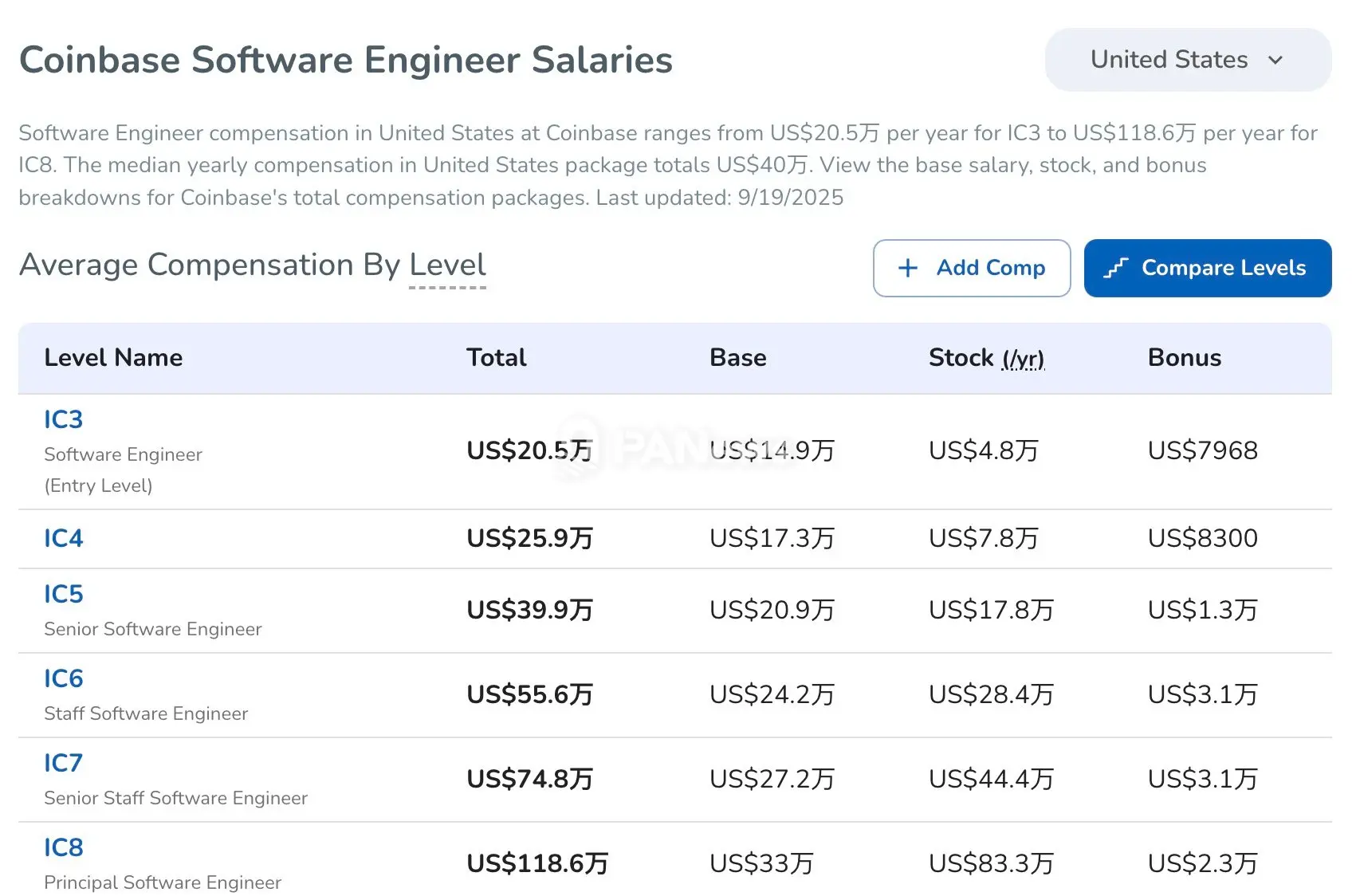
In addition, the salaries of developers on well-known blockchains such as Avalanche and Polkadot are generally higher than those on Ethereum, and often come with substantial token or equity incentives. For mainstream exchanges like Coinbase, the median annual salary for software engineers in the U.S. is $400,000, with even entry-level software engineers earning a base salary of $149,000, plus around $56,000 in stock and bonuses.
It can be seen that Ethereum core developers are at a clear disadvantage in terms of salary levels. However, as developers of the top blockchain, they are usually very competitive in the talent market.
When they receive job offers from other blockchain projects, the average offer reaches nearly $360,000, with the median being $300,000, essentially doubling their previous salaries. Among the 111 responses received by Protocol Guild, 42 respondents collectively received 108 job offers. The companies doing the poaching are mainly Layer 2 and other Layer 1 public chain projects.
Under the temptation of high salaries, Ethereum developers are generally unmoved.
However, despite the high salaries in the job market, most Ethereum core developers still choose to stay within the ecosystem.
A sense of mission and influence are important retention drivers. Reports and feedback from respondents indicate that many core developers see themselves as maintainers of “public goods” (protocol-level infrastructure) — they believe that the technological influence and public value of Ethereum outweighs the short-term interests of a single company.
At the same time, research-oriented and protocol design-oriented talents have high internal value and growth paths within the Ethereum ecosystem. The high complexity of the Ethereum ecosystem also provides engineers with rare technical challenges, opportunities for academic publications, and project leadership.
In addition, although the income from work is relatively low, many core contributors can make up for it through multiple income streams, such as consulting contracts, research grants, external audits, short-term hackathons, and teaching and research remuneration.
Additionally, Protocol Guild directly subsidizes developers through long-term on-chain allocated tokens, with a median reaching approximately $67,000, resulting in a median overall income of about $207,000 post-merger. This is a substantial compensation for many, reducing some salary disparities.
A survey shows that 59% of Protocol Guild members believe the organization is crucial for their stay in the Ethereum ecosystem. Developers generally have a positive attitude towards PG's funding model, viewing it as a “equity package” that compensates for insufficient income and provides career security.
The report from Protocol Guild also mentioned that many external offers, although appearing higher on paper, often contain a large amount of tokens or high-risk equity. The interviewed developers consider factors such as lock-up, market volatility, project long-term viability, and compliance risks. Therefore, some prefer to accept long-term incentives that are closely tied to the Ethereum ecosystem and relatively stable, such as the subsidies offered by Protocol Guild, rather than betting their careers on uncertain token values.
provides over 32 million dollars in “subsidies,” how Protocol Guild operates
Protocol Guild is a decentralized funding organization focused on supporting Ethereum core development, established to fill the gap in the developer compensation system. PG does not directly employ developers but acts as a “long-term incentive pool,” providing equity-like supplemental income for core contributors through donations from ecological projects and token commitments. Currently, the number of Ethereum core developers is approximately 200-300, of which about 190 are members of Protocol Guild.
Its operation mainly relies on the so-called “1% commitment” mechanism: participants in the project, as “financial backers,” lock 1% of the total issuance of tokens to the Protocol Guild, which are then periodically allocated to core developers in the form of a four-year vesting (four-year unlocking) through smart contracts.
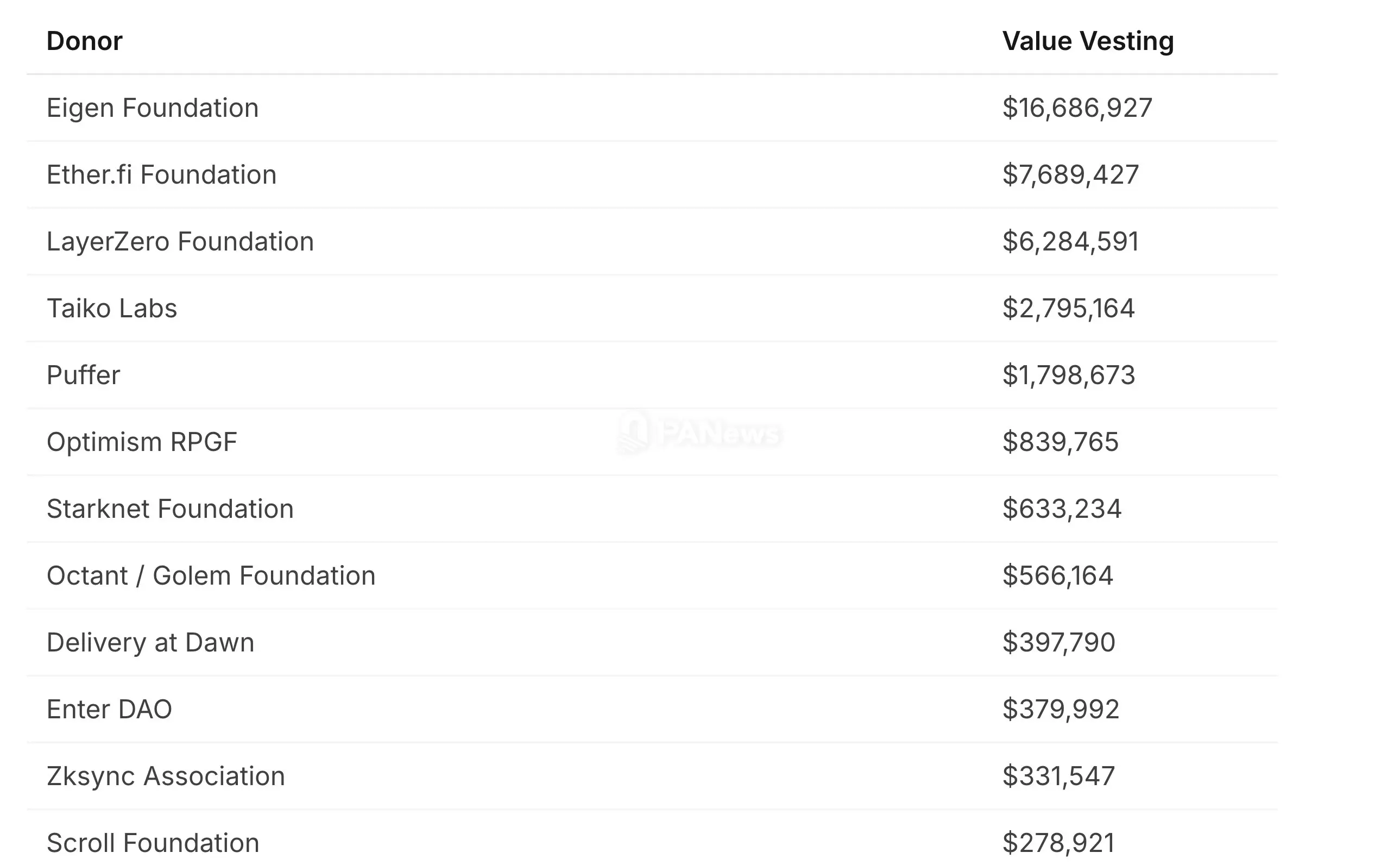
As of now, Ethereum ecosystem projects such as EigenLayer, Ether.fi, Taiko, and Puffer have committed to injecting 1% of their tokens into Protocol Guild. Additionally, the renowned asset management firm VanEck has also announced that it will donate 10% of its Ethereum ETF profits to Protocol Guild.
After aggregating these funds, they are allocated through a transparent on-chain algorithm based on the position weight and tenure of developers, in principle linked to the long-term success of the Ethereum ecosystem. The founding team of Protocol Guild emphasizes that this is not charity, but an economic infrastructure that aligns developers' incentives with the growth of the network.
In terms of impact, Protocol Guild has distributed over $32 million to Ethereum core developers since its launch in 2022. This funding accounts for about one-third of many developers' total income, playing a crucial role in their ability to continue contributing to development.
However, the Protocol Guild model still faces challenges, as the current donation projects and fund sizes rely on a few institutions, with only three major foundations providing almost all funding commitments. Whether it can continue to scale in the future will still require community efforts.