Bitcoin (BTC) is quietly changing the global financial landscape. According to the latest data from Bitcoin service company River, at the beginning of this month, the market capitalization of BTC accounted for 1.7% of the total global money supply, reaching a historic high. This milestone came at a time when Federal Reserve Chairman Powell was hesitant about interest rate policy, even suggesting that a new round of monetary easing is on the horizon.
Bitcoin market capitalization exceeds 2.4 trillion USD, accounting for 1.7% of global currency
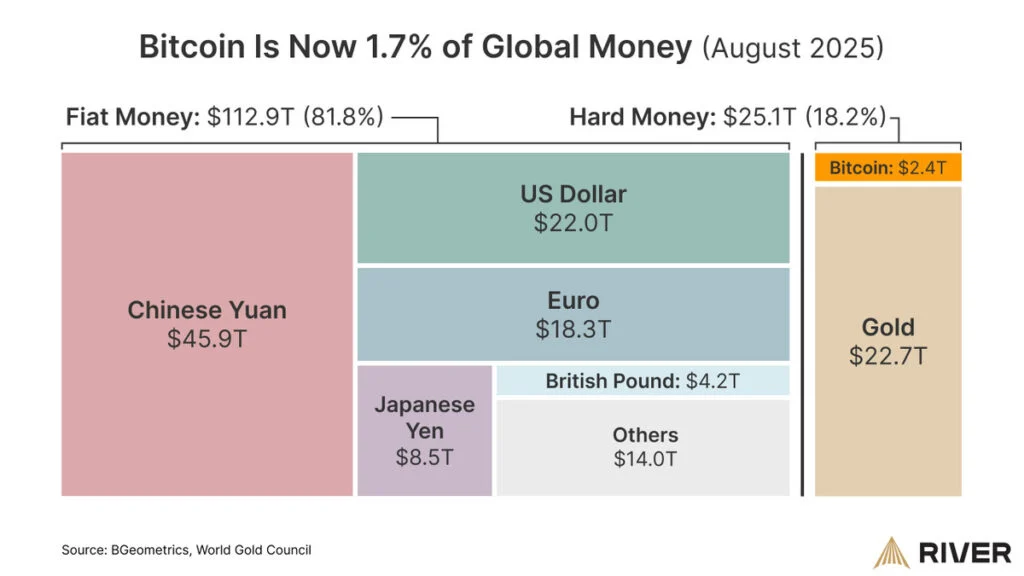
(Source: River, WGC)
In just 16 years, Bitcoin has grown from a internet curiosity used to exchange for pizza to a global currency network valued at $2.4 trillion.
Comparison benchmark:
Global fiat currency M2: approximately 112.9 trillion USD
Gold market capitalization: approximately 25.1 trillion USD (excluding silver, platinum, and palladium)
Based on the current market capitalization of 2.29 trillion dollars, BTC accounts for about 1.66%–1.7%.
River emphasized that this is not a short-term speculative rebound, but rather the process of Bitcoin gradually becoming a permanent component of global balance sheets.
The central bank cannot stop printing money, the value of hard currency is highlighted
The rise of Bitcoin is not a coincidence. Central banks around the world have continuously injected liquidity over the past decade, and each interest rate cut and quantitative easing has diluted the purchasing power of fiat currency.
Investors are increasingly inclined to shift their funds towards hard currency assets such as Bitcoin and gold to hedge against the risk of currency devaluation.
Powell hinted at interest rate cuts in Jackson Hole, BTC reacted quickly
At the Jackson Hole Economic Symposium, Powell stated: “Our policy interest rate is currently about 100 basis points closer to neutral than it was a year ago, and the stability of the labor market allows us to act cautiously when considering changes to our policy stance.”
The market interprets that interest rate cuts are coming.
After Powell’s speech, BTC surged 2% to $116,000 in the short term, but then softened.
CME futures data shows that 75% of investors expect a 25 basis point interest rate cut in September.
Why is this a historic turning point
Bitcoin is no longer just a fringe hedge tool, but a global currency asset with a market capitalization exceeding 2 trillion dollars, enough to stand alongside fiat currencies and gold.
High beta asset characteristics: global monetary expansion → digital asset valuations rise in sync.
Long-term significance: In the monetary environment of “money printing and interest rate cuts”, the rise in BTC share is a slow-motion monetary revolution.
The remaining question is: Will central banks choose to adapt to the rise of Bitcoin, or will they continue to promote its inevitable growth force?
Conclusion
Bitcoin’s share of the global currency ratio has surpassed 1.7%, marking not only a milestone in data but also a signal of the transformation of the global financial order. Against the backdrop of Powell hinting at interest rate cuts and the potential further dilution of the dollar, BTC’s long-term value proposition is becoming increasingly clear. For investors, this may be the best time to reassess their Bitcoin allocation. For more in-depth analysis of the crypto market, please follow the official Gate platform.
Disclaimer: The information on this page may come from third parties and does not represent the views or opinions of Gate. The content displayed on this page is for reference only and does not constitute any financial, investment, or legal advice. Gate does not guarantee the accuracy or completeness of the information and shall not be liable for any losses arising from the use of this information. Virtual asset investments carry high risks and are subject to significant price volatility. You may lose all of your invested principal. Please fully understand the relevant risks and make prudent decisions based on your own financial situation and risk tolerance. For details, please refer to
Disclaimer.


