Source: BlockBeats
Original Title: Old Trees Revive: The Summer Counterattack of Established DeFi Projects
The DeFi market is experiencing a long-awaited “veteran revival wave.”
As of now, the total value locked (TVL) in the DeFi market has climbed to $197 billion, just a step away from the historical high of $206 billion. More importantly, the leaders of this rebound are not newly emerged projects, but a group of “veterans” that once shone brightly during the DeFi Summer.
From the earliest speculative demand to the current “old tree returning to spring.” Behind the collective growth of the DeFi market is the accelerated entry of institutional funds (RWA, compliant lending, 401k crypto investments), the resurgence of retail demand for on-chain yields in a bull market, and new use cases brought about by technological iteration. The return of veterans reflects market confidence and also serves as the prelude to a new round of DeFi competition.
This article summarizes the main reasons for the recent surge in prices and TVL of these DeFi “veteran players” Aave, Uniswap, Euler, Pendle, Fluid, and Spark.
AERO: A violent rebound supported by Coinbase
Aerodrome Finance (AERO) is a decentralized exchange (DEX) that was launched in 2023 and deployed on the Base chain, operating with an automated market-making (AMM) model, featuring vote-lock governance and a robust liquidity incentive mechanism. It adopts a highly community-friendly design, with an anonymous team that has not accepted venture capital and no private placement lockup, maximizing the alignment of interests with users. Within just 72 hours of launch, it achieved a financial TVL exceeding $200 million, and by 2024, the total trading volume surpassed $1 billion, with the Slipstream feature contributing 85% of that. As of June 2025, AERO’s cumulative trading volume has exceeded $100 billion, firmly establishing its core position in the Base DeFi ecosystem.
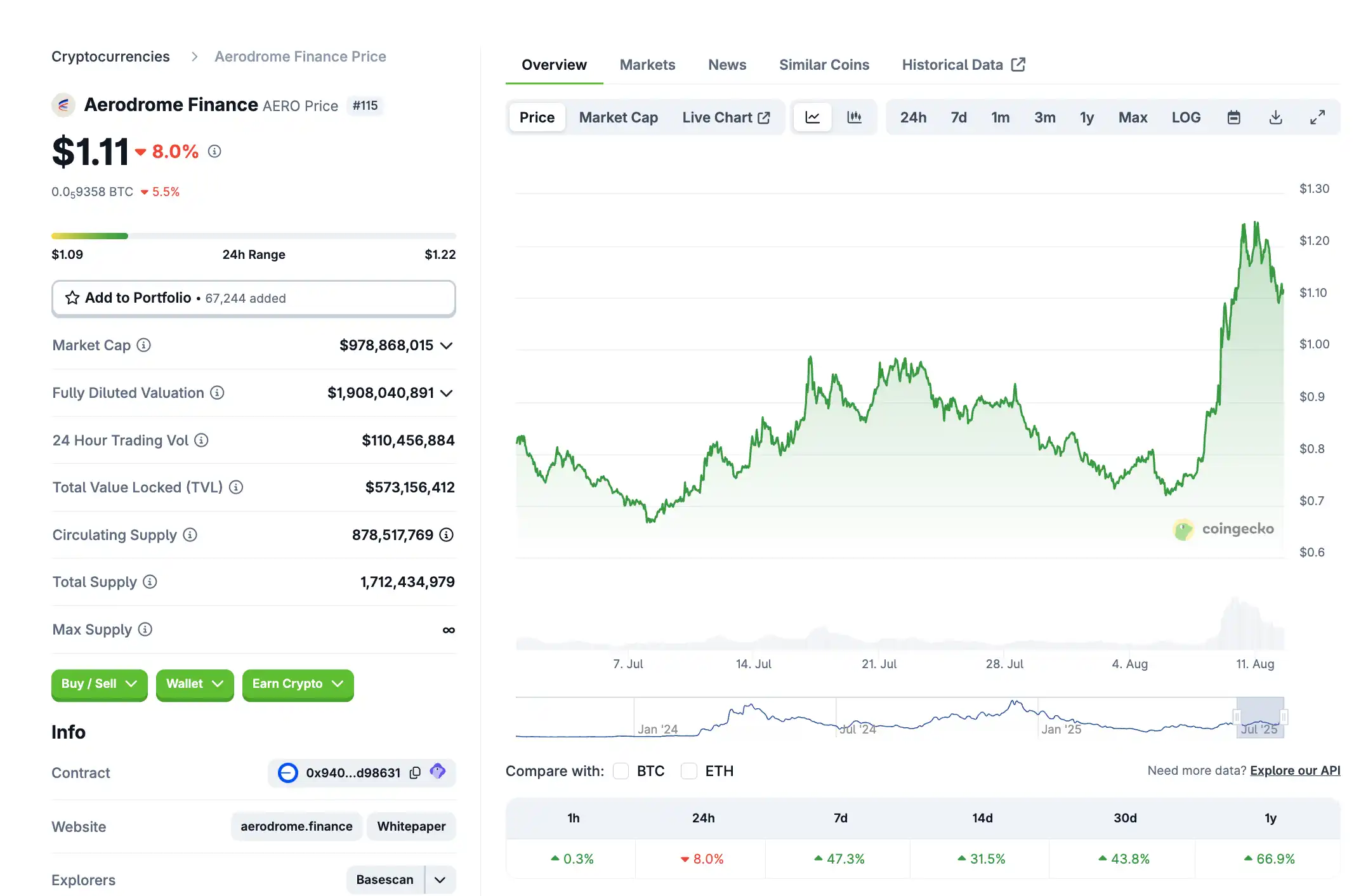
Recently, AERO has shown strong upward momentum: On August 9, stimulated by the news of Coinbase’s local DEX feature launch, AERO rose consecutively, reaching as high as $1.23, with a 7-day increase of about 47%. Its current market capitalization is approximately $978 million. It is one of the popular project tokens recently.
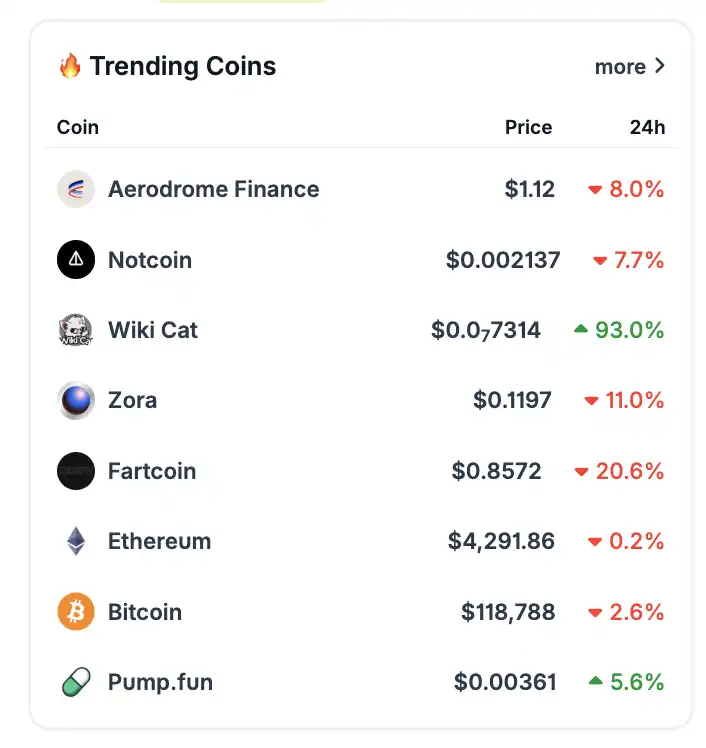
In addition to Coinbase integrating DEX trading features for Base native assets in its app, Aerodrome has become one of the first supported platforms. The reason for the rise of AERO may also be the launch of the “Pool Launcher” tool, which allows projects to create their own liquidity pools and earn related trading fees, attracting more Base native projects to join the ecosystem.
Currently, Aerodrome’s TVL is approximately $580 million, almost entirely from the Base chain. The 24-hour DEX trading volume is nearly $950 million, with a total trading volume of $20.5 billion over the past 30 days. In terms of income and investment, Aerodrome’s annualized transaction fee income is expected to be around $193 million, with approximately $15.85 million in income over the past 30 days, and the cumulative rewards incentive expenditure has reached $706 million, indicating a strong liquidity incentive orientation.
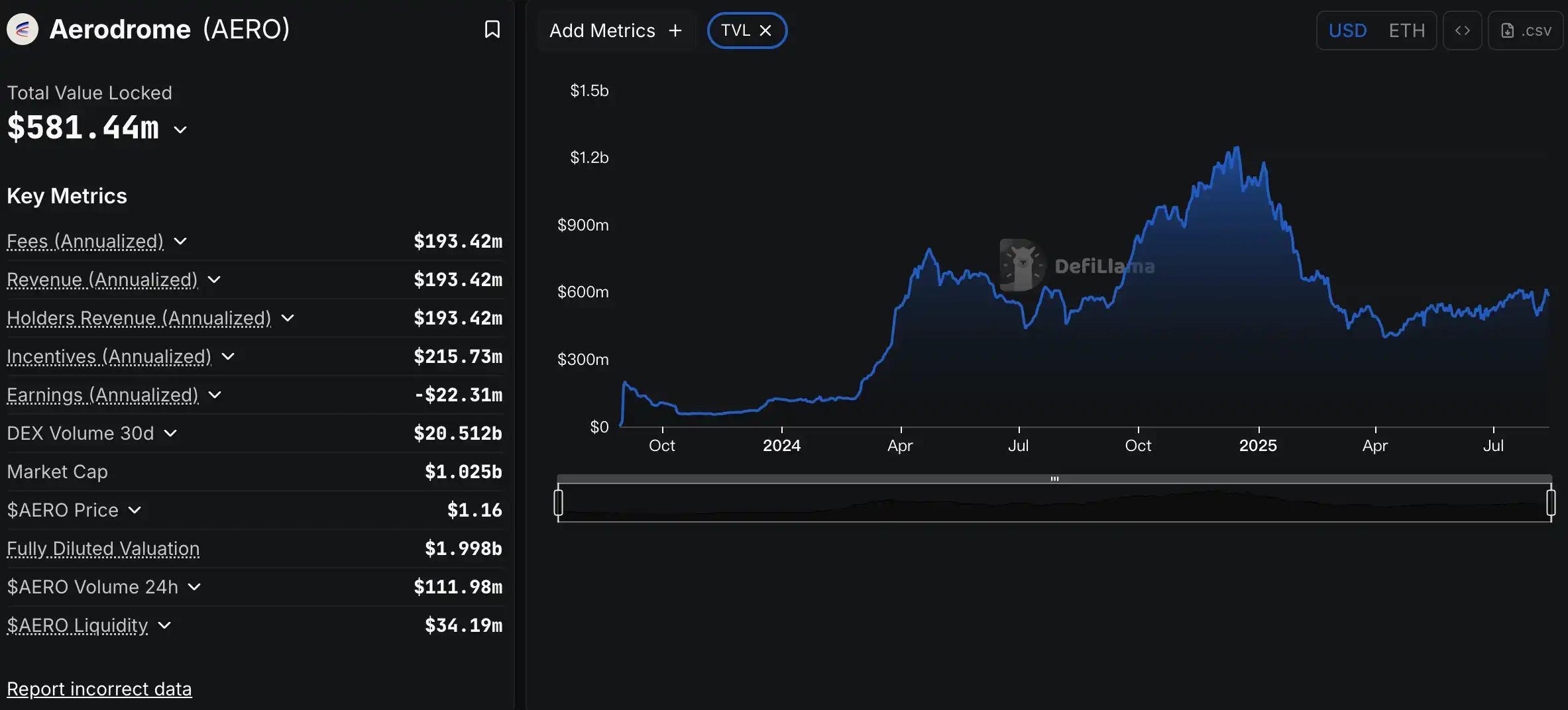
Currently, Aerodrome has built a leading trading and incentive mechanism on the Base chain, becoming a DeFi liquidity hub. The integration with Coinbase has opened a window to a broader user base, serving as a catalyst for the concentration of capital and liquidity explosion.
Although the upward trend is apparent, high incentive spending and overbought technical indicators suggest that adjustments should be cautiously anticipated in the short term. In the medium to long term, attention can be paid to whether its ecological expansion is sustained, whether cooperative projects are implemented, and whether Coinbase continues to expand its support range, which will determine whether it can return to its historical high ($2.32) or continue to break through.
Fluid Flip’s ambition for Uniswap
Fluid is a DeFi protocol that integrates DEX (Decentralized Exchange), lending, and Vault systems, achieving high capital efficiency and liquidity reuse through its innovative Liquidity Layer. Launched on Instadapp and reintroduced in 2023, Fluid allows assets to switch uses freely within the liquidity layer without multiple lock-ups, significantly reducing fragmentation costs and enhancing returns. Its Smart Debt and Smart Collateral models provide better capital efficiency for liquidity providers and debtors.
Recently, Fluid has become one of the focal points in the DeFi market: on August 4th, Fluid’s daily on-chain trading volume temporarily surpassed Uniswap, reaching approximately $1.5 billion, driving the price of $FLUID to soar 14.4% on that day. As of now, Fluid has risen to $7.38, with a 7-day increase of 36.1% and a 30-day increase of 51%.
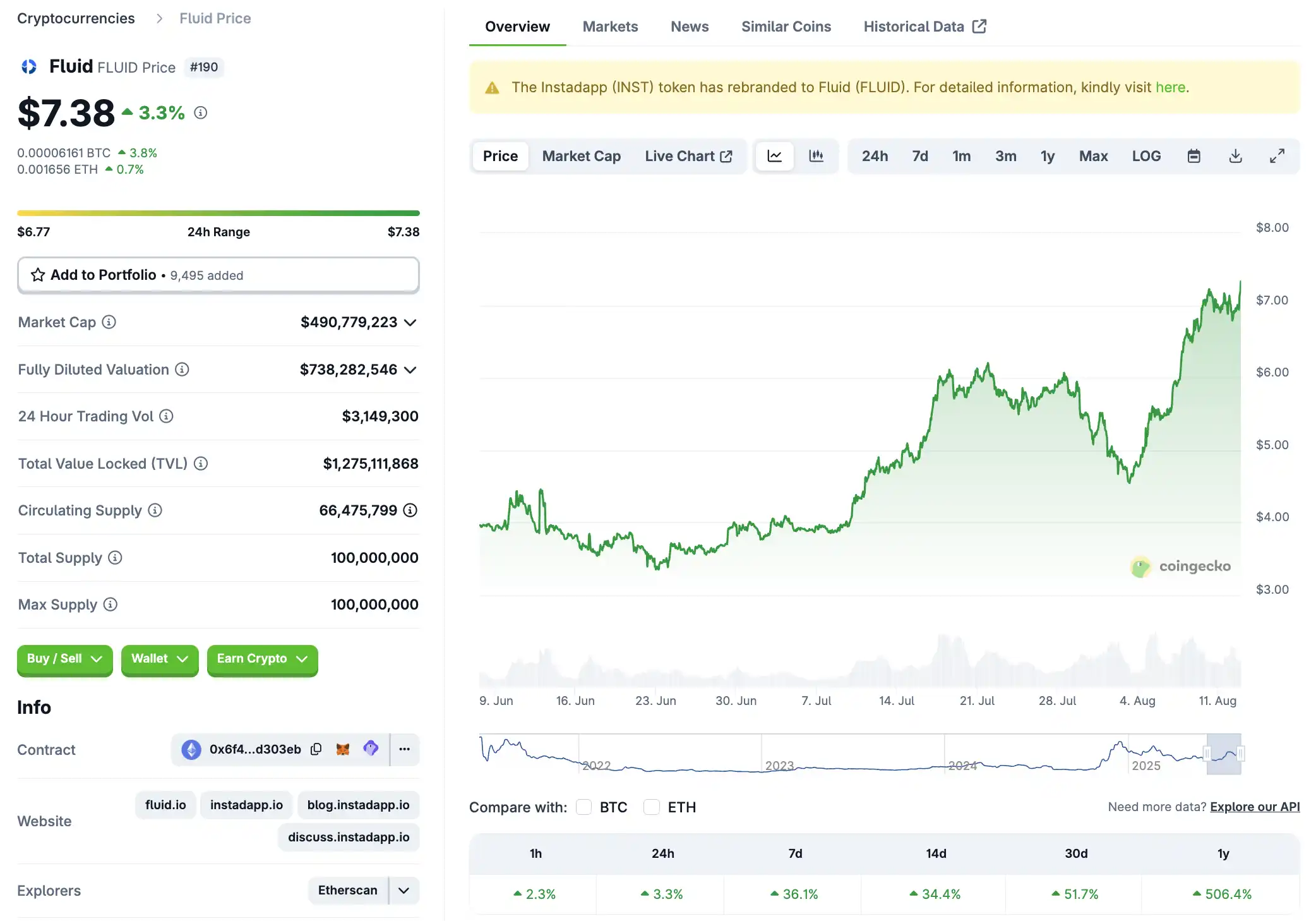
The reasons for the increase in Fluid may be as follows:
- The liquidity layer architecture breaks through fragmentation.
Fluid is launching on chains like Arbitrum and Solana, introducing a lighter Lite version, while supporting DEX v2 upgrades, which helps to further improve yield and user coverage. Additionally, Fluid’s Liquidity Layer enables liquidity sharing, allowing assets to be locked once to meet multiple use cases, serving as the core driving force for its rapid capital absorption and trading.
-
Trading shares rise rapidly
In the short term, Fluid has surpassed Uniswap, capturing over half of the stablecoin trading market, directly strengthening its ecosystem and sentiment-driven dual engines.
-
Trader confidence recovers
DEX daily trading volume hits a historic high, with token prices rising sharply in the short term, indicating an increased market recognition of the Fluid model and an affirmation of liquidity allocation efficiency.
-
Long-term favorable expectations of the repurchase mechanism
The official announcement states that a buyback will be initiated when the annual revenue reaches 10 million USD, which provides medium to long-term support for the token’s value and attracts investors to position themselves during the low price phase.
The platform’s cumulative trading volume has exceeded $7.9–$8 billion, with a monthly increase rate of approximately 27%, and a total value of about $838 million, showing a strong capital growth trend. Since 2025, Fluid’s deposits have grown nearly 40%, exceeding $1.4 billion, and have begun multi-chain layouts (such as Arbitrum, Solana) and the planning of DEX Lite. As of August 3, Fluid’s market share in the stablecoin swap market on Ethereum, Base, Arbitrum, and Polygon reached 55.5%, far surpassing Uniswap (25.7%) and Curve (13.4%).
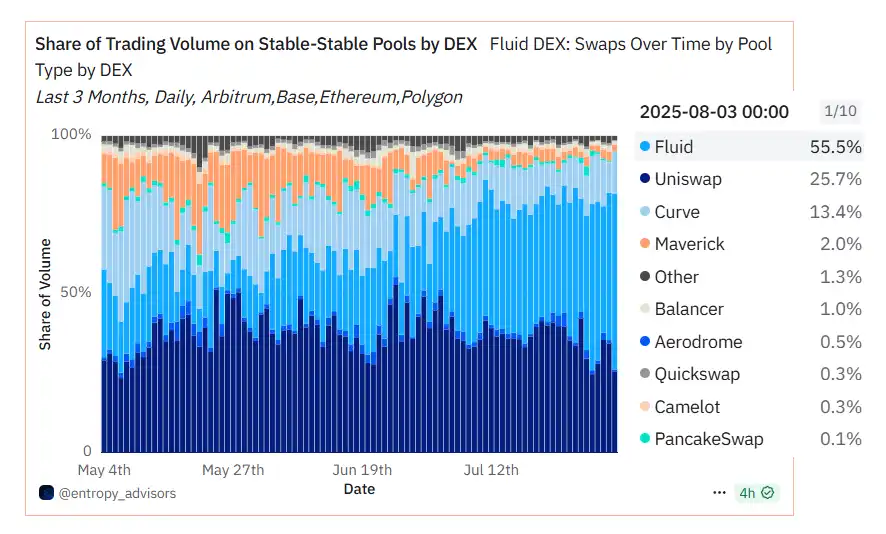
Overall, Fluid has become a “new force” in DeFi: through its unique Liquidity Layer, strong transaction data, and multi-chain expansion strategy, it has quickly brought the platform back to the center stage and set a new benchmark for stablecoin trading in DeFi. The short-term performance is impressive, but several risk points still need to be monitored: whether FLUID will experience adjustments in the short term remains to be seen; ecological landing and user stickiness, whether subsequent projects can truly be built on the Fluid liquidity layer, is the key to sustained momentum. If the subsequent DEX v2 and Lite version can be successfully launched and drive revenue to break key nodes, it may not only activate the buyback mechanism but also further enhance user stickiness and market valuation, helping Fluid become the new benchmark for stablecoin trading.
Uniswap v4 TVL breaks 1 billion USD again
Uniswap is the “veteran” of the DeFi world, with its v4 version officially launched in early 2025. It includes 12 chains such as Ethereum, Arbitrum, Base, Polygon, BNB Chain, and Unichain, and introduces the “Hooks” feature, allowing liquidity pools to have dynamic fees, on-chain limit orders, TWAP, and other custom logic. Additionally, through its Singleton architecture and Flash Accounting technology, gas costs are reduced by over 99%. v4 retains the capital efficiency advantages of v3 while enhancing flexibility and programmability, becoming an important part of the DeFi innovation infrastructure.
Recently, Uniswap has performed steadily: as of now, the price of UNI is $11.27, having increased by about 31% in the last 30 days, and its market value has risen back to the $6.7 billion range.
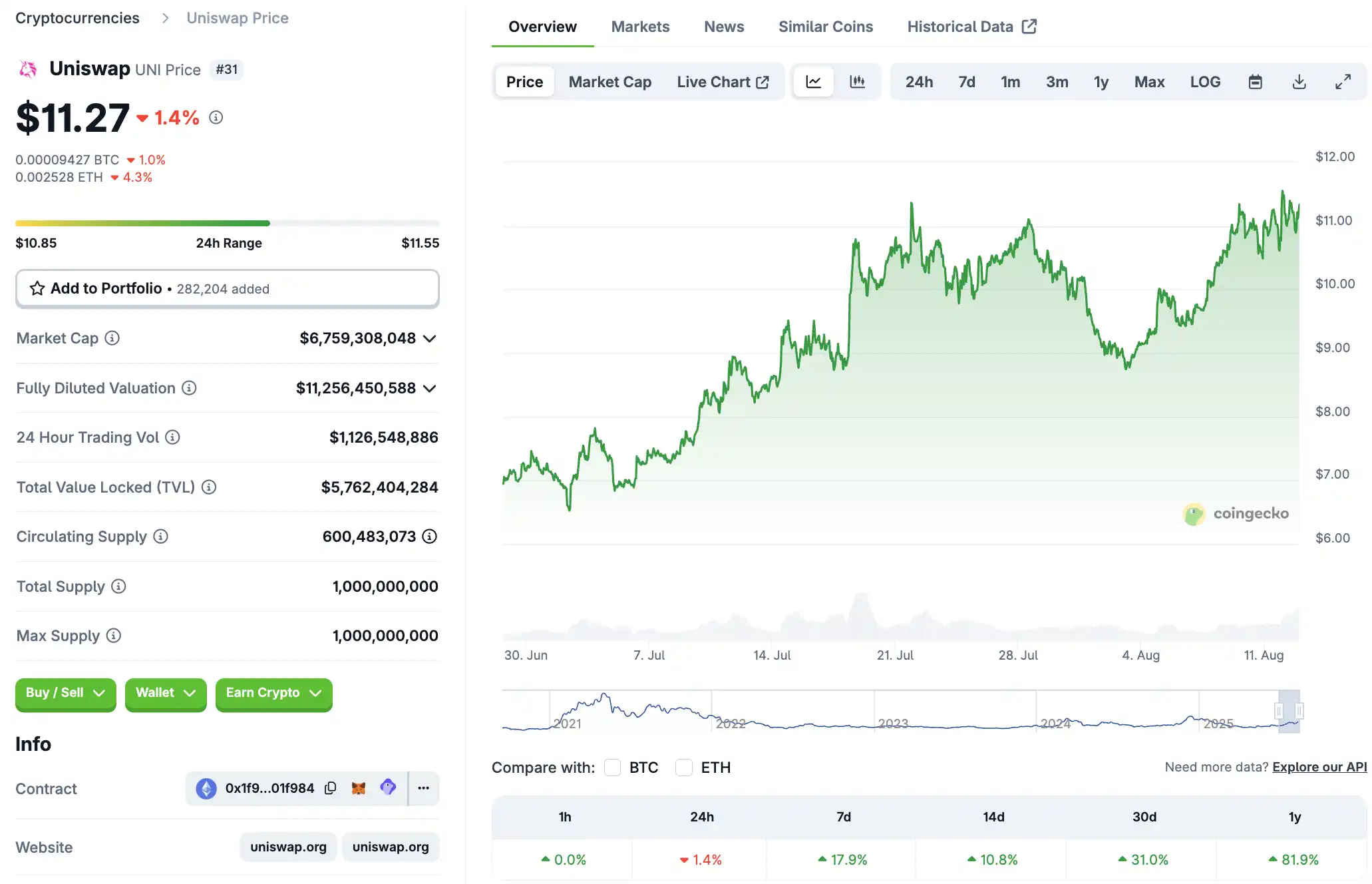
The reasons for the rise of UNI include:
-
Strong TVL rebound
v4 has broken through $1B TVL at an astonishing speed, providing solid emotional support for the price of UNI and highlighting the warming trend of the DeFi ecosystem.
-
Hooks innovate to attract capital
Programmable liquidity strategies have led to the rapid rise of various strategy projects (such as Bunni, EulerSwap), promoting user participation and operational depth.
-
Unichain expands the role prominently
The new network brings lower costs and a more efficient experience, creating a new growth engine for Uniswap and further increasing activity.
-
Technology Iteration and Institutional Upgrading
v4 introduces smart wallet support, cross-chain integration (such as Hyperbridge, LayerZero) and over 640M swap trading volume, building a more comprehensive trading infrastructure.
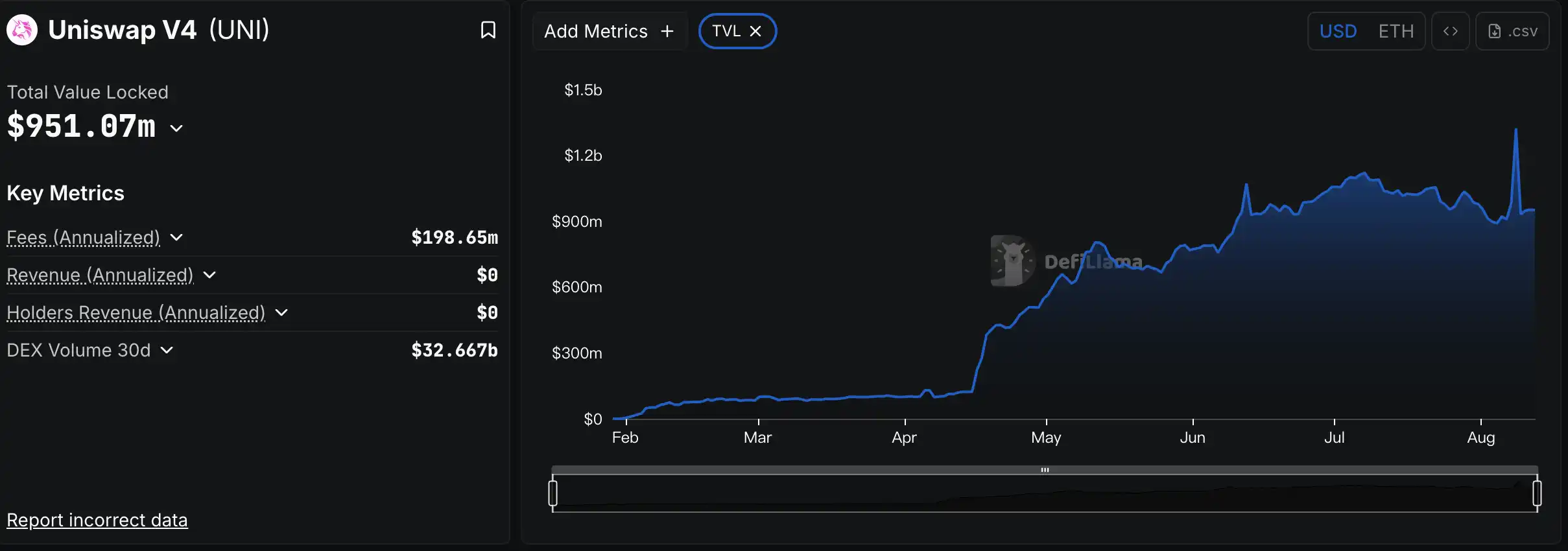
Currently, Uniswap v4’s TVL has surpassed the $1 billion milestone. In terms of cumulative trading volume, Uniswap has exceeded $11 billion, making it a central hub for DeFi liquidity. Among them, Unichain accounts for about 75% of the daily trading volume, while Ethereum accounts for about 15-20%. Regarding the deployment of Hooks, over 2,500 Hook liquidity pools have gone live, with both Bunni and EulerSwap having cumulative trading volumes exceeding $1 billion.
Despite Fluid shining brightly in the market, Uniswap remains a strong player: its v4 version continues to solidify its core position in DeFi through technological innovation and ecosystem expansion. The rapid growth of TVL and the rich application of Hooks are important foundations for its resurgence. However, technical indicators such as RSI are relatively high, which may lead to some profit-taking pressure in the short term.
Whether the upward trend can continue depends on: whether the Hook strategy pool can bring new growth; whether cross-chain integration can deepen ecological cooperation; whether Unichain can maintain its cost advantages and attractiveness, with the potential to challenge the $13–$14 range.
Euler: “Rebirth from the Ashes” After the Hacker Attack
Euler Finance is a modular lending protocol on Ethereum, known for its risk layering, flexible asset permissions, and high capital efficiency. It supports the integration of any ERC-20 asset, as well as leveraged position management and has a complex liquidation protection mechanism. After being heavily impacted by a hacking incident in 2024, the project quickly rebooted and regained its ‘trust high ground’, becoming one of the core players in the resurgence of the DeFi lending sector.
Recently, $EUL reached an all-time high, with the price once breaking $15, an increase of over 950% compared to the low point at the end of 2023. The market capitalization is also approaching $300 million. Although there has been a slight pullback, the current price is stable in the range of $11.8–$13.
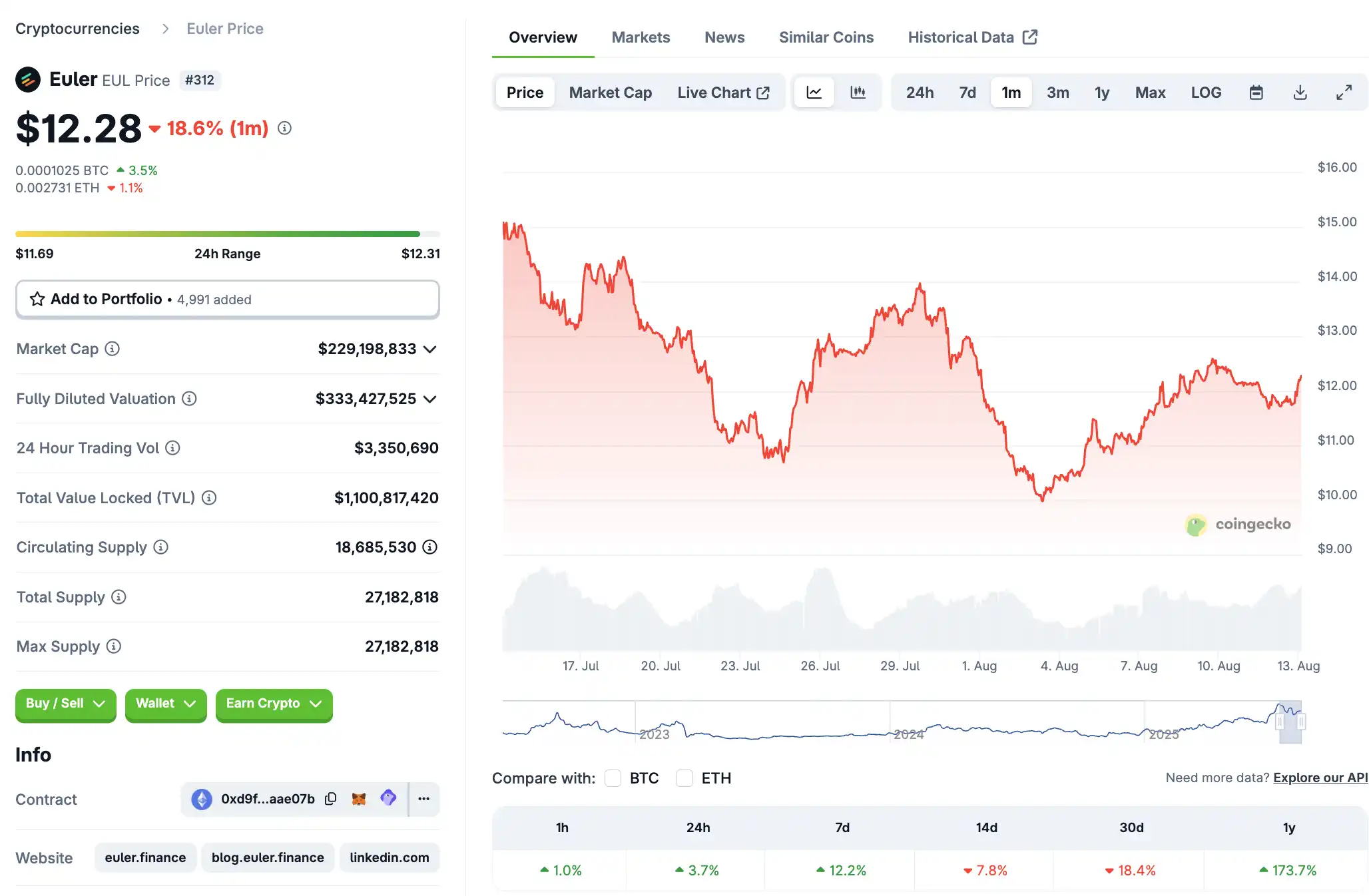
The reasons for Euler’s rise include:
-
Rebirth from the ashes
Euler quickly restarted after the hacking incident, winning the trust of the community and the return of capital, which is an important foundation for its significant rebound.
-
TVL and lending depth both rebound.
The abnormal growth of TVL and the surge in active loans reflect strong user borrowing demand and a recovery in protocol momentum.
-
EulerSwap Completes the Ecosystem
After launching the native DEX, Euler built a self-circulating liquidity path, enabling a closed-loop interaction among staking, lending, and trading.
-
Major platforms support increased investment
Recent news indicates that Coinbase will support EUL. After the announcement, the price rose by about 5.7% in one day, reflecting an increase in recognition from the capital market.
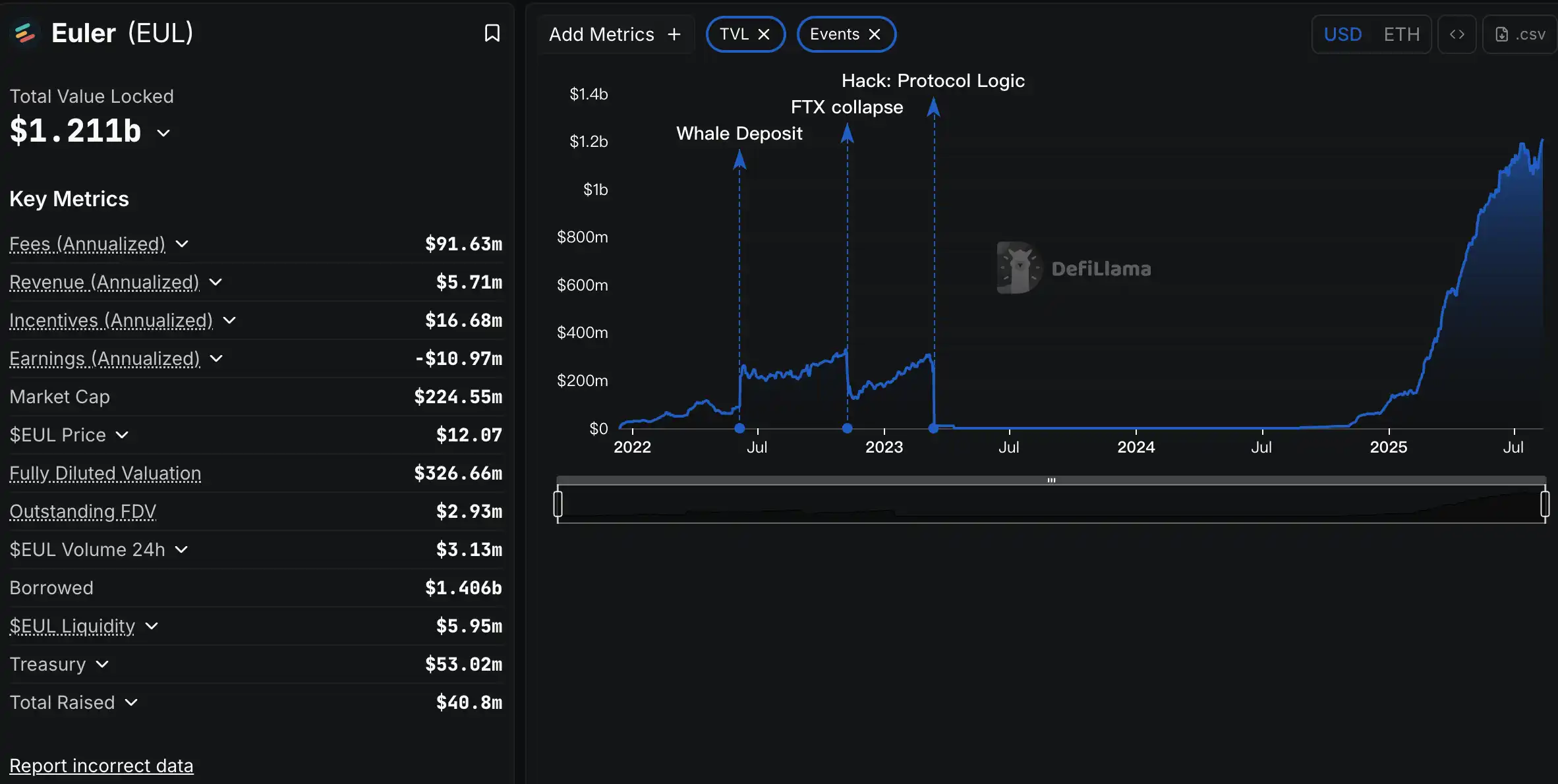
The latest data shows that Euler’s TVL has reached $1.2 billion, having basically overcome the impact and challenges following the hacking incident. Euler has launched a local DEX - EulerSwap, which has exceeded a cumulative trading volume of $1 billion since its launch in May. Loan activity: The active loan amount has recently surpassed $1 billion, while at the end of 2024 it was only about $240,000, showing a significant increase.
The revival of Euler is a typical “phoenix rising from the ashes” story: it has transitioned from the predicament of being hacked to a rapid restart, an explosion in TVL, product innovation, and gradually restoring its market value and market attention, demonstrating the resilience of older DeFi projects in terms of trust and governance.
However, it is worth noting the following: the pullback pressure after high prices; whether EulerSwap can maintain trading depth and whether the lending categories will expand will determine its ability to sustain growth; whether more capital platforms will continue to support it, such as deeper support from Coinbase and more CEX listings, will enhance liquidity and market capitalization foundation. If Euler can indeed maintain TVL growth, loan activity, and DEX development momentum in the future, it is expected to return to a higher valuation range and continue to write the classic chapter of “old tree returning to spring.”
Pendle: Driven by Boros, both TVL and price soar.
Pendle is a DeFi protocol that allows users to “trade future yields”. The core mechanism is to split any yield-bearing asset into “Yield Tokens” and “Principal Tokens”, enabling users to freely trade future yields. Pendle V3 introduces the Boros platform, creating advanced yield trading tools, and has become one of the core infrastructures for yield trading.
Pendle has recently performed impressively: the price once surged close to $6, with a weekly increase of up to 46%, far exceeding the overall market trend.
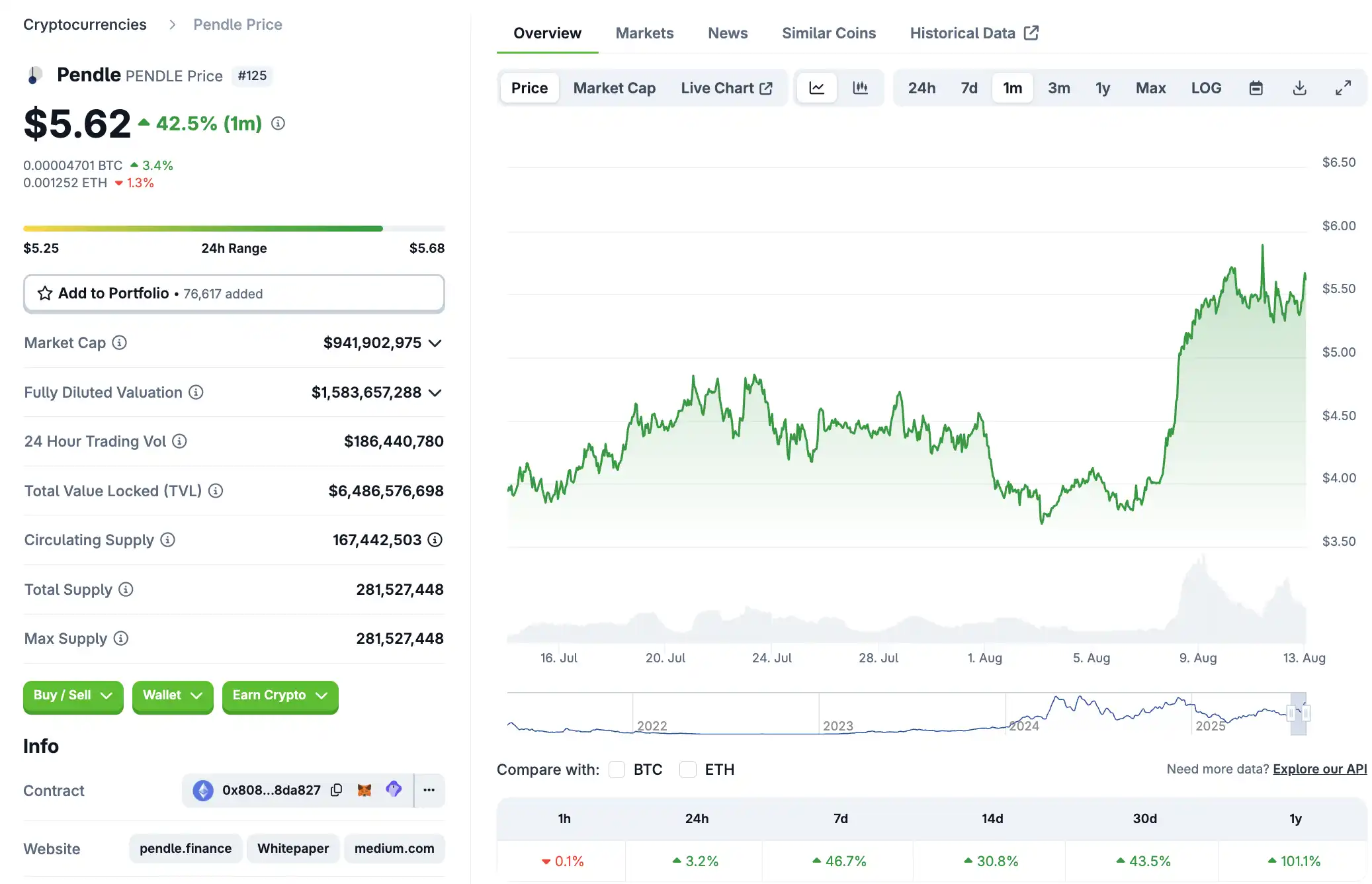
The reasons for Pendle’s rise are:
-
Yield Trading Platform Boros Engine Launch
Boros will convert the BTC/ETH funding rate into tradable assets (Yield Units) after its launch, quickly increasing user participation and capital inflow.
-
Cross-protocol integration mechanism optimizes capital efficiency
With cross-ecosystem collaboration from Ethena, Aave, and Boros, Pendle has become a hub for efficient yield strategies, with its PT-USDe strategy driving an increase in capital volume.
-
The growth of TVL and yields brings confidence.
The surge in TVL and revenue at an all-time high provides strong support for the tokens and boosts market sentiment.
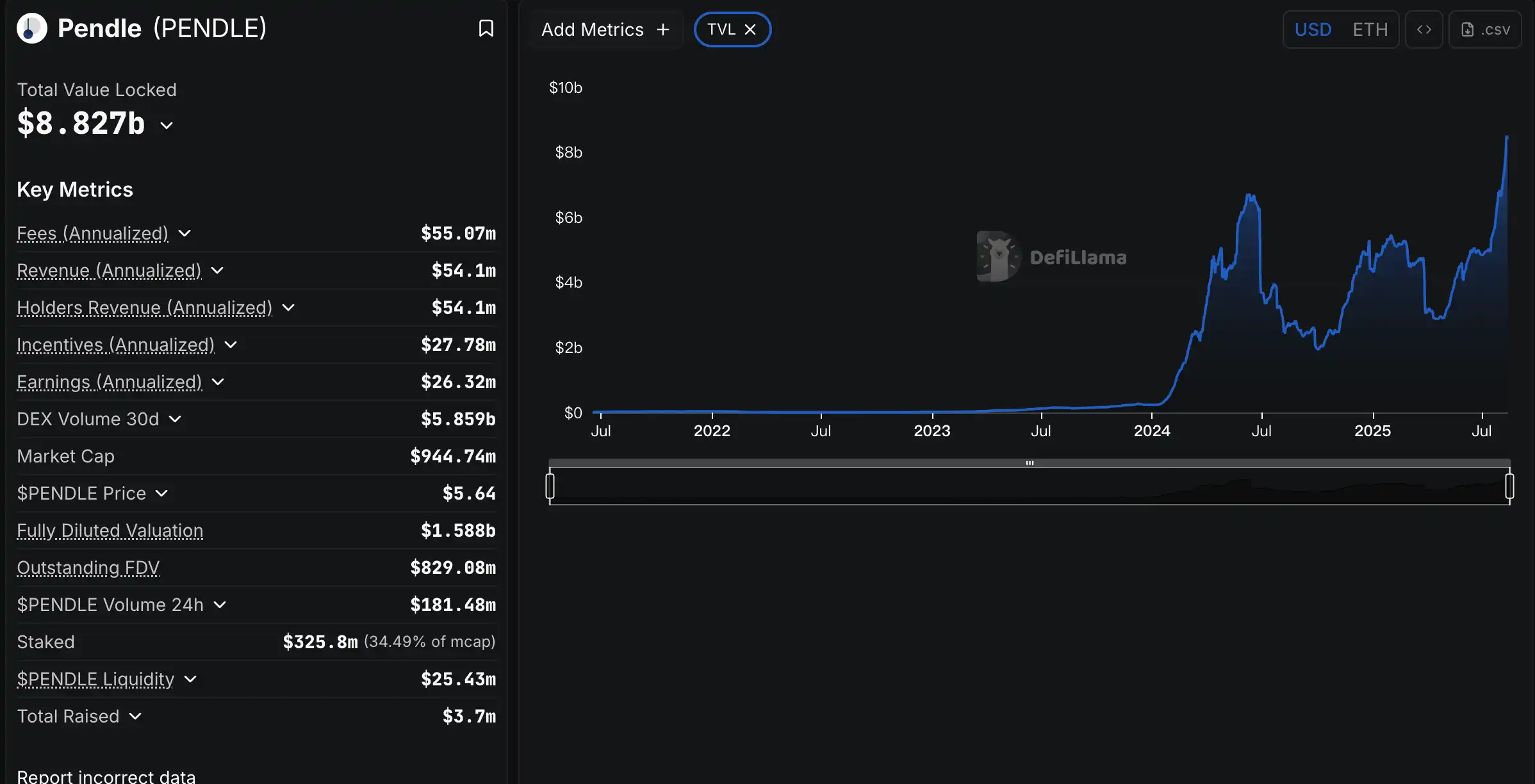
On the core data front, Pendle’s TVL reached a historical high of $8.8 billion, mainly driven by the funding explosion from the Boros platform. In the first two days after launch, it attracted over $1.85M in BTC and ETH deposits, and the number of active addresses for Pendle on Arbitrum doubled, attracting attention from both on-chain and institutional investors.
At the same time, the protocol integration drives a liquidity explosion. About 60% of the TVL comes from USDe strategies (such as PT-USDe generating leverage and liquidity on Aave), creating a powerful “yield-loop” asset circulation mechanism.
Pendle is becoming a new hotspot in DeFi due to its unique yield trading mechanism and protocol integration strategy: the Boros platform injects strong momentum into it, with both TVL and prices surging. However, one should be wary of short-term technical high position pullback risks and the centralization risks brought by USDe’s exclusivity. If Pendle can continue to expand Boros-supported assets (such as staking yields and government bond yields) and promote deeper integration of overall protocol governance and ecology, it has great potential to continuously challenge $7–$8 and move towards a true “new chapter for old projects.”
The Lending King is crowned again, Aave is gradually becoming institutionalized.
Aave is a top lending protocol in the DeFi world, known for its non-custodial, modular design and cross-chain support. Its launched GHO stablecoin, Umbrella security mechanism, and innovative features such as Aave Arc/Horizon further solidify its core position in the DeFi liquidity layer.
Recently, AAVE has performed remarkably: in mid-July, the price surged to a high of $330, with an increase of about 24% over 7 days. Although there is short-term pullback pressure at the high market price, the overall trend remains strong.
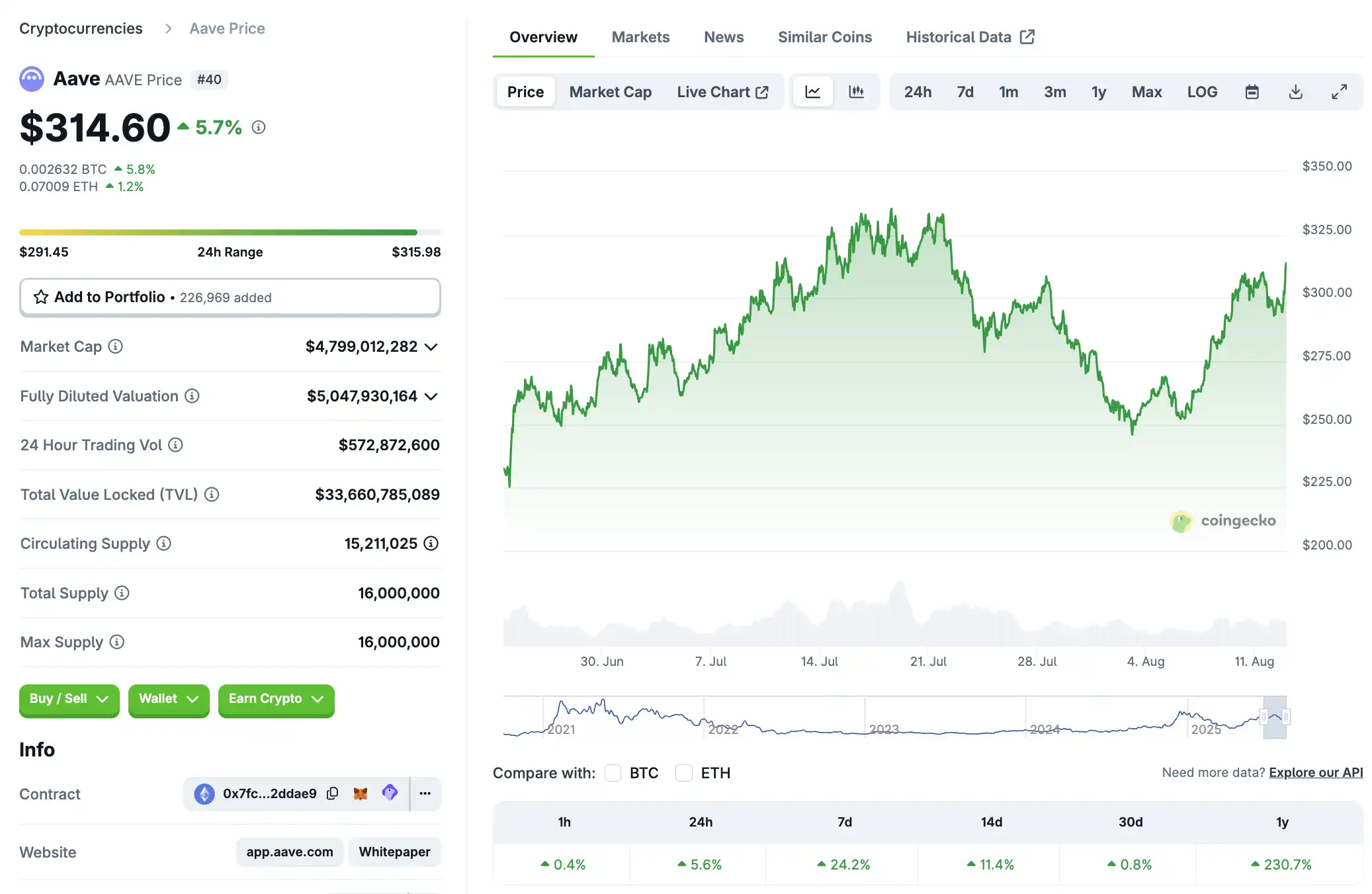
The driving factors for Aave’s rise include:
-
Capital inflow leads TVL
Aave still dominates the lending market, with new users and capital continuously pouring in, providing a solid foundation for market confidence.
-
Stablecoin GHO Performance Improvement Value Recognition
The cross-chain expansion of GHO, sGHO, anti-GHO, and other mechanisms provide multiple layers of收益激励 for holders, enhancing ecological stickiness.
-
Institutional pathways continue to be implemented.
Horizon, Arc, and KYC compliance mechanisms make Aave an important gateway for institutional-level DeFi lending.
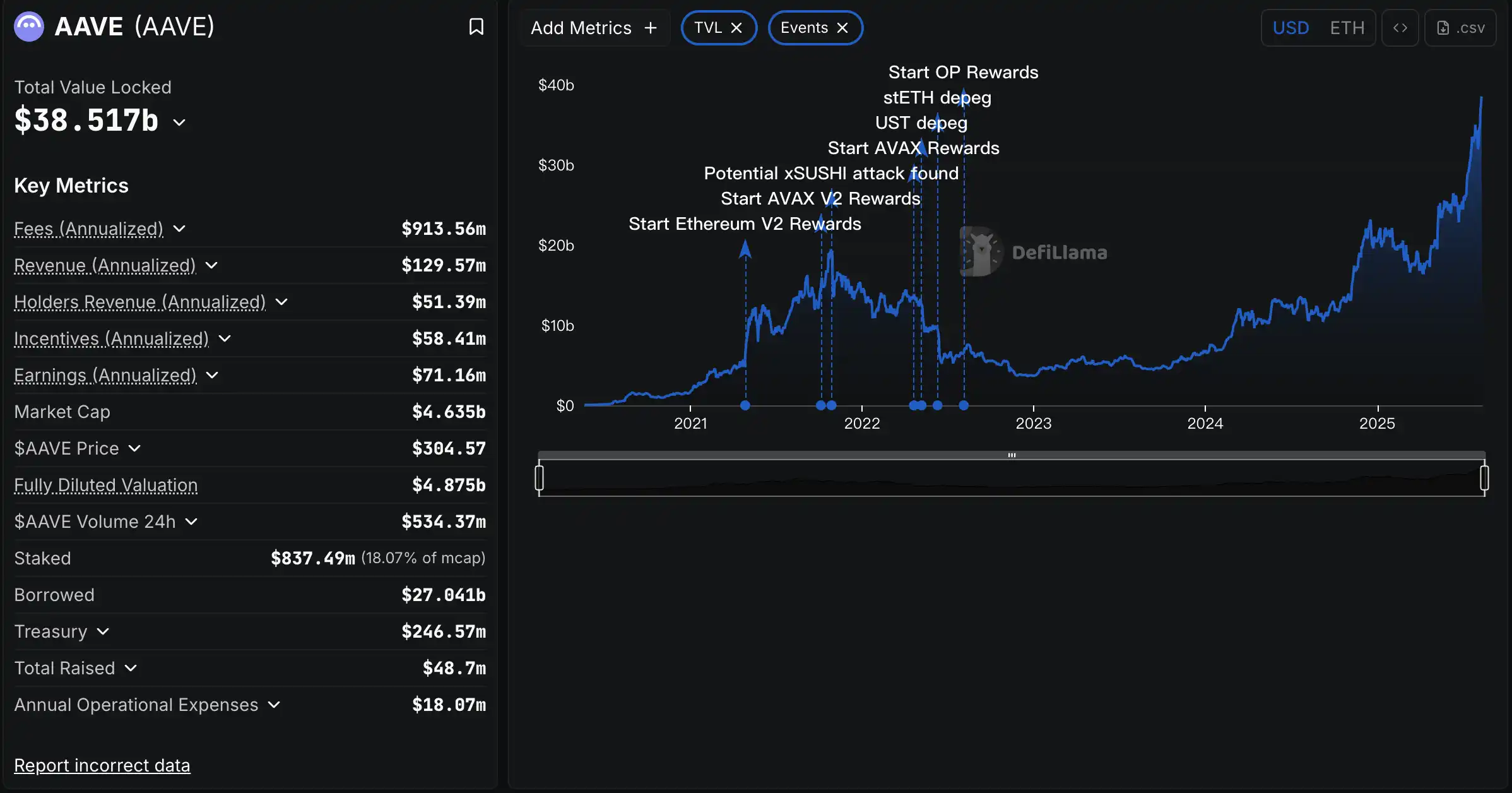
From other core data, Aave’s TVL currently stands at $38.04 billion, an increase of 52% since the beginning of the year, accounting for nearly a quarter of the total DeFi TVL and dominating the lending market. Its native stablecoin GHO has an issuance of $312M, and GHO’s cross-chain expansion on Arbitrum and Base has facilitated revenue growth, with AAVE achieving a return rate of 22.97% in the recent rebalance period.
In terms of specific institutional cooperation, Aave has launched the Horizon project to promote the use of RWA and institutional pathways; it has also partnered with Plasma to launch a blockchain fund aimed at institutions; Aave DAO has approved a white-label solution for the Kraken Ink chain.
As a veteran in the DeFi lending space, Aave remains “old but resilient”: its TVL and deposit scale continue to break records, the functionality of GHO is consistently expanding, and institutional pathways are steadily advancing, all injecting strong momentum into its resurgence. However, AAVE’s price is facing correction pressure at high levels, with technical indicators like RSI nearing overbought conditions, suggesting a potential need for adjustment in the short term. Whether it can continue to lead the DeFi lending space in the future will also depend on the launch progress of Aave V4, the effectiveness of RWA channel implementation, and regulatory trends.
Spark: A Sword of MakerDAO
Spark Protocol (abbreviated as Spark) evolved from MakerDAO and is now part of the Sky ecosystem. It is a sophisticated on-chain capital allocator aimed at efficiently deploying hundreds of millions of dollars in stablecoin capital into DeFi, CeFi, and RWA (real-world assets). Its core products include SparkLend (lending), Spark Savings (yield generation), and Spark Liquidity Layer (cross-chain liquidity allocation), among others.
Since the official airdrop of the SPK token on June 17, 2025, its market performance has been extremely eye-catching: the original TGE issuance price was about $0.065, and in a short period, the SPK price experienced significant fluctuations—dropping to less than half of the issuance price (around $0.03), but then rebounded strongly, reaching a historical high of $0.18 on July 23, with an increase of over 400%. The current price is stable in the range of $0.12–$0.13, with a market capitalization close to $190 million and a 24-hour trading volume climbing to nearly $450 million.
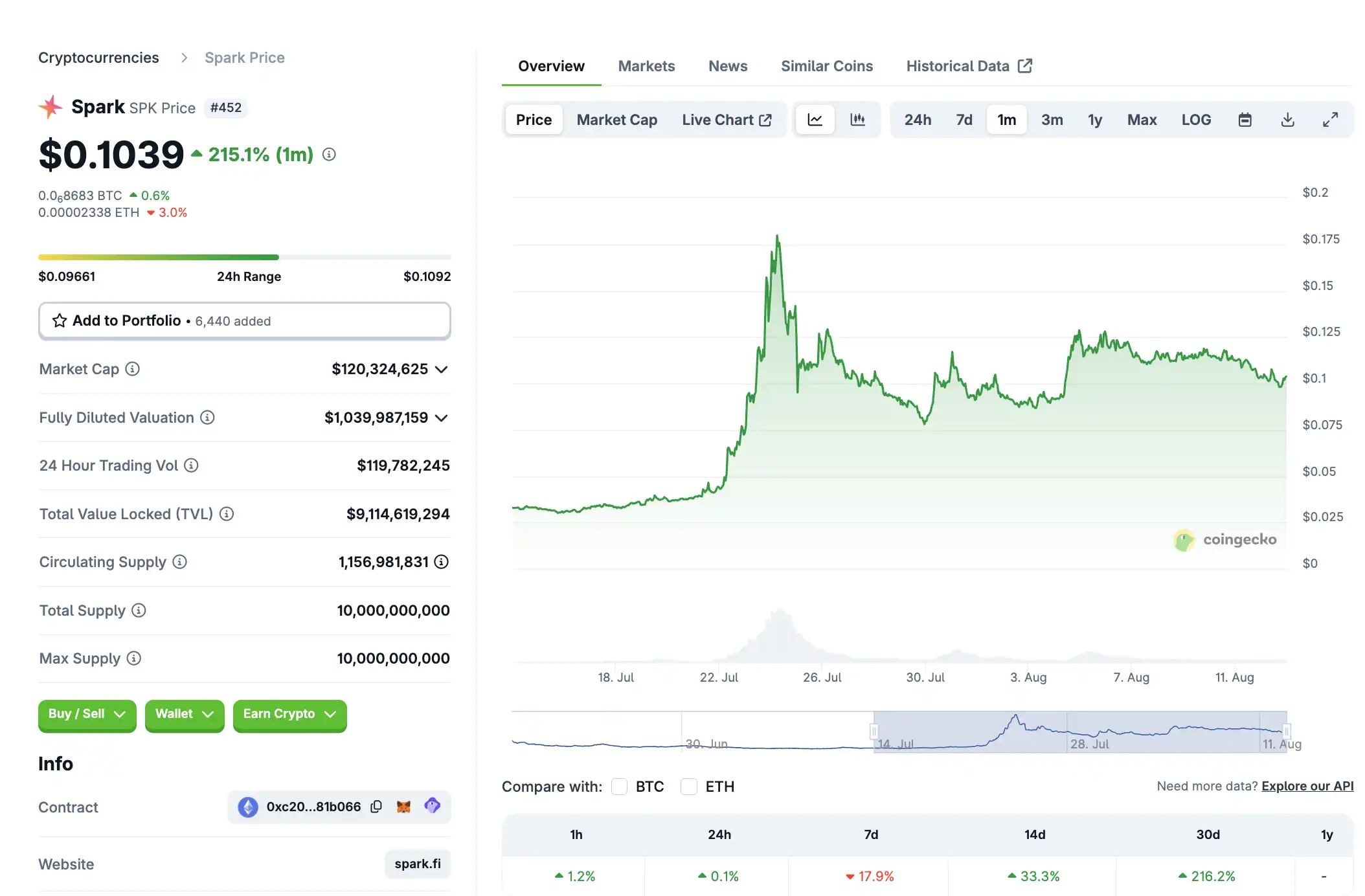
The main driving forces behind the rise of SPK tokens may include the following 4 points:
-
TVL surge helps boost sentiment.
Since April, Spark’s TVL has surged by 250%, and this type of capital injection directly boosts market confidence, causing the SPK price to rebound rapidly and set a new ATH.
-
Airdrops and listings fuel trading
Spark was launched with a large-scale airdrop and listed on mainstream exchanges (such as Binance), establishing favorable mechanisms to boost initial market attention and price volatility.
-
Top-level funding and technical endorsement
With a $6.5 billion stablecoin reserve backed by the Sky (formerly MakerDAO) platform, and a transparent mechanism as the core of capital deployment, Spark is endowed with a strong stable state.
-
Product Structure Integrity
Spark has a product matrix that covers yield generation, lending, and cross-chain liquidity, comprehensively connecting user needs through SparkLend, Savings, and SLL.
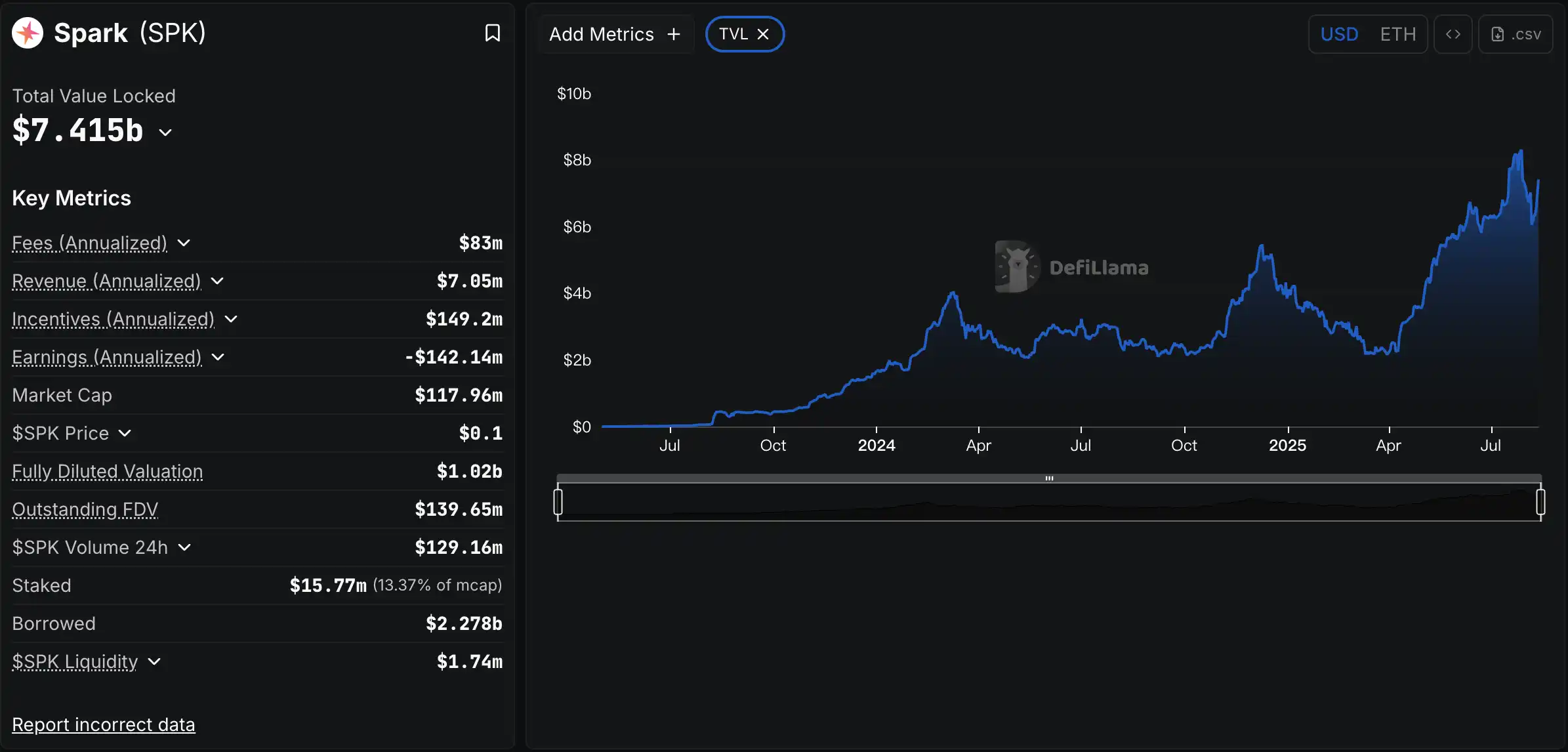
As of the time of writing, Spark’s total TVL has reached $7.4 billion. Previously, in July, the TVL hit a peak of $8.1 billion, ranking as the sixth largest platform in DeFi, with SparkLend managing approximately $4.7 billion and SLL managing around $3.4 billion. Spark is rapidly reshaping the standards of stablecoins and capital efficiency in DeFi, with the explosive TVL, airdrop sentiment, and Sky’s endorsement resonating together, allowing SPK to achieve a legendary comeback of “old project reborn” in a short period.
However, at the same time, high volatility and early cash-out pressure still exist, and prices have currently dropped by 30-40%. Short-term caution is needed against market adjustments. Whether it can continue to strengthen in the future will depend on whether the Spark ecosystem can continue to expand (such as CeFi channels, RWA integration), governance activity, and the loyalty of SPK holders.


