Author: Helen Partz, CoinTelegraph; Translated by: Bai Shui, Golden Finance
Cryptocurrency stablecoins achieved tremendous success in 2024, with circulation reaching an all-time high of over 200 billion dollars in December.
Stablecoins—cryptocurrencies designed to mimic the value of a currency, most commonly the US dollar—are an indispensable part of the cryptocurrency ecosystem, accounting for 5% of its market value.
As 2025 approaches, this article summarizes industry predictions and forecasts for the main trends in stablecoins for the coming year.
The Next Stop is 300 Billion USD: USDT and USDC Will Maintain Dominance
Multiple industry executives and founders have stated that Tether’s USDT and Circle’s USD Coin (the two largest stablecoins by market capitalization) are likely to maintain their dominance in 2025.
Guy Young, the founder of the decentralized stablecoin protocol Ethena, predicts that USDT will continue to be the largest stablecoin next year, with the total market cap of stablecoins rising to $300 billion.
“I expect our circulation to exceed $300 billion, and Tether will continue to dominate with its existing moat, while the rest of the market faces challenges from new fintech and Web2 entrants and their own products,” Young pointed out.
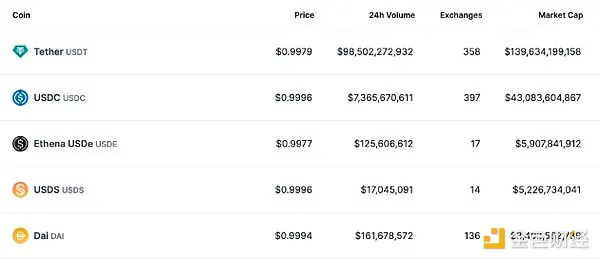
As of December 24, the top five stablecoins ranked by market capitalization. Source: CoinGecko
Ailona Tsik, Chief Marketing Officer of Alchemy Pay, stated that stablecoins like USDT and USDC “have already become important tools for global transactions, and their adoption in emerging markets and decentralized applications may accelerate.”
“Stablecoins supported by fiat currencies such as USDT and USDC may maintain their dominance due to their established credibility, liquidity, and a broad user and business ecosystem that relies on them.”
Coinbase, a partner of USDC, stated in its 2025 outlook that stablecoins “are just getting started.” Some analysts predict that these tokens could grow to a $3 trillion market in the next five years.
Stablecoin Payments: Visa Anticipates Surge in Demand for Stablecoin Cards
Cuy Sheffield, the cryptocurrency chief at Visa, pointed out that the adoption of stablecoins can modernize and simplify global payments, but the existing consumption opportunities for stablecoins are still limited.
“If 2024 is a year of resurgence in stablecoin demand, then 2025 will bring the next key opportunity: the rise of stablecoin pegged cards,” Sheffield said.
“By 2025, as wallets look to leverage the adoption of stablecoins and issue stablecoin-linked cards, this demand will only increase.”
He said that Visa will expand its capabilities to allow issuers to directly settle stablecoin-linked cards with payment giants.
The CEO of the crypto platform Uphold, Simon McLoughlin, is also optimistic about the increase in payment adoption rates in the coming year.
“2025 will be the year when stablecoins enter the mainstream as international payment tools,” McLoughlin said. He highlighted new types of stablecoins aimed at cross-border settlements, such as Ripple Labs’ Ripple USD (RLUSD), which began trading on December 17.

Ripple began transferring RLUSD out of the exchange on December 17. Source: Ripple
Bill Zielke, Chief Marketing Officer of BitPay, stated that although stablecoins account for only 5% of all transactions, by 2024, they are expected to represent at least a quarter of the transaction volume on crypto payment platforms.
“Although the average BTC transaction value on BitPay is slightly above $1,000, the average USDC transaction exceeds $5,000,” he said.
“We expect that as stablecoins further solidify their role in global commerce and business-to-business payments, this trend will continue until 2025,” Zielke added.
Regulatory divergences and the demand for a unified system will persist.
Although many people are optimistic about the growth of stablecoins in 2025, global regulation of stablecoins remains inconsistent.
Alchemy Pay’s Tsik stated: “One of the main challenges stablecoins will face by 2025 is dealing with the constantly changing regulatory environment.”
BitGo stablecoin head Ben Reynolds stated that regulatory uncertainty and the need for increased transparency will remain significant challenges in 2025 until lawmakers provide clear guidance.
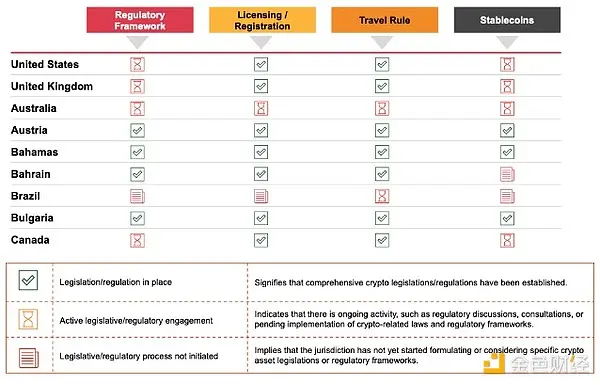
“Overview of Cryptocurrency Regulation” in PwC’s 2023 Cryptocurrency Regulation Report. Source: PwC
Vishal Gupta, the founder of True Markets, pointed out that the legal environment for stablecoins “will still face issues of inefficiency and fragmentation due to inconsistent regulatory frameworks.”
He mentioned the global regulatory divergence caused by the EU’s introduction of specific stablecoin rules, particularly in the regulation of the cryptocurrency asset market (MiCA).
“Regulatory divergences may create opportunities in regions with clear and balanced rules, but they may also pose challenges in areas where regulations are overly complex or restrictive,” Gupta said.
As Donald Trump ( prepares to take office in January, companies like BitPay hope for clearer and more consistent regulations for stablecoins and the cryptocurrency market.
Stablecoin Trends in 2025: L2, Yield, and Interoperability
Many industry executives predict that stablecoins will further develop in areas such as Layer )L2(, yield, and interoperability next year.
BitPay’s Zielke said that the adoption of L2 stablecoins on networks such as Arbitrum, Optimism, and Base will become one of the largest areas of development for tokens in 2025.
Tether CEO Paolo Ardoino stated that stablecoins “will become the most important monetary technology in the coming decades, and blockchain and L2 will integrate.”
Reynolds from BitGo predicts that next year will drive greater interoperability between blockchains, allowing stablecoins to be transferred seamlessly in the cryptocurrency space. Gupta from True Markets points out that this will unlock “new use cases for both retail and institutional markets.”
![VETg1nN3qeO8XhP7weRXhcA3FiVAKgX5Ifry6Uae.jpeg])https://img-cdn.gateio.im/webp-social/moments-23b34aa48b9bae394c8f5f637f5c2a46.webp “7336663”(
Ethereum, Tron, and Avalanche are the three major networks for USDT. Source: Tether
With the increasing adoption of L2 and interoperability, the stablecoin industry may also see more yield-generating stablecoin solutions by 2025.
Azeem Khan, the Chief Operating Officer of the Ethereum L2 platform Morph, emphasized that stablecoins like PayPal USD can provide yield rewards simply by holding the stablecoins. Companies like BitGo are also launching yield-generating stablecoins in 2024.
“There will be other yield-generating stablecoins entering the market, seeking to gain more holders and find ways to add them as payment options,” Khan said.
The Risks of “Exotic” Stablecoins
Gupta from True Markets stated that as the demand for stablecoin yields increases, “exotic” stablecoins (those designed to offer higher returns) will increase.
“The pursuit of higher returns may lead to the emergence of ‘exotic’ stablecoins, which effectively act as structured financial products, concealing risks that retail users may not fully understand,” he added.
Gupta warned that retail investors may be tempted by promises of higher returns without fully grasping the associated risks, which could lead to significant losses.
“Industry participants must prioritize transparency, detailed risk disclosure, and education for retail users. Regulators should establish clear standards to protect consumers while maintaining space for innovation.”


