Original | Odaily Daily Report (@OdailyChina)
Author | Ding Dong (@XiaMiPP)

In December 2024, ETH plummeted from $4000 to $1400, with almost no significant rebound, a drop of over 65%. This crash was accompanied by a capitulation-style sell-off from traders and early whales, resulting in a drastic reshuffling of market positions amid panic. The ETH/BTC exchange rate also fell back to a low of 0.018, almost returning to the starting point of the bull market in 2019.
Can ETH replicate the same trend this time from the same starting position?
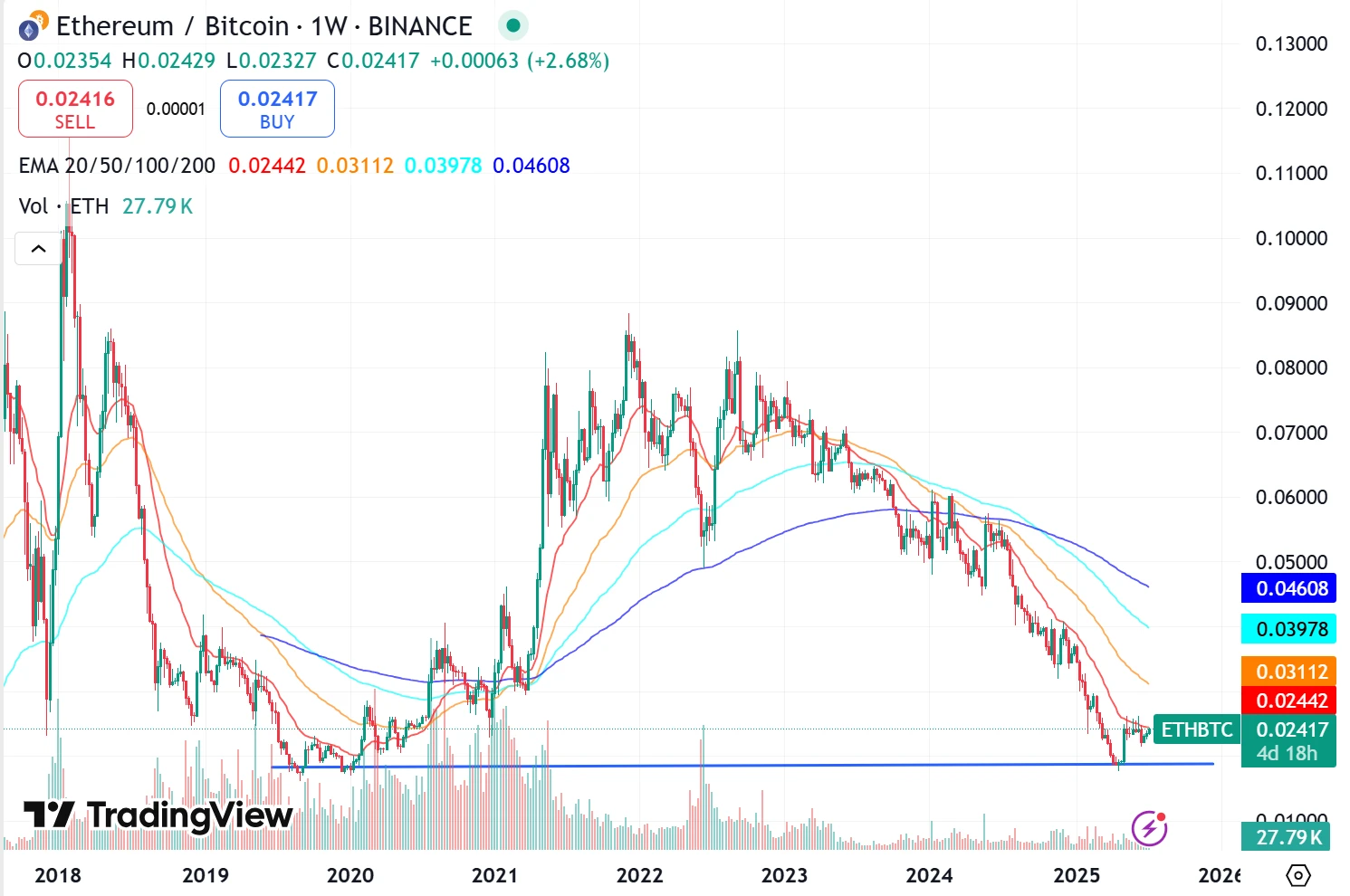
Just when most people are losing confidence in Ethereum, a structural transformation is quietly brewing. Policy boundaries are becoming clear, institutional capital is returning, EF is self-correcting, on-chain data shows divergence, and the industry narrative is refocusing. ETH may be brewing a structural re-evaluation.
Policy Tailwind: A Cryptocurrency Regulatory Framework Emerging from Uncertainty
At the macro level, cryptocurrency assets are gradually stepping out of the gray area. Key legislative processes such as the “GENIUS Act” and “CLARITY Act” have made breakthroughs, and the SEC is also discussing establishing an exemption framework for DeFi. The regulatory approach in the cryptocurrency industry is shifting from exclusion to acceptance, from suppression to “limited encouragement.”
As the foundation of DeFi and the core settlement layer for stablecoins and NFTs, Ethereum may become the most direct beneficiary of this round of policy tailwinds, with its compliance process inherently embedded within the entire industry framework. When the regulatory environment becomes clearer, the first to be reassessed for value by institutions will inevitably be Ethereum, which has its roots in “orthodox infrastructure.”
Capital Returns: The New Narrative of ETH Has Been Ignited
Since the announcement by the US-listed company SharpLink to establish an ETH strategic reserve, listed companies such as Siebert Financial, Treasure Global, and Bit Digital have successively announced that they will incorporate it into their corporate balance sheets. ETH is beginning to write a new narrative as a strategic reserve asset.
SharpLink, known as the “ETH version of MicroStrategy,” has announced its purchase of an additional 7,689 ETH, bringing its total holdings to 205,634 ETH. Based on the current price of $2,600, the total value of the holdings is approximately $530 million. Behind this round of capital reallocation is a reassessment of the asset properties of ETH.
The capital’s sense of smell is always keen, and multiple institutions are stirring. On July 3, Abraxas Capital withdrew 48,823 ETH (worth $126 million) from Binance and Kraken. A wallet suspected to be associated with Matrixport withdrew 40,734 ETH (worth $104 million) from Binance and OKX.
Nick Tomaino, founder of 1confirmation, stated that Coinbase has been hoarding ETH, and currently holds over $335 million worth of ETH on its balance sheet. Robinhood will also follow Coinbase, and other companies will imitate as well. Although it is still in the early stages, the competition for ETH ownership through L2 has already begun.
Foundation Self-Correction: Governance Shifts to Transparency
The Ethereum Foundation, which has been questioned for its “lack of transparency,” is also beginning to make deep adjustments to its governance structure. In the face of centralization dilemmas and transparency crises, the foundation is undertaking a major restructuring of its research and development team, laying off employees. At the same time, the foundation has released the latest version of its financial policy document, clarifying its asset management strategy, ETH sale mechanisms, and its long-term commitment to the DeFi ecosystem.
This is not only an attempt at self-correction but also a signal to the market: Ethereum will continue to defend its credible neutrality and institutional legitimacy.
Further Reading: “Restructuring the R&D Team, Can EF’s Organizational Change Be a Booster for ETH Prices?”.
Data Support: On-Chain Metrics Speak
On-chain data is telling the story of Ethereum’s rise. As of now, the number of weekly active unique users of stablecoins based on Ethereum has surpassed 750,000, setting a new historical high. Among them, USDT and USDC still dominate, with circulating volumes on Ethereum of 73 billion USD and 41 billion USD respectively, accounting for about 85% of the total market value of stablecoins.
CryptoQuant data shows that since June 2025, over 500,000 ETH have been newly staked, bringing the total staked amount across the Ethereum network to surpass 35 million for the first time, setting a historical record. Meanwhile, the total holdings of “accumulation addresses” that have never sold ETH have also risen to a historical high of 22.8 million. During the consolidation phase in June, the buying by long-term holders of Ethereum significantly increased, with accumulation volume showing a clear divergence from price trends, indicating a strong tendency among long-term holders to hoard.

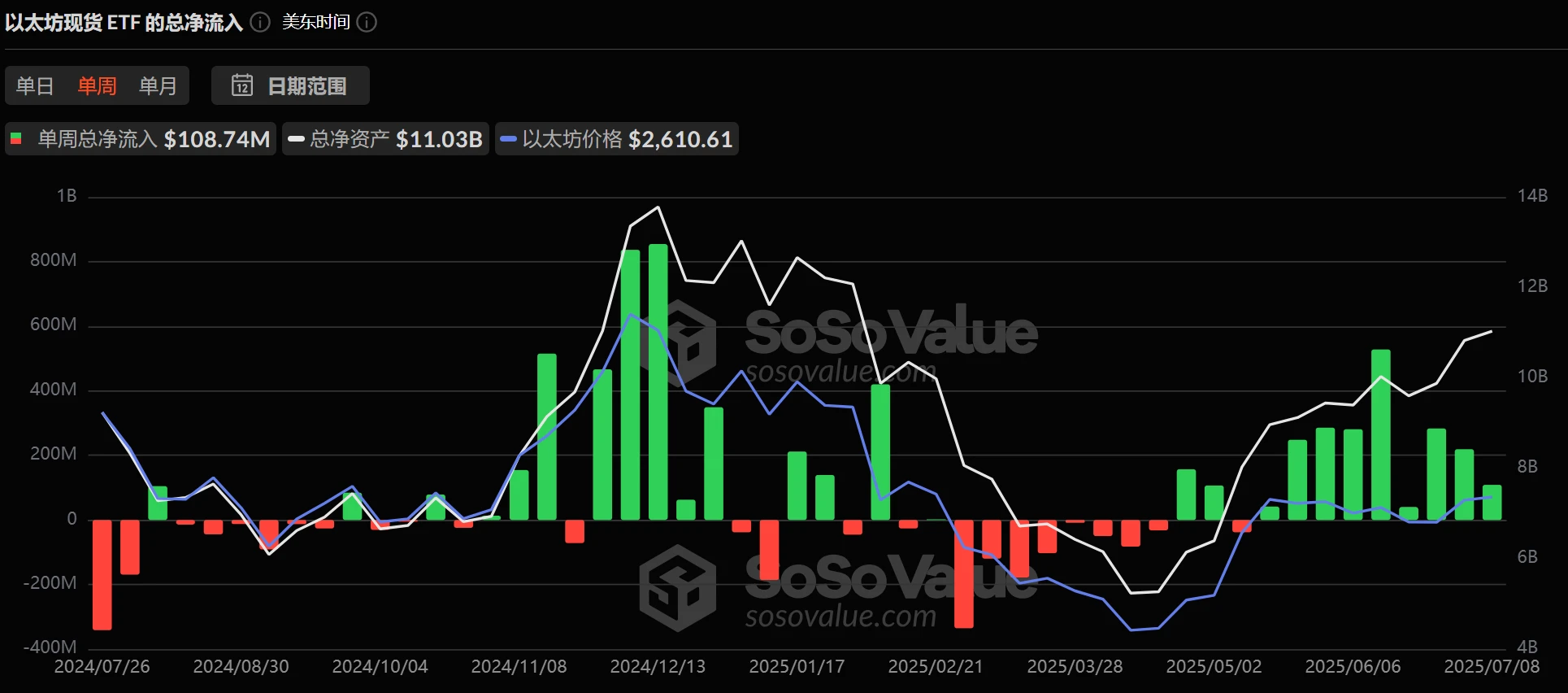
Ethereum Spot ETF Records Net Inflows for Nine Consecutive Weeks. Bitwise Chief Investment Officer Matt Hougan stated that inflows into Ethereum exchange-traded funds will accelerate significantly in the second half of the year, as more stablecoins and stocks begin to trade on the Ethereum blockchain, which is a phenomenon easily understood by traditional investors. In June of this year, the inflow of funds into Ethereum ETFs reached $1.17 billion, and if this trend continues, the inflow into Ethereum ETFs in the second half of the year could reach $10 billion.
Industry Perspective: The Return of Believers
Under the push of multiple factors, the market seems to have found sufficient reasons for the rise of Ethereum. Industry leaders are also rallying for the next round of Ethereum’s rise, reestablishing market confidence.
1confirmation Founder: Strongly supports Ethereum, which is the cornerstone of the industry’s continuous development.
Nick Tomaino, the founder of 1confirmation, firmly stated that Ethereum is the cornerstone for the continuous advancement of the entire industry. He emphasized that the values of trustworthiness, neutrality, open-source, and permissionless innovation must be continuously inherited and spread.
Tomaino pointed out that some current popular trends, such as venture capital chains and corporate adoption of Ethereum treasury strategies, while not directly related to the aforementioned values, do not imply that they are bad. He cited Hal Finney’s perspective from 33 years ago, stating: “Computers can be used to liberate and protect people, rather than control them.”
Bankless Co-founder: Ethereum MEV Minimization Investment or Supporting Traditional Financial Adoption
David Hoffman, co-founder of Bankless, stated that Ethereum’s ongoing commitment to trusted neutrality and minimizing MEV (Miner Extractable Value) could provide it with an additional advantage in its adoption within the traditional finance (TradFi) sector. He pointed out that blockchains like Robinhood, which use a single sorter, do not face illegal MEV issues, but Ethereum’s investment in fair MEV infrastructure is akin to “compliance” efforts in traditional finance. This investment could become a significant driving factor for traditional financial institutions to choose Ethereum over other blockchains, further enhancing Ethereum’s competitiveness in compliance and technological credibility.
ZKsync founder: Solana fundamentally cannot compete with Ethereum in terms of decentralization and censorship resistance.
Previously, Solana co-founder Toly stated that Solana is not looking to “wage war” with Ethereum, but rather to combat centralized sequencers Layer 2 based on Ethereum.
Alex Gluchowski, the founder of ZKsync and CEO of Matter Labs, responded to Solana co-founder Toly by stating that Solana cannot compete with Ethereum in terms of decentralization and censorship resistance, and also cannot compete with single sequencer Layer 2 networks in terms of latency and performance.
Consensys CEO: Ethereum Layer 1 will become the global main ledger.
Consensys CEO and Ethereum co-founder Joseph Lubin stated: “Ethereum Layer 1 will become the global main ledger. It allows anyone to view, use, and add data or features without permission, possessing trustworthy neutrality and resistance to censorship. It features tamper-proof and verifiably tampered characteristics (achieved through a confiscation mechanism and transparency), and continues to advance its decentralization process. It has a top-tier large community that remains highly vigilant, as there will always be patient and well-resourced participants attempting to undermine the system. Fortunately, as Ethereum develops and matures, the difficulty of undermining the system will increase.”
Conclusion: ETH, this time is truly different.
Every round of faith reconstruction always begins in the coldest moments of the market. After undergoing the baptism of a sharp decline, its chip structure has become sparse, and any marginal influx of funds could trigger a price bounce. Currently, its price may still be fluctuating, but its value has quietly begun to change.
ETH might really be back.


