Author: Onkar Singh, CoinTelegraph; Translated by: Bai Shui, Jinse Finance
1. Understanding the 10-Year Treasury Yield: Definition and Importance
The 10-year Treasury yield is the interest rate that the U.S. government must pay to borrow money for a period of 10 years.
When the government needs cash, it issues bonds known as government bonds, and the 10-year government bond is one of the most closely watched bonds. “Yield” refers to the annual return rate for purchasing the bond and holding it until maturity. It is expressed as a percentage, such as 4% or 5%.
Imagine if the government said, “Lend me $1000, and I will pay you back with interest in 10 years.” The interest rates and yields would fluctuate based on the demand for bonds, inflation expectations, and overall economic conditions. Since U.S. Treasury bonds are considered safe (the government is unlikely to default), the 10-year Treasury yield is the benchmark for “risk-free” returns in the financial sector.
Why is this so important for cryptocurrencies? Cryptocurrency yields and stablecoins are part of the broader financial world, while the yield on 10-year government bonds influences investor behavior, which in turn affects the cryptocurrency market. Let’s take a deeper look.
2. The Impact of 10-Year U.S. Treasury Yield on Global Financial Markets
The 10-year U.S. Treasury yield is not unique to the United States—it plays a crucial role in global financial markets, influencing various aspects from stock markets to currencies and emerging economies.
As the US dollar is the world’s reserve currency and US Treasury bonds are a global safe haven, changes in the yield of 10-year US Treasuries can trigger shocks worldwide. The specifics are as follows:
- Stock Market: The rise in U.S. Treasury yields may lead to a withdrawal of funds from the stock market, particularly from growth stocks such as technology companies, as investors can obtain higher returns from bonds. In 2021, when yields surged, technology stock indices like the Nasdaq were hit hard as investors moved towards safer assets. This shift may set the stage for how investors view higher-risk assets like cryptocurrencies.
- Global Borrowing Costs: The yield on 10-year government bonds affects global interest rates. When yields rise, borrowing costs for businesses and governments also increase, which may slow economic growth. For example, in 2022, rising yields led to a tightening of financial conditions, impacting various aspects from loans to European companies to mortgage rates in Asia.
- Currency Market: The rise in the yield of 10-year government bonds has led to a stronger dollar, as investors flock to dollar-denominated assets. A stronger dollar may make cryptocurrencies, which are typically priced in dollars, more expensive for international investors, potentially suppressing demand. This also puts pressure on emerging market currencies, as their debt (often denominated in dollars) becomes more costly to service.
- Emerging Markets: Economically weaker countries rely on cheap borrowing. When U.S. Treasury yields rise, capital flows from higher-risk emerging markets to U.S. bonds, causing volatility in their stock and bond markets. This may spill over into the cryptocurrency market, as investors in these regions may sell crypto assets to offset losses in other areas.
- Inflation and Monetary Policy: The 10-year Treasury yield is a barometer of inflation expectations. If yields rise due to investors anticipating higher inflation, central banks like the Federal Reserve may raise interest rates, tightening global liquidity. This could reduce speculative investments in assets like cryptocurrencies, as seen when aggressive rate hikes in 2022 cooled the market.
For cryptocurrency investors, this global impact sets the stage. An increase in the yield of 10-year government bonds may indicate that cryptocurrency prices and yields will face a more challenging market environment, especially amid global market turbulence. Conversely, low yields tend to stimulate risk appetite, thereby boosting speculative assets such as cryptocurrencies.
3. Rising Government Bond Yields: Will Safer Returns Diminish the Attractiveness of Cryptocurrency Yields in 2025?
The 10-year U.S. Treasury yield is an important indicator of global financial health, and this yield shows significant fluctuations in 2025. As of May 9, 2025, the yield is approximately 4.37%-4.39%.
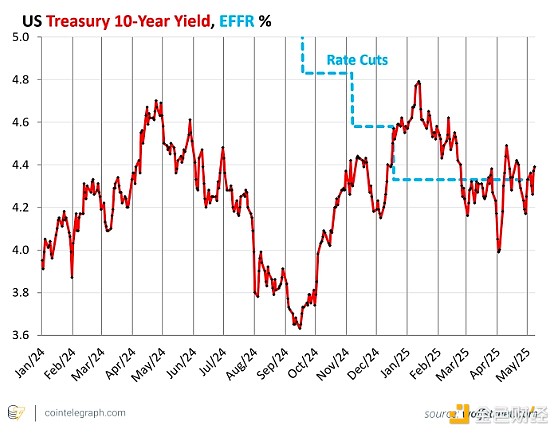
The volatility of yields is driven by factors such as trade tensions, inflation expectations, and Federal Reserve policies. Recently, the interest rate cuts have not lowered yields as expected, which is contrary to historical trends.
In the cryptocurrency space, yields are obtained through activities such as staking, lending, and providing liquidity, often offering returns of 5%-10% or even higher. However, the rise in the yield of 10-year U.S. Treasury bonds has posed challenges.
Research suggests that higher yields on safe assets may reduce demand for the yields of riskier cryptocurrencies, as investors may prefer the stability of U.S. Treasury bonds. This capital competition could lead to a decline in participation in cryptocurrency lending platforms, which may drive up yields to attract users, but overall market activity may decline.
This is because many cryptocurrency platforms need to borrow money to operate, and their borrowing costs are linked to broader interest rates, which are influenced by the 10-year U.S. Treasury yield. If interest rates rise, these platforms may pass on the higher costs to users, thereby affecting the yields you receive.
4. How Government Bond Yields Affect Stablecoins
Stablecoins like Tether’s USDt and USDC are closely tied to traditional finance, as their value is typically backed by assets such as cash, bonds, or — you guessed it — U.S. Treasury securities.
The following is the impact of the 10-year Treasury yield on stablecoins:
- Supported Assets: Many stablecoins (such as USDC) hold U.S. Treasury bonds in their reserves to maintain their peg to the dollar. An increase in U.S. Treasury yields (currently at 4.39%) means that stablecoin reserves can earn more income, which theoretically can be shared with users as returns.
- Regulatory Complexity: The regulatory frameworks in some countries complicate this process. In the European Union, the Markets in Crypto-Assets Regulation (MiCA) prohibits stablecoin issuers and crypto asset service providers (CASP) from offering interest to prevent them from being used as a means of value storage, but users can still earn yields through decentralized finance (DeFi) platforms.
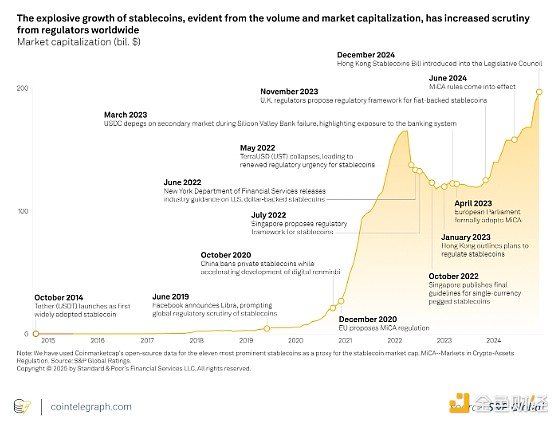
- Opportunity Cost: If the yield on 10-year Treasury bonds is high, holding stablecoins (which typically have lower yields than riskier cryptocurrencies) may be less attractive than directly purchasing U.S. Treasury bonds. Investors may withdraw funds from stablecoins, thereby reducing the amount available for lending, which may potentially lower the yields on stablecoins.
- Market Sentiment: Rising U.S. Treasury yields typically signal tightening monetary policy (such as the Federal Reserve raising interest rates), which can disrupt the cryptocurrency market. For example, in 2023, when yields reached their highest point in years, cryptocurrency prices (including stablecoin-related tokens) felt pressure as investors became more cautious. This could indirectly affect the yields of stablecoins, as platforms adjust based on market conditions.
- DeFi Dynamics: In decentralized finance (DeFi), stablecoins are the pillars of lending and trading. If U.S. Treasury yields rise, traditional finance becomes more attractive, which may reduce activity on DeFi platforms, thereby lowering the yields of stablecoin pools. On the other hand, some DeFi protocols may increase yields to maintain user engagement.
It is worth noting that an increasing number of people are calling for regulations that allow stablecoins to share profits with users, especially in jurisdictions like the UK and the US where legislative work is underway. This debate is crucial because allowing profit sharing can enhance the adoption of stablecoins, thereby increasing fiscal revenue, but clear regulatory provisions are needed to avoid legal risks.
5. USDC and U.S. Treasury Bonds: How Should You Invest Your Funds?
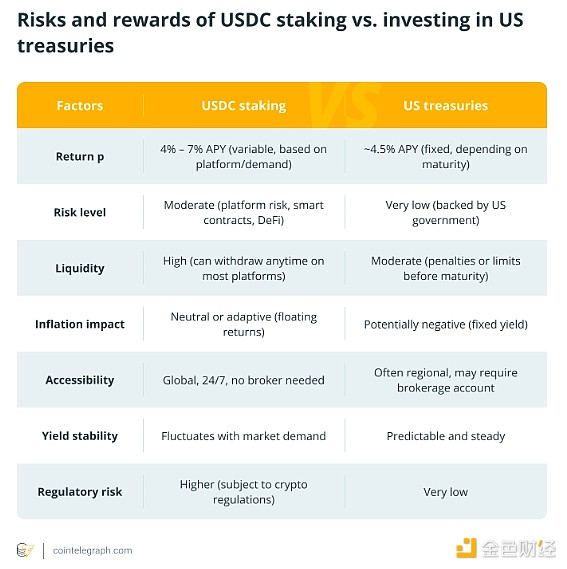
USDC staking offers higher but more volatile returns, with moderate risk; while US Treasury bonds provide stable, low-risk returns guaranteed by the government.
When users stake USDC (by borrowing on platforms like Aave or Coinbase), they can earn floating returns, with annual interest rates typically ranging from 4% to 7%, depending on demand and platform risk.
U.S. Treasury securities, especially the 10-year Treasury bonds, offer fixed income; the yield is about 4.37%-4.39%. These securities are backed by the U.S. government, making them one of the safest investments.
While USDC can offer higher yields, it also comes with additional risks such as smart contract vulnerabilities, platform failures, and regulatory changes. U.S. Treasury bonds, although safer, have limited upside potential.
6. The Impact of Rising Government Bond Yields on Cryptocurrency Investors
For cryptocurrency investors, higher government bond yields may reduce risk appetite, but tokenized government bonds provide a safe alternative.
If you are considering staking your Ethereum or lending USDC, understanding the trend of treasury yields can help you anticipate whether the yields are rising, falling, or posing additional risks.
For example:
- If the yield rises, it may indicate that cryptocurrency yields could become more competitive, but it may also mean that the global market is becoming tense. You might want to stick to investing in stablecoins or safer platforms.
- If the yield is low, investors may put their funds into cryptocurrencies to increase returns, but this also increases volatility. This could be an opportunity to earn more returns, but you need to be aware of the risks.
Additionally, if you are using stablecoins to store cash or earn extra returns, the 10-year Treasury yield can indicate whether these yields will remain attractive, or if you might find better returns elsewhere. Due to the global influence of stablecoins, yields can foreshadow broader economic changes that may impact your cryptocurrency strategy.
Additionally, if regulatory frameworks evolve to allow for profit sharing, especially in the United States, stablecoin holders may benefit from higher reserve income, although the EU’s restrictions have pushed profit generation towards DeFi. Alternatively, traditional investors could explore tokenized government bonds for blockchain-based exposure to government debt, with the potential to integrate them into broader portfolios when regulations become clearer.
A significant development in 2025 is the rise of tokenized government bonds, which is the digital representation of U.S. Treasury bonds on the blockchain. According to an analysis by RWA.xyz, as of May 4, 2025, the total value of tokenized government bonds has reached $6.5 billion, with an average yield to maturity of 4.13%. This trend provides cryptocurrency investors with a way to achieve yields comparable to traditional bonds, potentially mitigating the impact of rising U.S. Treasury yields on the cryptocurrency market.
Furthermore, the emergence of tokenized U.S. Treasury bonds marks a blurring of the lines between traditional finance and decentralized ecosystems. These blockchain-based government debt instruments not only provide yield stability but also reflect a broader trend: the integration of real-world assets (RWA) into the cryptocurrency market. This development has the potential to reshape risk management practices, attract more conservative capital, and accelerate regulatory engagement with digital assets.


