Author: Vince Quill, CoinTelegraph; Translated by: Deng Tong, Golden Finance
U.S. President Donald Trump has excluded a range of tech products, including smartphones, chips, computers, and some electronic products, from reciprocal tariffs, providing much-needed relief from trade pressures for the tech industry.
According to the U.S. Customs and Border Protection, memory cards, modems, diodes, semiconductors, and other electronic products are also excluded from the “reciprocal” trade tariffs.
Kobesi wrote in a post on X on April 12: “In the end, large tech companies will stand out.”
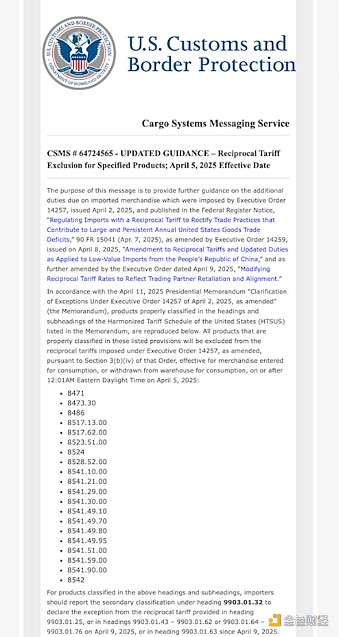
The U.S. Customs and Border Protection announced a tariff exemption for certain technology products. Source: U.S. Customs and Border Protection
Tariff reductions will alleviate the pressure on technology stocks, which are one of the biggest victims of the trade war. The cryptocurrency market is closely related to technology stocks, and as positive news from the trade war triggers an increase in risk appetite, the cryptocurrency market may also see a rise.
After the news of the tariff exemption was announced, the price of Bitcoin broke $85,000 on April 12, indicating that the cryptocurrency market has begun to respond to the latest macroeconomic developments.
During periods of macroeconomic uncertainty, the market is skeptical of every word and action from Trump.
On April 9, President Trump announced a 90-day suspension of reciprocal tariffs on U.S. goods and reduced the tariff rate to 10% for countries that had not imposed counter-tariffs on U.S. goods, thereby retracting the previous comprehensive tariff policy.
On the same day that Trump announced a suspension of tariffs, Bitcoin soared by 9% and the S&P 500 index rose by over 10%.
Macro economic trader Raoul Pal stated that tariff policy is a negotiating tool for reaching a China-US trade agreement, and described the US government’s trade rhetoric as ‘posturing’.
Bitcoin advocate Max Keiser believes that exempting some tech products from import tariffs will not lower bond yields, nor will it further achieve the Trump administration’s goal of lowering interest rates.
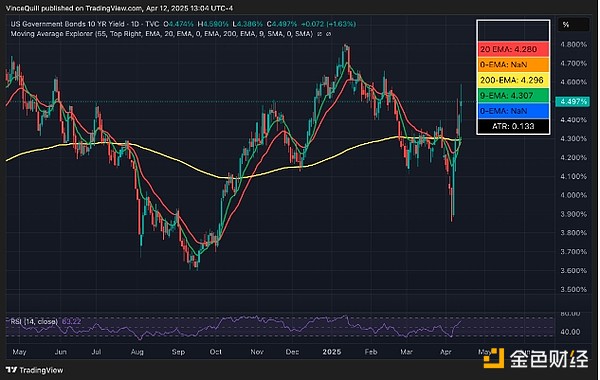
After the introduction of the Trump administration’s comprehensive trade policy, the yield on 10-year U.S. Treasury bonds soared. Source: TradingView
On April 11, due to bond investors reacting to the macroeconomic uncertainties brought about by the prolonged trade war, the yield on the 10-year U.S. Treasury surged to a local high of around 4.5%.
Kaiser wrote on April 12: “The recent preferential treatment for Chinese technology exports will not reverse the trend of rising interest rates. For years, confidence in U.S. bonds and the dollar has been declining, and this trend will not stop.”
Disclaimer: The information on this page may come from third parties and does not represent the views or opinions of Gate. The content displayed on this page is for reference only and does not constitute any financial, investment, or legal advice. Gate does not guarantee the accuracy or completeness of the information and shall not be liable for any losses arising from the use of this information. Virtual asset investments carry high risks and are subject to significant price volatility. You may lose all of your invested principal. Please fully understand the relevant risks and make prudent decisions based on your own financial situation and risk tolerance. For details, please refer to
Disclaimer.


