Paul Atkins quickly promoted the relaxation of encryption regulation after taking office, with the approval of ETFs, regulatory guidance, and settlements of lawsuits progressing simultaneously.
Written by: Ashley
On April 10, 2025, the SEC welcomed its new chairman, Paul Atkins. This leader, nominated by President Trump and confirmed by the Senate with a vote of 52 to 44, stated upon taking office that establishing a regulatory framework for digital assets would be a “top priority”. He promised to create a transparent SEC that widely incorporates industry and consumer opinions, fundamentally changing the previously closed and high-pressure regulatory style. Paul Atkins quickly became the focus of the encryption industry, and within the first 48 hours of his term, a series of favorable regulatory developments emerged. Multiple lawsuits related to encryption during the tenure of former SEC chairman Gary Gensler were withdrawn, the SEC issued a statement urging detailed disclosures when issuing cryptocurrencies, and he personally stepped in to guide project teams on how to issue tokens. Such a concentrated series of actions has led people to wonder: Is Trump’s SEC going to be the “nanny” of the encryption industry?
The new SEC chairman takes office with “three fires” bringing frequent good news.
Paul Atkins is not a new face at the SEC, but rather an old player in encryption. From 2002 to 2008, he served as an SEC commissioner, accumulating rich regulatory experience. After that, he founded Patomak Global Partners, providing compliance and risk strategy consulting for financial and digital asset companies, including encryption exchanges and DeFi platforms. He has also led the encryption advocacy organization Token Alliance, publicly supporting digital asset innovation. It has been disclosed that he and his spouse hold encryption-related assets worth up to 6 million dollars.

On April 9, 2025, the Senate confirmed Atkins’ nomination with full support from the Republicans, marking a significant shift in the SEC’s approach from the enforcement-first style of former Chairman Gary Gensler to a more market-friendly orientation. During his tenure, Gensler initiated over 100 enforcement actions related to encryption, emphasizing that most tokens fall under the jurisdiction of securities law and expressing skepticism towards the industry. In contrast, Atkins advocates for a principles-based regulatory framework that provides clear and workable rules for digital assets. During the Senate Banking Committee hearing on March 28, he explicitly stated that digital assets are the SEC’s top priority this year, committing to work with the Commodity Futures Trading Commission (CFTC) and Congress to fill regulatory gaps and enhance the U.S.'s global competitiveness in the Bitcoin and blockchain finance sectors.
Atkins took over as acting chair after Mark Uyeda, who had served in that capacity since Gensler’s resignation in January. Under Trump’s “encryption-friendly” administration, Uyeda’s brief term has paved the way for the SEC’s transformation, such as the dismissal of multiple encryption-related enforcement cases and the repeal of the internal rule SAB 121 that restricted public companies’ custodianship of encryption assets. Atkins’s appointment accelerates the trend of regulatory easing, and his term will last until June 2026, during which he may advance significant changes to the encryption regulatory policy framework.
Atkins’ “first spark” pointed to the financial markets, and his pro-market stance injected a strong boost into the financialization of encryption assets. On his first day in office, April 10, the SEC approved options trading for spot Ethereum ETFs, a milestone that provides investors with more avenues for participation. In addition, Atkins supports simplifying private market rules and proposes defining accredited investors by financial sophistication instead of net assets, which may further lower the barriers to encryption investment.
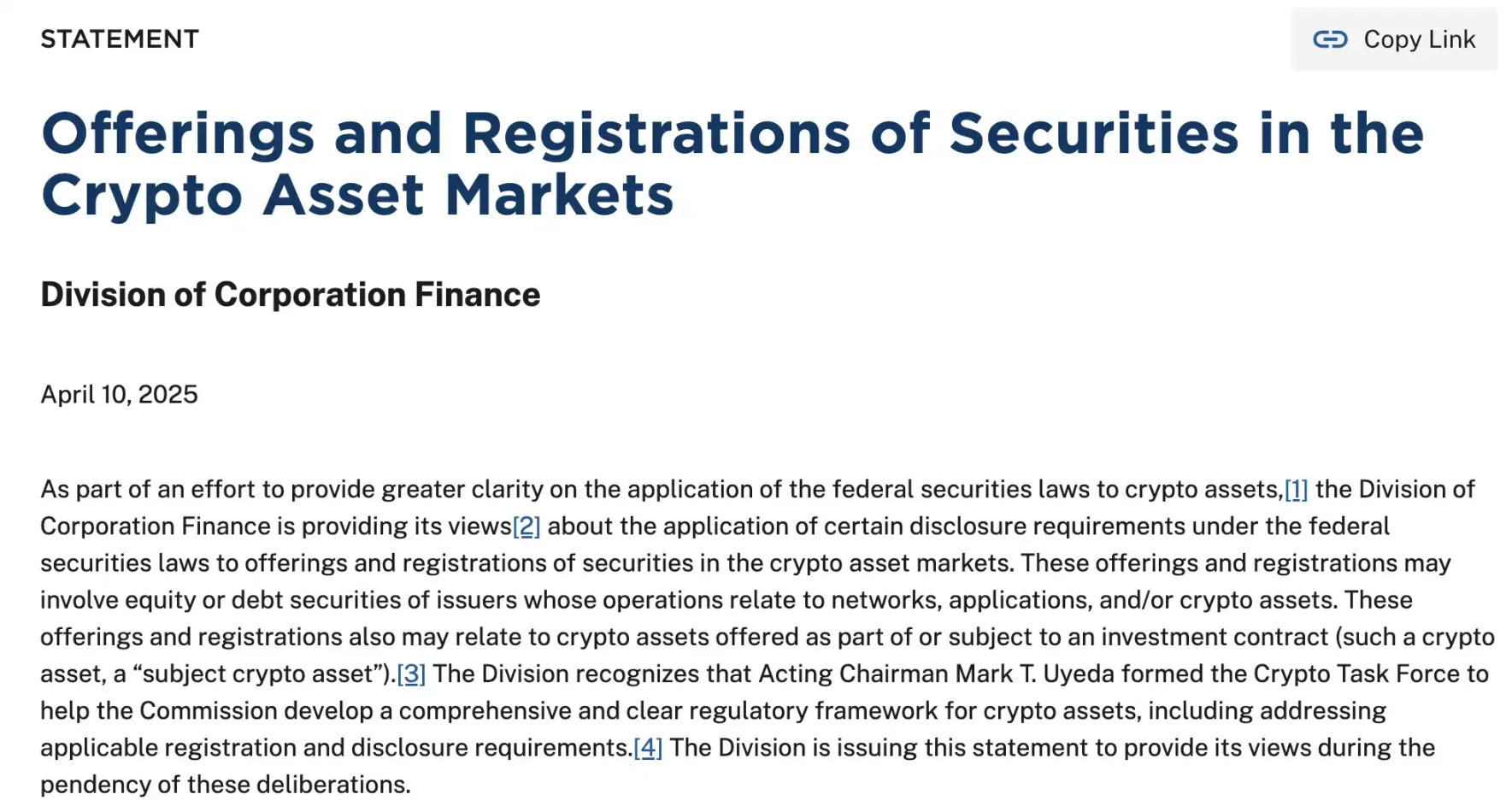
The “second fire” provided regulatory guidance for the future. On the second day of taking office, the SEC issued a non-binding guidance stating: “These issuances and registrations may involve equity or debt securities of issuers related to networks, applications, and/or encryption assets. These issuances and registrations may also involve encryption assets that are part of or governed by investment contracts (such encryption assets are referred to as ‘underlying encryption assets’).” It urged companies issuing or handling tokens that may be considered securities to provide detailed disclosures, including business content, token roles, network development milestones, and the rights of token holders. While it is still not clear which cryptocurrencies qualify as securities, it attempts to provide the industry with a clearer reference framework based on the SEC’s observations of existing company disclosure information. Such detailed “on-the-ground guidance” also reflects the SEC’s shift from “punitive regulation” to “guiding regulation,” hoping to reduce market uncertainty through communication and transparency, so that the industry does not wander on the edge of danger and can avoid repeatedly testing the waters.
The “third fire” has melted the “difficult cases” that were frozen during Gary Gensler’s term, and the SEC has shown a more lenient attitude towards past encryption lawsuits. On April 11, Helium network developer Nova Labs announced that the SEC had withdrawn its charges of selling unregistered securities against them. Previously, the SEC had initiated lawsuits against Nova Labs for three tokens—HNT, MOBILE, and IoT. With the appointment of Atkins, this lawsuit quietly came to an end, setting a positive precedent for similar projects. On the same day, the SEC also reached a settlement in its long-standing lawsuit with Ripple, with both parties submitting a joint motion to suspend the appeal, and Ripple paying a $50 million fine, with the remaining $75 million refunded to the company.
In addition, to promote regulatory clarity, the SEC’s cryptocurrency working group plans to hold four public roundtable meetings from April to June 2025, covering topics such as encryption trading, custody, asset tokenization, and DeFi. Commissioner Hester Peirce referred to this as the “spring sprint towards encryption clarity,” marking a shift from confrontation to cooperation for the SEC. The first meeting will focus on “tailored regulations for encryption trading” on April 11, followed by discussions on the integration of traditional finance with blockchain and DeFi with the American spirit.
What other tricks does the “encryption dad” have?
Atkins’s intensive actions after taking office are inseparable from the overall policy background of the Trump administration, closely aligning with encryption policies.
After Trump returned to the White House, policies have been frequently loosened. Firstly, the progress of encryption ETF approvals has been impressive. Previously stalled ETF applications for XRP and Solana due to Gensler’s tough stance are now undergoing a more lenient review within the SEC. The industry expects that multiple ETFs will be approved by 2025, significantly enhancing market liquidity. Secondly, market makers such as Citadel Securities and Wintermute are returning, promoting a comprehensive improvement in market liquidity, trading efficiency, and regulatory compliance. At the same time, stablecoin legislation is also advancing rapidly. Trump has repeatedly publicly supported stablecoins to increase demand for U.S. Treasury bonds, bolster the digital dominance of the dollar, and consolidate the dollar’s global leading position. In April, the Senate Banking Committee passed the “GENIUS Act” proposed by Republican Senator Bill Hagerty, which sets licensing, reserve, and disclosure requirements for stablecoin issuance, providing a lightweight regulatory framework. Atkins stated that the SEC will coordinate with the CFTC to clarify the securities and commodity attributes of stablecoins and support state-level regulatory exemptions for stablecoins with a market value below $10 billion to encourage innovation.
Not only that, but today, Trump also signed a bill that abolished the IRS’s rules for brokers on DeFi platforms, clearing obstacles for DeFi development. The rule introduced in 2024 classified DeFi platforms as brokers, requiring them to submit tax forms for users, which sparked widespread discontent in the industry. When signing the bill, Trump stated that the rule “hindered innovation in the United States” and “violated the privacy of ordinary Americans.” This is the first cryptocurrency-related law signed by the Trump administration, once again demonstrating that from nominating a pro-market SEC chairman to abolishing restrictive rules, the Trump administration is working to create a favorable environment for the digital asset industry, aiming to make the United States a global digital finance center.
Under Trump’s leadership, the federal government seems to be forming a more relaxed atmosphere for encryption policies, and the SEC appears to have shifted from a “regulatory iron fist” to a “crypto caretaker.” Multiple encryption ETFs have been approved, years of lawsuits have been dropped, several market makers have returned, and the DeFi broker rules have been abolished. The Trump administration is trying to stimulate industry growth by reducing regulatory barriers. However, this policy shift has also raised some concerns. Senator Elizabeth Warren criticized Atkins for his connections to Wall Street and FTX advisors, arguing that his background could undermine regulatory fairness. Critics also argue that overly lax regulation could lead to market chaos and even increase risks for investors.
Both strict regulation of market order and nurturing industry innovation and growth are required. In the future, whether this “encryption dad” can find a balance between innovation and protection, achieving the global status of the U.S. digital asset market, will require time to test. It is foreseeable that, with the support of the Trump administration, the SEC’s encryption policies will continue to be the focus of global attention, and the future of the U.S. digital asset market may begin to write a new chapter from here.


