Original author: @0xJaehaerys
Compiled by: LlamaC
“Recommendation: This article mainly introduces how Zero Knowledge Proofs (ZK-Proofs) create a new, multi-billion dollar verifiable computing market, as well as the technical advantages, market positioning, and recent progress related to ecological data of Succinct and its native token $PROVE in this field. As a frontier trend, its FDV has significantly increased in valuation, please do your own research.”
Introduction
This article by Uma Roy, co-founder of Succinct, marks a paradigm shift. It proclaims not the birth of yet another token, but a data-driven, real-time emerging new economy: the verifiable computing economy. For years, zero-knowledge (ZK) technology has been seen as the theoretical endgame for blockchain scalability. Today, it has become an engineering reality, opening up one of the most important infrastructure races of the next decade.
The driving force behind this transformation comes from what David Hoffman calls Ethereum's “Manhattan Project”: a fundamental re-architecture of the protocol that significantly increases its throughput without sacrificing decentralization. Until recently, this was a distant vision. However, a series of strategic protocol upgrades and key technological breakthroughs have turned it into an executable roadmap.
I have always thought that what we are doing with ZK, especially the ZK-EVM that will eventually be applied to Ethereum, is somewhat like Ethereum's Manhattan Project… While Ethereum is researching ZK behind the scenes to retain all those things that are currently bringing Wall Street onto the chain, they are also developing this highly futuristic technology.
This report provides a fundamental analysis of this emerging billion-dollar market. The report will explain why the demand for ZK proofs is not speculative but structurally inevitable; quantify the scale of this economic opportunity; and detail how platform-first companies like Succinct, with their native token $PROVE, are poised to become the infrastructure of this new era of verifiable computing.
1. The Necessity of a New Market
The inevitable requirements of 1.1 Gigagas and Teragas
Ethereum is undergoing a monumental change, driven by a core development roadmap that is not based on speculation but rather a predetermined and inevitable evolution process. This re-architecture of the protocol itself creates a structural, predictable, and exponentially growing demand for zero-knowledge (ZK) proofs. In pursuit of global scale throughput, Ethereum is destined to become the first and largest consumer in a brand new verifiable compute economy worth billions of dollars.
This demand stems from a clear and grand long-term vision. The Gigagas roadmap aims to expand the throughput of the L1 execution layer to 1 Ggas/s, which is approximately equivalent to 10,000 TPS. However, as Ethereum Foundation researcher Justin Drake pointed out, this is merely the “tip of the iceberg.” The ultimate goal is to achieve a total throughput of 1 Tgas/s (about 10 million TPS) through the collaborative work of around 1,000 L2s, creating a “Teragas” ecosystem. In this model, 99.9% of the transaction volume occurs on L2, while L1 evolves into the ultimate hub for shared security and settlement. As Drake said:
“10,000 TPS is simply not enough. To serve the entire world, we need to reach a level of 10 million transactions per second and 1 teragas per second. How do we achieve this goal? The answer is L2.”
Proposals like EIP-7938 formally establish this exponential expansion, advocating for a tripling of the L1 Gas cap every year. This mechanism aims to achieve stable and predictable growth, thus creating a reliable demand curve for the computational resources needed to ensure network security.
This transition will be managed through a multi-year “gradual incorporation” plan, which systematically reduces process risks. The plan is advanced in different phases, ultimately mandating the use of ZK proofs to verify block validity before 2027, making proof generation a core and economically indispensable function of the protocol. By directly hardcoding this requirement into the evolution of the protocol, Ethereum is effectively establishing an industrial policy for the ZK space, providing the necessary economic signals for the rationale behind significant capital investment in future infrastructure.
1.2 Finality Issues: Vitalik Buterin on Why ZK is Crucial for L2
The urgency of this transformation goes far beyond L1. It addresses the main bottleneck in the current L2 ecosystem: the friction and risks associated with slow withdrawal finality. As Ethereum co-founder Vitalik Buterin recently stated, achieving fast withdrawal times is a key objective, and for L2, “it is even more important than the second phase.”
In the era of ZK 1.0, the companies you mentioned are bundling ZK technology with business use cases… ZKSync is both an L2 company and a ZK company… What we do is enable companies that know nothing about ZK, such as Optimism or Arbitrum, to take advantage of ZK now that it has become so easy, allowing them to focus on what truly matters, such as business expansion or user adoption.
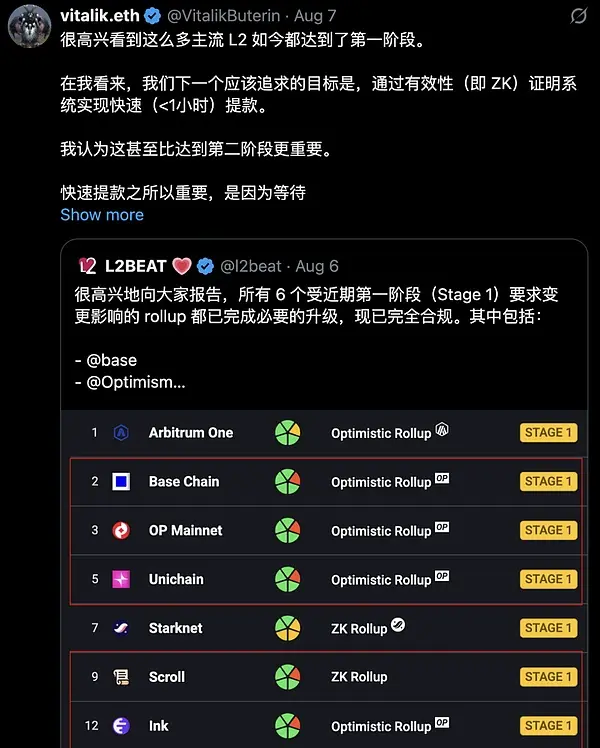
In a detailed explanation, Buterin emphasized the core issues of the current mainstream Optimistic Rollup design:
“Waiting a week to withdraw is simply too long for people, even for intention-based cross-chain bridges… If liquidity providers have to wait a week, the cost of their capital becomes prohibitively high. This greatly incentivizes people to turn to solutions with unacceptable trust assumptions (such as multi-signature/MPC), which goes against the very purpose of L2's existence.”
His proposed solution is to decisively shift towards a validity proof system driven by ZK technology. While acknowledging historical trade-offs, he emphasized the recent changes in the technological landscape:
“Historically, ZK proof technology has been immature and costly, making Optimistic proofs a wise and secure choice. However, this situation is changing rapidly.”
In his view, by shortening the native withdrawal time to under one hour in the short term and ultimately achieving a withdrawal time of 12 seconds in the medium term, ZK proof can “further solidify Ethereum L1's position as the default asset issuance location and the economic center of the Ethereum ecosystem.” This high-level recognition will regard the shift to ZK not merely as a technical preference, but as a strategic necessity for the security and economic integrity of the entire Ethereum ecosystem.
This flexibility not only attracts software developers but also professional hardware manufacturers. Industry-leading ZK hardware acceleration company Cysic announced that its upcoming “ASIC compatible with zkVM will be launched, and it will natively support SP1.” This specialized hardware company plans to provide native support, indicating strong confidence in the industry regarding SP1 as a potential standard for verifiable computing, bridging the gap between open-source software and dedicated chips.
2. Quantifying Opportunities Worth Billions of Dollars
2.1 The Unit Economics of Proofs
The economic feasibility of a scalable ZK ecosystem depends on the unit cost of proving a given computation amount. Although early ZK systems were notoriously expensive, development trajectories similar to “Moore's Law” have led to a sharp decline in costs. At the “Frontiers” event hosted by Paradigm, John from Succinct stated that the average proof cost per transaction currently ranges from 0.01 cents to 0.1 cents, describing this cost as “almost negligible compared to other costs like DA.”
In my opinion, the incentive mechanism is very simple. Just like today, it relies on transaction fees and MEV… the cost is about 0.01 cents. As long as individual users are willing to pay this fee, it is enough to cover the proof cost.
It is expected that this cost will continue to decline. Ethereum Foundation researcher Justin Drake made a key prediction, forecasting that as hardware and software continue to improve exponentially, the long-term, scalable costs of L1 proof will stabilize between $0.0001 and $0.001 per Mgas/s (million gas per second). This rapid decline in costs is transforming ZK from a niche, expensive technology into a commoditized practical tool, laying the foundation for a huge market.
2.2 Market Size - Bottom-Up Forecast (Conservative View)
A conservative, bottom-up financial model estimates the annual revenue of the ZK proof market by combining expected throughput growth with cost estimates. According to this model, the non-altruistic substantial revenue from L1 proofs is expected to emerge starting in 2027, when protocols will be mandated to use ZK proofs to validate the validity of blocks.
If you imagine that the cost of each transaction is just 0.1 cents, and you are processing transactions at a Solana-level TPS, such as 4000-5000 transactions per second, then multiplying all these numbers together, the final proof requirement is about 100 million dollars per year.
Table 1: L2 Ecosystem ZKP Demand and Revenue Forecast (2025-2030)
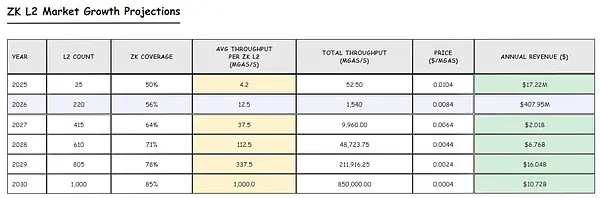
Methodology — L2 Ecosystem ZKP Demand and Revenue Forecast (2025–2030)
- L2 Quantity and ZK Coverage Rate
- Starting from 25 L2s in 2025, expanding to 1000 L2s by 2030.
- Coverage represents the share of ZK-based L2 each year, growing from 50% to 85%.
- The average throughput of each ZK L2
- Set to be equal to the L1 throughput of the same year to meet the “teragas aggregation” hypothesis (i.e., the capacity of each L2 grows with the expansion of the base layer).
- This is an optimistic assumption that, for simplicity, compresses the heavy-tailed throughput distribution into a uniform average.
- Total Throughput Calculation:
TotalThroughput(Mgas/s)=(L2Count×CoverageRate)×AvgThroughputperZKL2
- Pricing Assumption
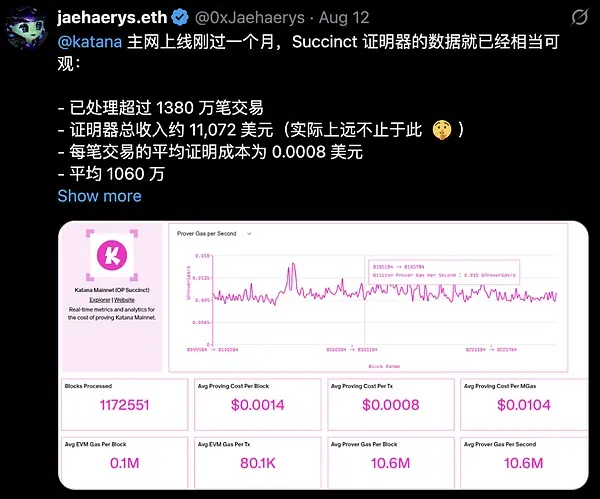
- The initial price per Mgas is $0.0104 (refer to Katana, 2025).
- Driven by hardware efficiency, competition in the validator market, and protocol-level optimizations, costs will significantly decrease to $0.0004 by 2030.
- Use linear price interpolation between the starting year and the ending year.
- Annual Income:
AnnualRevenue=TotalThroughput×PriceperMgas×31,536,000(seconds/year)
Table 2: Potential Market Size of ZK Proofs (TAM) ( 2025-2030, Bottom-Up Approach )
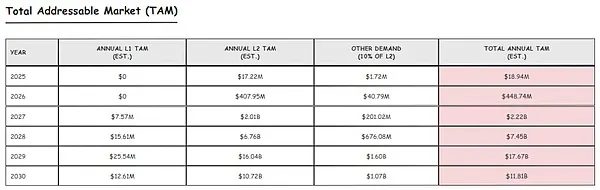
- Growth in L2 Quantity — Starting from 25 L2s in 2025, expanding linearly to 1,000 by 2030.
- ZK Coverage Rate — Only a portion of L2 adopts ZK proofs: 50% by 2025, increasing to 85% by 2030.
- The average throughput of each ZK L2 - set to be equal to the throughput of the same year's L1 (this is an optimistic assumption). This is consistent with the logic of the “teragas” roadmap, which states that mature L2s will reach the capacity of L1.
- Total L2 Throughput — The formula is: Number of ZK L2 × Average throughput of each ZK L2
- Among them, ZK L2 quantity = L2 total × coverage rate.
- The price of every million Gas — set at $0.0104 at the beginning of 2025 (based on the proof cost of Katana L2), and linearly decreasing to $0.0004 by 2030, to reflect the efficiency improvements brought by zkVM, hardware, and market competition.
- Annual L2 potential market capitalization:
TotalL2Throughput(Mgas/s)×PriceperMgas×SecondsperYearTotalL2Throughput(Mgas/s)×PriceperMgas×SecondsperYear
- Annual L1 potential market cap — Starting from 2027 (when L1 block mandatory proof will be launched), priced the same as that year's L2 $/Mgas, L1 throughput based on Ethereum scaling roadmap.
- Other Requirements — Conservatively estimated to be 10% of the potential total market for L2, covering ZK bridges, co-processors, and verifiable applications (ZKML, on-chain privacy).
- Potential market cap: L1 potential market cap + L2 potential market cap + other demand
2.3 Market Size Estimation - Top-Down Vision (Teragas Finality)
Another top-down model based on the Ethereum “Gigagas” and “Teragas” roadmap indicates that the potential market size could be an order of magnitude larger.
Table 3: Ethereum L1 Gas Throughput Forecast (2027-2030)
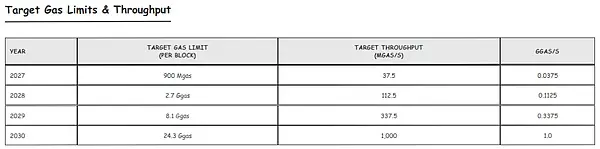
Table 4: ZK Proof Market Size and Revenue Forecast (Top-Down, 2027-2030)
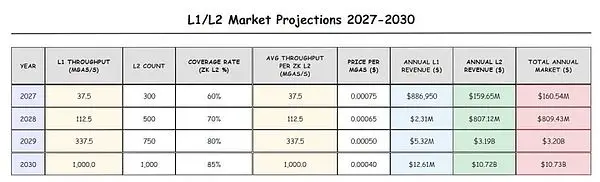
- Methodology (for this top-down table)
- L1 Throughput — Based on the Ethereum scaling roadmap goal: 37.5 → 1,000 Mgas/s (2027–2030).
- L2 Quantity — Increase from 300 to 1,000 during the period of 2027–2030.
- ZK Coverage Rate — Only a portion of L2 uses ZK proofs, and this proportion has increased from 60% to 85%.
- The average throughput of each ZK L2 - set to be equal to the throughput of the same year's L1 (for example, 37.5 Mgas/s in 2027 and 1,000 Mgas/s in 2030) to align with the total throughput assumption at the teragas level.
- Price per Mgas — decreases with improvements in prover hardware and market competition: $0.00075 (2027) → $0.00040 (2030).
- L2 Total Throughput:
AggreGateL2Throughput=(L2Count×ZKCoverage)×L1Throughput
- Income Formula: L1
- Revenue = L1_Throughput × Price × Seconds per Year
- L2 Revenue = AggreGate_L2_throughput × Price × Seconds per year
- Total Market = L1 Revenue + L2 Revenue
2.4 Who will pay for the proof?
This multi-billion dollar demand will not be funded by protocol inflation, but rather supported by the robust and diversified revenue models of L2 and application chains. As detailed in an analysis article by Conduit, projects with their own chains have at least seven different revenue levers to ensure they can afford the operational costs of ZK proofs.
Table 5: Comparison Analysis of L2 Revenue Streams
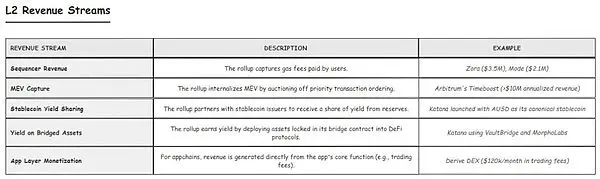
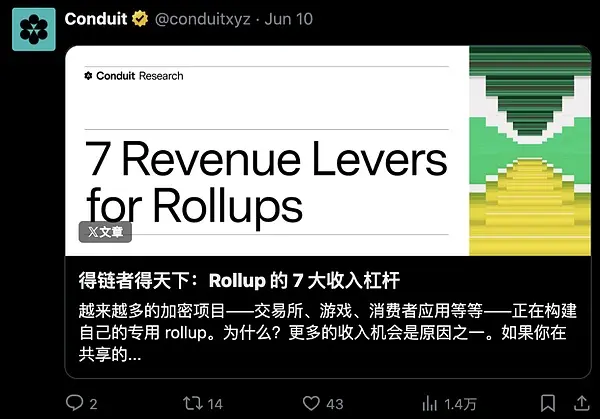
The one who possesses the chain controls the world: 7 major revenue levers of Rollup
Three, the technical advantages of Succinct
3.1 Real-time proof has become a reality
If there are no recent significant breakthroughs in ZK proof performance, the entire vision of “Gigagas” will remain at the theoretical stage. As John from the Succinct team said, achieving “real-time proof”—the ability to generate ZK proofs for any Ethereum block within 12 seconds—represents the “moon landing moment” in the ZK field.
This transformation not only signifies an enhancement in performance but also represents a revolution in developer accessibility. As Uma Roy, co-founder of Succinct, explained, developing ZK in the past required a team of “40 PhDs in cryptography” and hundreds of millions in capital to create a single, application-specific proof system. With the emergence of general zkVM, this model has been completely shattered. Roy stated, “Basically, you go from needing 40 PhDs in cryptography and tens of millions or hundreds of millions in R&D costs to a project that can be completed over a weekend.”
Through two powerful analogies in the podcast, this breakthrough can be better understood:
- From ASIC to CPU: The entire industry is shifting from dedicated integrated circuits (ASICs) that can only solve one problem to general CPU models, meaning that an engine like SP1 can provably run any program.
- The foundational model of cryptography: The function of SP1 is similar to that of foundational models in the field of artificial intelligence. Just as ChatGPT makes AI accessible through plain English, SP1 also makes ZK easy to use through standard code. “Just like in artificial intelligence and foundational models, you input English to use AI,” Roy pointed out, “here, you only need to input ordinary code to use ZK, it's that simple.”
Succinct's SP1 HyperCube is a definitive proof of this achievement. In a milestone demonstration, the system successfully proved 93% of all real-time Ethereum mainnet blocks in 12 seconds. The remaining 7% of blocks took longer, not due to technical limitations, but because of improper pricing of certain operations in the EVM Gas billing table, such as the Blake2 precompiled. This milestone clearly confirms that real-time proof is engineering feasible.
3.2 The Progressive Engine: SP1 zkVM
The core of the Succinct tech stack is SP1, a high-performance, open-source zero-knowledge virtual machine (zkVM). SP1 is a strategic asset designed to serve the broadest range of verifiable computing tasks, driving the industry into the “ZK 2.0” era.
I believe that the successful issuance of the $PROVE token can almost be said to validate zKVM as a viable asset class… It's quite remarkable, you know, on the first day of issuance, its fully diluted valuation actually exceeded that of ZKRollup projects like ZKSync, Scroll, and Starknet.
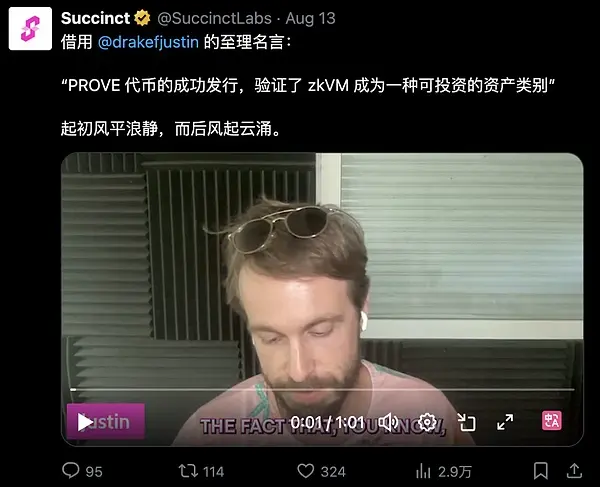
“Our goal is to eliminate all the complexities of cryptography so that developers can 'write ordinary code' using standard languages like Rust and obtain ZK proofs.”
- Easy to use: As a RISC-V zkVM, SP1 allows developers to leverage existing, battle-tested code libraries and familiar languages without needing to learn complex cryptography.
- Versatility: Choosing RISC-V as the target instruction set not only aligns with the broader trend of the entire ZK ecosystem, but more importantly, it is consistent with the long-term roadmap of Ethereum L1.
- Performance trajectory: The continuous improvements of SP1 present a “Moore's Law-like” trend. The proof time has been reduced from several minutes in 2023 to just a few seconds in 2025, and its improvement speed far exceeds the annual computation demand growth rate of 3 times proposed in the Ethereum roadmap.
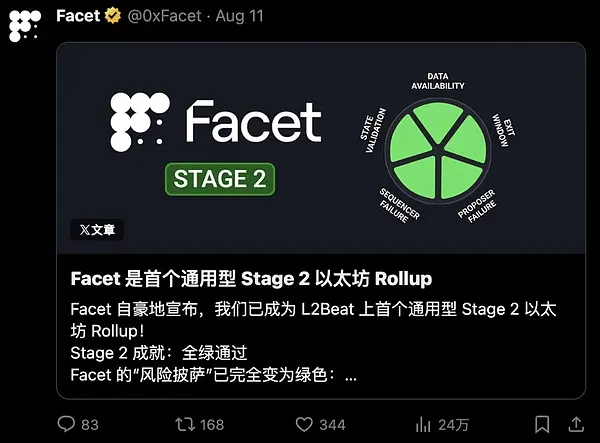
The versatility of SP1 is not limited to achieving a complete ZK-rollup. Its powerful capabilities as a general-purpose zkVM have spawned novel hybrid designs to meet specific market demands. A typical example is its application in zero-knowledge fault proofs. Projects like Facet utilize a system based on OP Succinct Lite to port their state transition functions to Rust (via Kona and REVM) and compile them into SP1 ELF binaries. This enables them to provide the low-cost 'ideal case' of Optimistic systems while retaining the 'single transaction resolution' feature of ZK proofs in the event of a challenge. This demonstrates SP1's ability to serve a broader cryptographic security model, thus expanding its potential market size.
As more mature and professional provers join, the effectiveness of this market model is being validated in real-time. An important development is that @cysic_xyz (a leading ZK hardware acceleration company) has gone live as a multi-node prover on the Succinct prover network. Cysic is not a general computing provider; they “fully自主研发整个技术栈”, including custom hardware designed specifically for ZK workloads and high-throughput GPU clusters.
3.3 The Economics of Real-Time Proofs
The level of performance is not only technically feasible but also economically attainable. Establishing a local proof cluster capable of real-time proof is estimated to have capital expenditures of
$100,000 to $300,000. This is much more cost-effective than using cloud service providers, because according to John, “NVIDIA actually throttles the performance of their graphics cards… they do it intentionally to achieve higher profits.”
This feasibility aligns with the Ethereum Foundation's “Family Proof is Inevitable” initiative, which sets a target power consumption limit of ≤10 kW. Justin Drake has already indicated his personal goal of proving the viability of this move:
“This is basically what I hope to achieve this year: to prove every Ethereum block in real-time… and to do it from home.”
Four, everything can be ZKified
4.1 New Design Space for Applications
Although expanding Ethereum is currently a market worth tens of billions of dollars, the real long-term opportunity lies in the “ZKification of everything.”
As pointed out by John from the Succinct team, a universal zkVM means “the improvements we made for real-time proof of Ethereum will also be applicable to other computations.”
4.2 Succinct Application Case Study
Succinct's SP1 has already provided support for various different applications:
- Verifiable Exchange (Hibachi) – A privacy-focused perpetual contract exchange built using ZK, where the integrity of the off-chain order book can be cryptographically verified.
- Cross-chain interoperability (Celestia) – Implements “lazy bridging” using Succinct technology, which utilizes ZK proofs to securely and efficiently validate the state of other chains.
We have been researching a concept called “lazy bridging”… If there is no execution environment on-chain, it becomes very difficult for your chain to verify the state of other chains. Therefore, we have been working hard to achieve this through ZK proofs.
- DeFi L2s (@katana) – Focused on DeFi, L2 Katana launches on Polygon through Conduit, utilizing Succinct's ZK proof technology for fast and secure settlement, and connects to Polygon's Agglayer.
- Core DeFi Infrastructure (Lido): Lido, as a leader in the liquid staking space, is utilizing SP1 on its testnet to support a “trustless accounting oracle.” This system enhances security by verifiably tracking the balance of staked ETH without relying on trusted administrators.
- Advanced Cross-Chain Bridge (Across): The Across protocol collaborates with Succinct to generate ZK proofs on the Ethereum consensus layer. This enables them to securely and efficiently bridge Ethereum's state to many other chains, which is a key feature for achieving interoperability.
- Unstoppable Rollups (Facet): Facet is the first general-purpose second-layer rollup, providing a strong case study for the adoption of Succinct technology. To achieve its goal of being an “unstoppable Rollup” without an admin key, Facet removes the official bridge and its associated security risks. It does not use bridged gas tokens but instead utilizes a native token (FCT), whose mining amount is proportional to the L1 ETH burned by users when they publish transactions. This architecture is secured by a hybrid ZK-fraud proof system built on Succinct technology. When a state root proposal is challenged, a ZK proof is generated using SP1 zkVM to explicitly resolve the dispute. This allows Facet to remain a “lightweight platform” that provides pure, unstoppable computation while leaving asset management and bridging functions to a competitive ecosystem composed of applications chosen by users.
4.3 Expanding Frontier: Revenue from ZK Cross-Chain Bridges, Co-Processors, and Verifiable Applications
The bottom-up market model also includes a rapidly growing “other demand” category, covering ZK cross-chain bridges, ZK co-processors, and other verifiable applications.
According to conservative estimates, by 2030, the annual revenue in this field will grow to over $126 million.
With the maturity of ZKML and on-chain privacy solutions, this field is likely to expand further.
Five: Succinct and $PROVE
5.1 Prover Network: A Universal, Permissionless Market
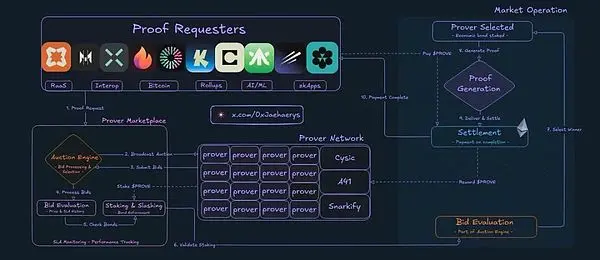
The core strategy of Succinct is not just to build a better prover, but to create an authoritative market for proving. This global supply is not a hypothesis, but composed of experienced operators. The network has attracted numerous provers, often referred to as “former miners,” who are mostly located in Asia and have ready-made infrastructure, low-cost electricity, and available consumer-grade GPUs.
Its bilateral market connects the global computing power supply with the growing demand for ZK proofs through a real-time auction system.
We are building a bilateral market: the Succinct Prover Network. It aims to commoditize the generation process of ZK proofs.
This competitive landscape is the engine of market efficiency, exerting continuous downward pressure on prices and delays, directly benefiting consumers.
5.2 $PROVE Token: The Economic Engine of the Network
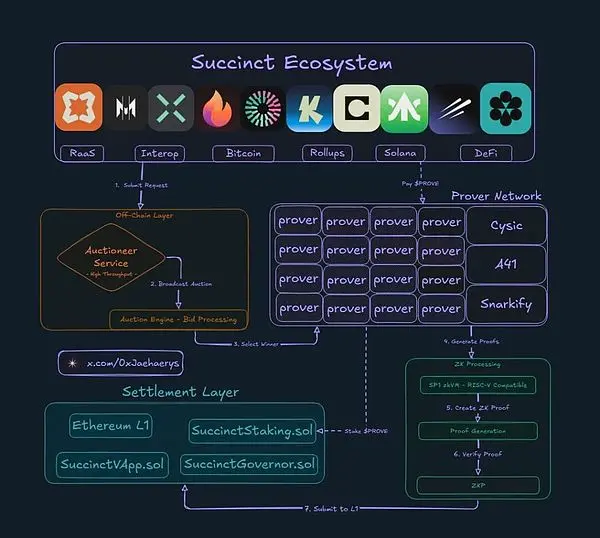
The entire economic model of the Succinct ecosystem is embodied in its native token $PROVE.
The token has two main symbiotic functions:
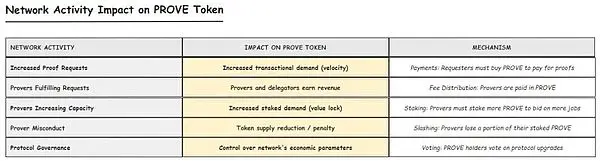
- Payment – $PROVE is the sole currency in the network marketplace. All fees for generating proofs must be paid in $PROVE , thereby establishing a direct trading demand for this token.
- Staking for Security – To participate in proof auctions and earn rewards, validators need to stake $PROVE as an economic guarantee. This is crucial for the reliability of the network as it aims to prevent “griefing” – where validators commit to generating proofs but ultimately fail to deliver, causing significant delays to applications like L2. As Roy said, “validators should not be able to perform malicious attacks… that would be a very bad user experience.” If validators fail to fulfill their commitments, part of their stake will be forfeited to ensure they “are held accountable.”
5.3 Value Accumulation Flywheel
Table 6: Utility and Value Accumulation Model of $PROVE Token
5.4 First Day Data: Putting Theory into Practice
The effectiveness of this economic model was proven on the first day the network went live.
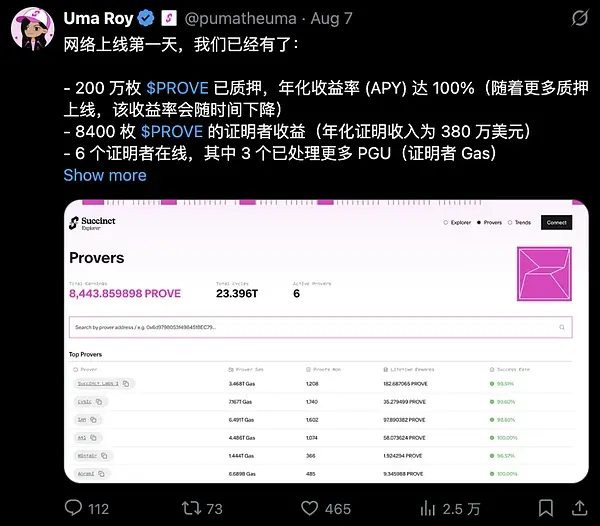
Co-founder Uma Roy reported in a public post:
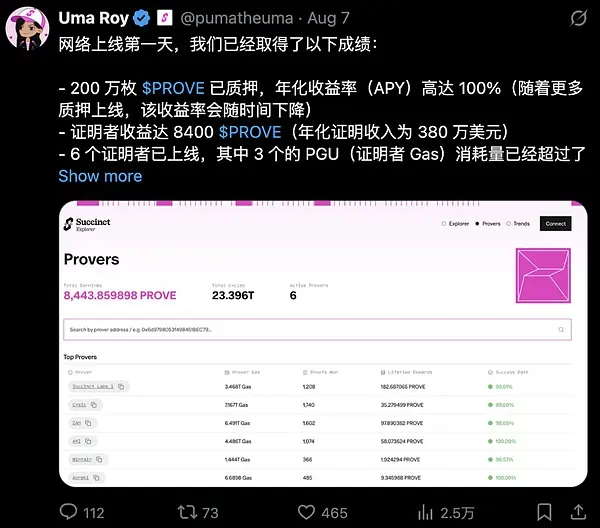
Roy pointed out that as more than 35 existing clients in the Succinct private cluster are preparing to transition to the public network, the demand for proof will inevitably “grow parabolically.”
Conclusion
The grand expansion roadmap of Ethereum combined with the maturity of zero-knowledge technology is creating one of the most important emerging infrastructure markets of the next decade. The strategic focus of the Ethereum Foundation has shifted, along with its financial investment, turning a theoretical ideal into an engineering competition. The technological breakthroughs led by teams such as Succinct are making the goal of this competition—real-time proofs and large-scale expansion of L1—a realizable reality.
The era of repetitive execution is coming to an end. The era of cryptographic verification is beginning.
In this new paradigm, decentralized infrastructure providers like Succinct Prover Network will become indispensable “pick and shovel” suppliers in this emerging economy.
The economic model of the $PROVE token integrates payment and staking functions, creating a powerful flywheel that directly links network growth with the accumulation of token value. Therefore, investing
$PROVE is not just a bet on a single application, but a direct investment in the foundational, verifiable computing layer of the next generation of the internet.
Prove the software of the whole world.


