
Futures
Access hundreds of perpetual contracts
TradFi
Gold
One platform for global traditional assets
Options
Hot
Trade European-style vanilla options
Unified Account
Maximize your capital efficiency
Demo Trading
Introduction to Futures Trading
Learn the basics of futures trading
Futures Events
Join events to earn rewards
Demo Trading
Use virtual funds to practice risk-free trading
Launch
CandyDrop
Collect candies to earn airdrops
Launchpool
Quick staking, earn potential new tokens
HODLer Airdrop
Hold GT and get massive airdrops for free
Pre-IPOs
Unlock full access to global stock IPOs
Alpha Points
Trade on-chain assets and earn airdrops
Futures Points
Earn futures points and claim airdrop rewards


Promotions
AI
Gate AI
Your all-in-one conversational AI partner
Gate AI Bot
Use Gate AI directly in your social App
GateClaw
Gate Blue Lobster, ready to go
Gate for AI Agent
Gate MCP
Gate Skills Hub
10K+ Skills
From office tasks to trading, the all-in-one skill hub makes AI even more useful.
GateRouter
Smartly choose from 30+ AI models, with 0% extra fees


South Korea Arrests Man for a Fake AI Wolf Photo That Raised Alarms
In brief
South Korean police arrested a man Thursday for posting an AI-generated photo of an escaped wolf—an image convincing enough to fool city officials and trigger an emergency alert to thousands of residents. According to police, the stunt delayed the capture of an actual wolf, which had escaped from a zoo two weeks prior, by up to nine days. Daejeon Metropolitan Police charged the unnamed 40-year-old with obstructing official duties by deception, specifically for “distributing fabricated wolf sighting images created using generative AI.” When questioned, he told investigators he did it “just for fun.” The wolf at the center of this weird saga is Neukgu—a two-year-old male wolf that dug its way out of an enclosure at Daejeon’s O-World zoo on April 8. Neukgu also happens to be part of a program to restore the Korean wolf, a species now considered extinct in the wild on the Korean Peninsula.
Hours after Neukgu went missing, the fake image appeared online. It appeared to show a light-brown wolf trotting through a road intersection near the zoo. The photo was convincing enough that Daejeon city government issued an emergency text to residents warning the wolf had moved toward the intersection—and displayed it at an official press briefing. “A single AI-manipulated image delayed the capture of the wolf by as many as nine days,” Daejeon police said. “The prolonged deployment of police and fire personnel caused significant disruption to their primary duty of protecting the public.”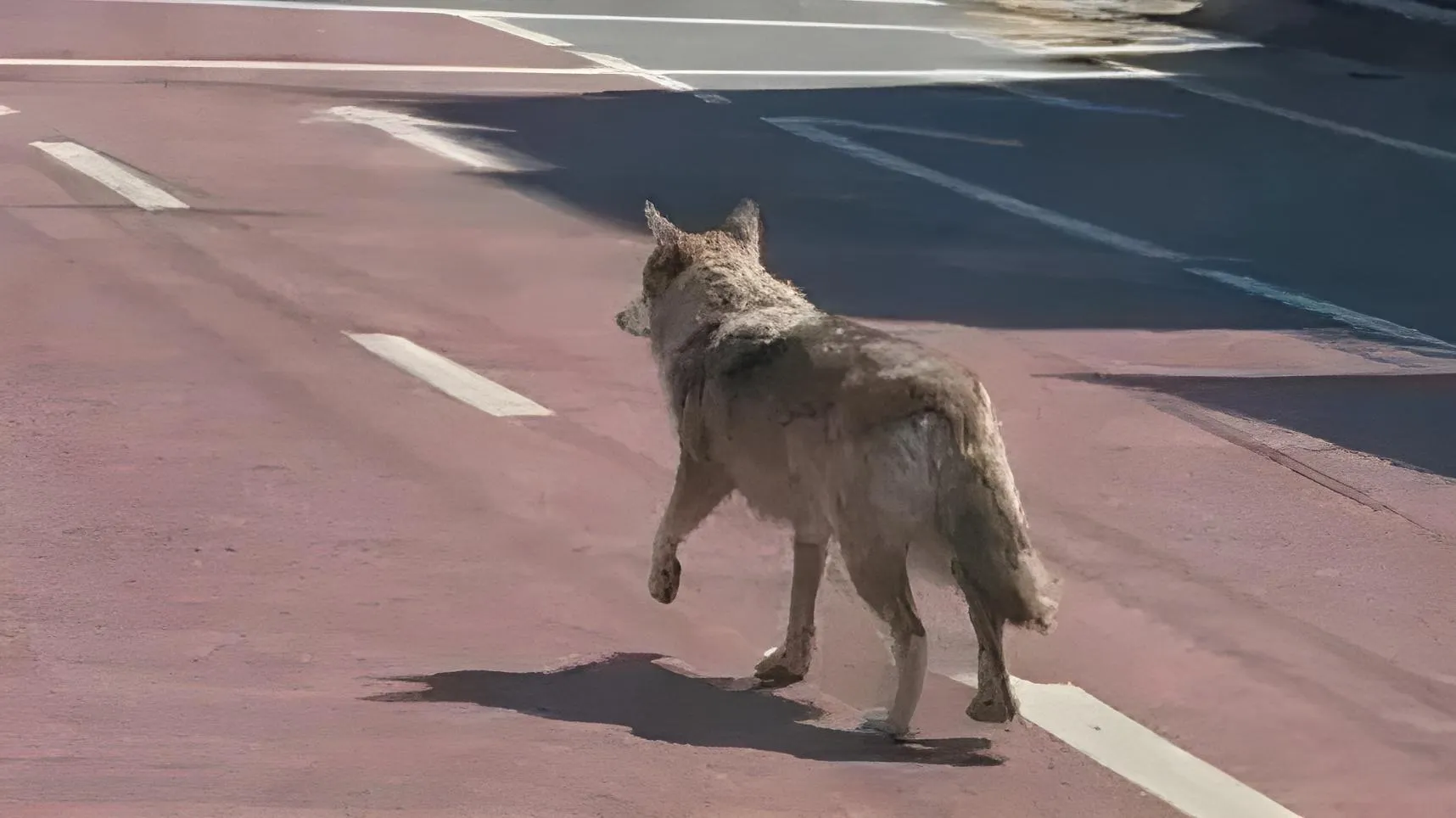
The AI-generated image of the wolf in South Korea that raised alarms. Image: Upscaled by Decrypt using AI
The hunt for Neukgu was not a minor operation. The city mobilized hundreds of firefighters, police officers, and soldiers, deploying drones and thermal cameras to track the 30-kilogram runaway. A nearby elementary school shut down over safety concerns. President Lee Jae Myung offered a public prayer for the wolf’s safe return. Neukgu kept slipping away despite multiple confirmed sightings.
He was finally recaptured on April 17, after authorities received a tip about a sighting in a park near an expressway. Since then, Neukgu has become a local celebrity with its own meme coin—because, of course. Police traced the arrested man through surveillance camera analysis and AI detection software. The case adds a concrete criminal dimension to a pattern increasingly documented across emergency situations: AI-generated images spreading fast enough to redirect official response before anyone can verify them. Similar fabricated visuals hit during the 2025 LA wildfires and Hurricane Helene—but neither produced a criminal arrest linked directly to the images. If convicted, the man faces up to five years in prison or a fine of 10 million Korean won—about $6,700.