
Futures
Access hundreds of perpetual contracts
TradFi
Gold
One platform for global traditional assets
Options
Hot
Trade European-style vanilla options
Unified Account
Maximize your capital efficiency
Demo Trading
Introduction to Futures Trading
Learn the basics of futures trading
Futures Events
Join events to earn rewards
Demo Trading
Use virtual funds to practice risk-free trading
Launch
CandyDrop
Collect candies to earn airdrops
Launchpool
Quick staking, earn potential new tokens
HODLer Airdrop
Hold GT and get massive airdrops for free
Pre-IPOs
Unlock full access to global stock IPOs
Alpha Points
Trade on-chain assets and earn airdrops
Futures Points
Earn futures points and claim airdrop rewards


Bitcoin Whale Accumulation Hits Strongest Pace Since 2013 as Exchange Reserves Keep Falling
Bitcoin largest holders appear to be buying again in size, and the pace is starting to stand out even by long-cycle standards. According to CryptoQuant data cited by Bitfinex, whales have accumulated 270,000 BTC over the past 30 days, marking what the firms described as the strongest accumulation wave since 2013. At the same time, the amount of Bitcoin held on exchanges has dropped to its lowest level since December 2017, adding another sign that available supply is continuing to thin. Whale buying is picking up while exchange supply shrinks Those two trends together matter more than either one on its own. Whale accumulation can sometimes reflect quiet positioning by larger market participants, but when it happens alongside falling exchange balances, the message usually looks more directional. Coins are not just being bought. They are also being moved away from trading venues, which tends to reduce immediately liquid supply. That does not guarantee a straight line higher in price, of course. Bitcoin has a habit of making even strong-looking supply signals wait longer than traders expect. Still, the setup is notable.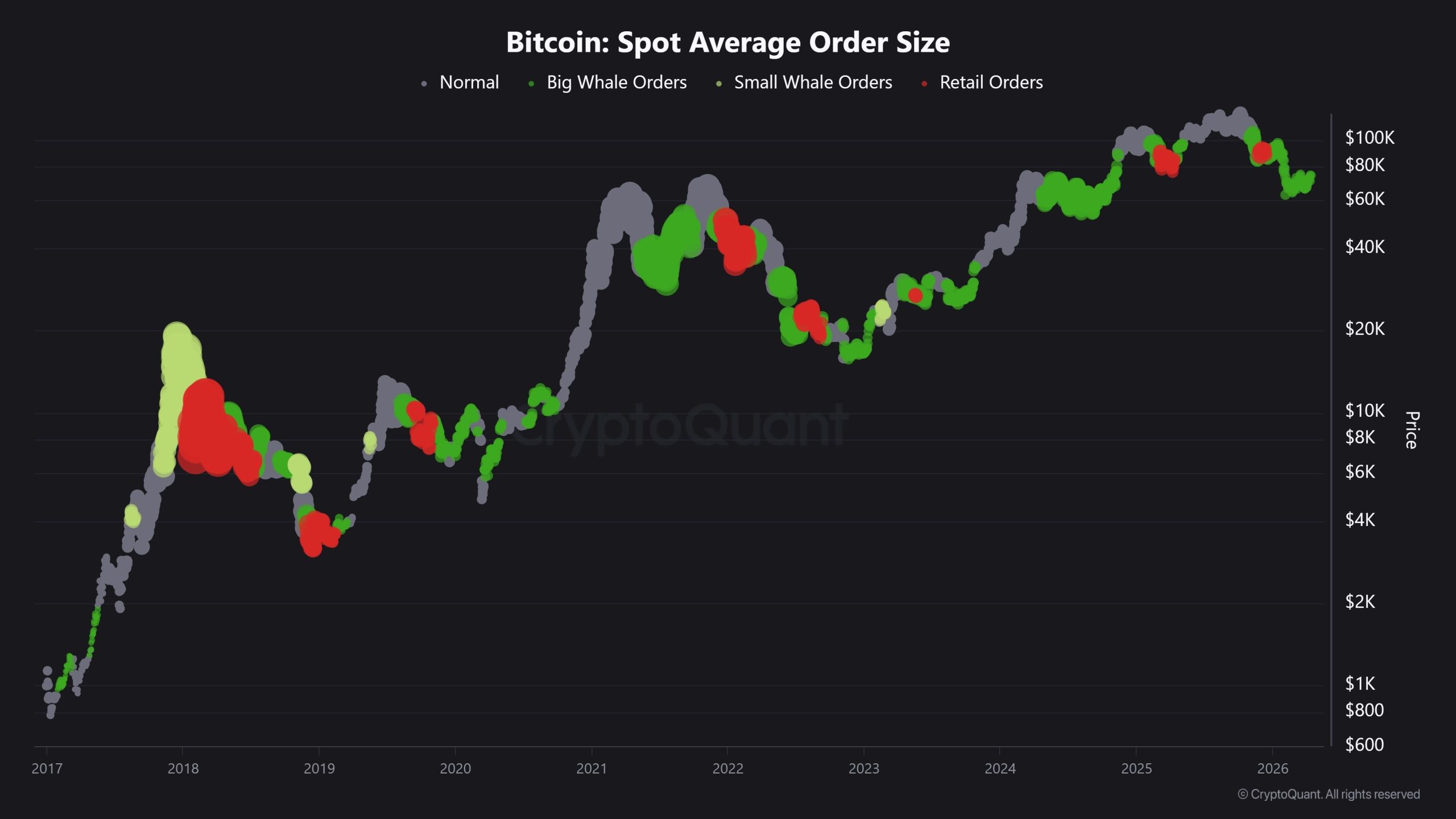 The CryptoQuant chart shared by Bitfinex adds another layer to that view. It shows larger order sizes clustering in periods that historically aligned with stronger long-term accumulation, while smaller retail activity often appeared more reactive during tops and pullbacks.
Market structure is starting to look tighter
If exchange reserves continue falling, the market may become more sensitive to fresh demand shocks. That is usually where supply-side narratives start to matter more. When fewer coins sit on exchanges and larger holders keep absorbing available Bitcoin, it becomes harder for the market to find easy liquidity without higher prices pulling sellers back in.
For now, the picture is fairly clear. Bigger holders are accumulating aggressively, exchange balances are thinning, and the broader structure looks tighter than it has in years. That does not remove volatility, but it does suggest the underlying supply backdrop is becoming harder to ignore.
The CryptoQuant chart shared by Bitfinex adds another layer to that view. It shows larger order sizes clustering in periods that historically aligned with stronger long-term accumulation, while smaller retail activity often appeared more reactive during tops and pullbacks.
Market structure is starting to look tighter
If exchange reserves continue falling, the market may become more sensitive to fresh demand shocks. That is usually where supply-side narratives start to matter more. When fewer coins sit on exchanges and larger holders keep absorbing available Bitcoin, it becomes harder for the market to find easy liquidity without higher prices pulling sellers back in.
For now, the picture is fairly clear. Bigger holders are accumulating aggressively, exchange balances are thinning, and the broader structure looks tighter than it has in years. That does not remove volatility, but it does suggest the underlying supply backdrop is becoming harder to ignore.