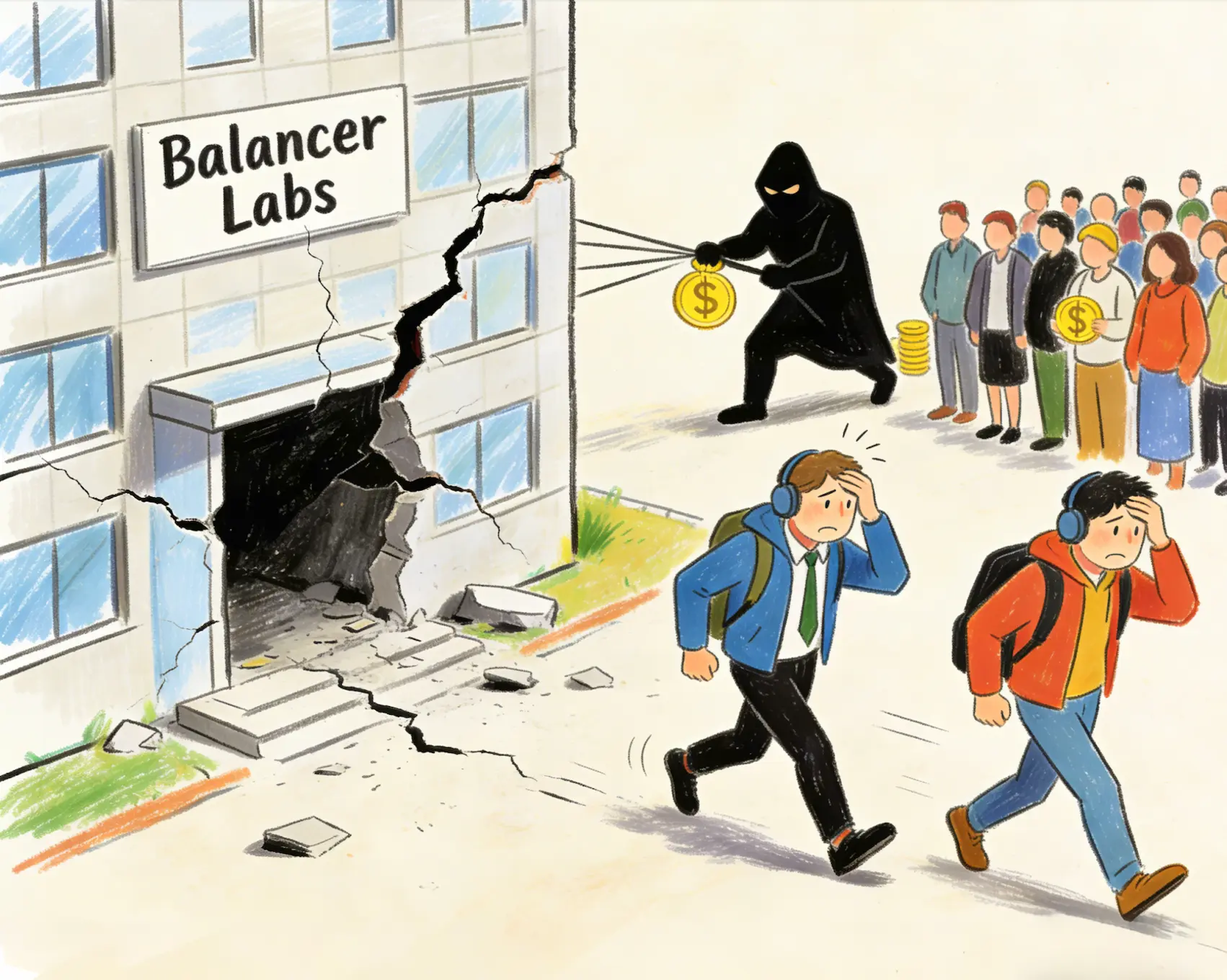
 Balancer Labs, the development entity behind the decentralized finance (DeFi) protocol Balancer, announced on March 23, 2026, that it is winding down operations following months of financial strain, legal exposure from a $116 million exploit in November 2025, and an unsustainable cost structure.
Co-founder Fernando Martinelli stated that the company had become a “liability rather than an asset to the protocol,” operating without revenue while spending heavily to attract liquidity at the cost of diluting BAL token holders. The protocol itself will continue under the management of the Balancer Foundation and Balancer’s decentralized autonomous organization (DAO), with a proposed restructuring aimed at eliminating token emissions, cutting operational costs, and making the protocol economically sustainable.
Balancer’s total value locked (TVL) peaked at $3.3 billion in November 2021 but has since declined to $158 million following the exploit and broader market pressures.
Reasons for Shutdown
Financial Pressure and Legal Exposure
Martinelli cited the November 3, 2025, exploit of Balancer v2 as a key factor, noting that it “created real and ongoing legal exposure” that made maintaining a corporate entity unsustainable. Balancer Labs had been operating without revenue while spending heavily on liquidity incentives, a strategy that came at the cost of diluting BAL token holders, according to CEO Marcus Hardt.
Revenue vs. Cost Imbalance
Despite the shutdown, Martinelli noted that Balancer is “still generating real revenue” at over $1 million across the past three months. He framed the issue as a functional protocol “buried under a broken tokenomics model and an overweight cost structure,” arguing that the economics—not the technology—are fixable.
Restructuring Plan
DAO-Led Governance
Under the proposed transition, Balancer’s future will be managed by the Balancer Foundation and the protocol’s DAO, moving away from a centralized corporate structure. Martinelli advocated for a “lean continuation path” that involves:
-
Cutting BAL token emissions to zero
-
Restructuring fees to enable the DAO to capture more revenue
-
Reducing the team as much as possible
-
Targeting lower operating costs
Tokenomics Reform
Proposed changes to BAL tokenomics include:
-
Ending emissions to eliminate inflationary pressure
-
Restructuring fee distribution so 100% of protocol fees flow to the DAO treasury
-
Offering a BAL buyback to allow holders to exit at a set price
-
Winding down the veBAL governance model, which Martinelli said became dominated by external incentives and “bribe” dynamics
Product Focus
Operationally, the protocol will narrow its focus to key products including:
-
reCLAMM (recently launched concentrated liquidity automated market maker)
-
Liquidity bootstrapping pools (LBPs)
-
Stable and liquid staking token pools
-
Weighted pools
Protocol Impact and Recovery Context
TVL Decline
Balancer’s TVL fell from $3.3 billion in November 2021 to $800 million by October 2025. The November exploit triggered an additional $500 million drop over two weeks, with TVL now at $158 million—illustrating the difficulty DeFi protocols face in recovering from large-scale hacks.
Founder’s Future Role
Martinelli stated he will step away from any formal role once Balancer Labs is dissolved but plans to remain involved informally as an adviser and supporter. He framed the shutdown as a reset rather than an ending, arguing that DeFi projects can recover if they “cut excess, fix incentives, and execute with discipline.”
Frequently Asked Questions
Why is Balancer Labs shutting down?
Balancer Labs is winding down due to a combination of factors: legal exposure from the November 2025 exploit, an unsustainable cost structure, and a lack of revenue to support operations. The company had been spending heavily on liquidity incentives while operating without revenue, diluting BAL token holders.
Is the Balancer protocol shutting down too?
No. The protocol will continue operating under the management of the Balancer Foundation and Balancer’s DAO. The restructuring aims to eliminate BAL emissions, restructure fees, and reduce operational costs to create a sustainable economic model.
What changes are planned for BAL tokenomics?
Proposed changes include ending BAL emissions, restructuring fee distribution so 100% of protocol fees go to the DAO treasury, offering a buyback to allow holders to exit at a set price, and winding down the veBAL governance model. These changes aim to align costs with revenue and reduce sell pressure.
Disclaimer: The information on this page may come from third parties and does not represent the views or opinions of Gate. The content displayed on this page is for reference only and does not constitute any financial, investment, or legal advice. Gate does not guarantee the accuracy or completeness of the information and shall not be liable for any losses arising from the use of this information. Virtual asset investments carry high risks and are subject to significant price volatility. You may lose all of your invested principal. Please fully understand the relevant risks and make prudent decisions based on your own financial situation and risk tolerance. For details, please refer to
Disclaimer.


