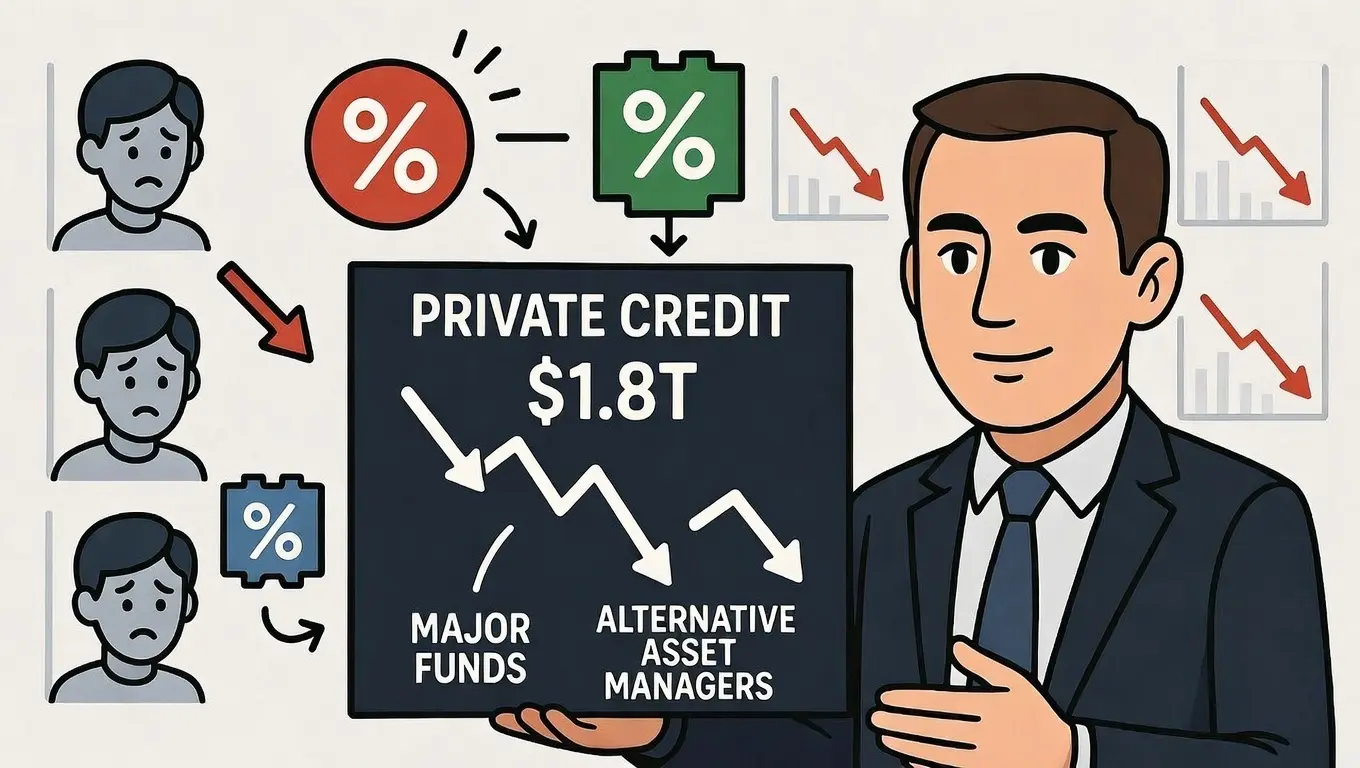
 Stani Kulechov, founder and CEO of Aave, has published an analysis warning of growing distress in the $1.8 trillion private credit market as persistently high interest rates strain borrowers, with major funds facing redemption pressures and share prices of leading alternative asset managers declining 20 to 50 percent.
Kulechov’s March 6, 2026 assessment outlines scenarios ranging from isolated fund defaults to systemic contagion, while cautioning that DeFi protocols must implement robust transparency standards to avoid becoming “exit liquidity” for institutional investors seeking to offload illiquid assets.
High Interest Rate Environment and Private Credit Fundamentals
Cost of Capital Burden
The U.S. Federal Reserve began an aggressive tightening cycle in March 2022, raising rates from near zero to over 5 percent by mid-2023—the fastest hiking cycle in four decades. Rates have remained elevated through early 2026 with only modest cuts, creating sustained pressure on borrowers who initiated loans during the low- or mid-rate era.
For businesses with outstanding obligations, this translates into significantly higher cost of capital that compounds over time. While borrowing and lending are normal phases of corporate finance, the problem arises when elevated costs become unmanageable for borrowers over extended periods.
Private Credit Structure
Private credit funds typically operate as closed-end or semi-liquid vehicles managed by asset managers, deploying capital into lending opportunities to generate returns for investors ranging from pension funds and insurance companies to family offices and retail participants.
Closed-end funds prohibit redemptions until maturity, typically 7 to 10 years. Semi-liquid funds offer quarterly redemption windows with limits, while Business Development Companies provide daily liquidity through exchange trading. These structures function as private banks, lending capital to businesses and collecting interest.
Private credit primarily finances leveraged buyouts for private equity, middle-market corporate loans, asset-backed lending across aircraft, shipping, and consumer loans, and real estate credit. The market has grown to fill gaps left by banks retreating from riskier corporate lending, driven largely by post-2008 Basel III regulations. Today, private credit finances an estimated 80 to 90 percent of leveraged buyouts in the U.S. middle market.
Market Distress Signals
Redemption Pressures and Manager Responses
Recent months have revealed significant stress across private credit. Blackstone’s flagship private credit fund, BCRED, managing approximately $82 billion, received $3.7 billion in redemption requests during Q1 2026—roughly 8 percent of net asset value. Blackstone injected $400 million of its own capital to support liquidity, with the fund coming close to gating redemptions.
BlackRock’s HPS Corporate Lending Fund, a $26 billion vehicle, received $1.2 billion in redemption requests, necessitating gating with approximately $580 million in requests unable to be honored.
Blue Owl’s retail private credit vehicle experienced $2.9 billion in redemptions during Q4 2025, with requests reaching 15 percent of NAV, largely driven by exposure to software lending. Some funds’ monitored loan default metrics have risen to as high as 9 percent.
Market Repricing
The market has begun repricing private credit exposure. The VanEck BDC Income ETF has declined approximately 15 percent over the past year. Blue Owl Capital shares have fallen roughly 50 percent over the past year, with approximately 30 percent of that decline occurring during 2026. Apollo, Blackstone, Ares, and KKR have each seen shares decline approximately 20 percent on private credit concerns.
The average Business Development Company now trades at roughly a 20 percent discount to NAV while offering 10 to 11 percent yields—a historically unusual position as these funds traditionally traded at premiums. This discount signals market concerns that loan portfolios may be overvalued, defaults could rise, or liquidity risk is building.
Major Private Credit Managers by AUM
Apollo: Approximately $460 billion
Blackstone: Approximately $330 billion
Ares: Approximately $280 billion
KKR: Approximately $220 billion
Carlyle: Approximately $190 billion
Blue Owl: Approximately $170 billion
Scenario Analysis and Systemic Risk Assessment
Scale and Contagion Potential
Total redemptions across affected funds have reached approximately $7 billion or more, representing 5 to 10 percent of NAV for impacted vehicles. While public alternative managers are down 20 to 30 percent, the overall private credit market remains $1.8 to $2 trillion in size. Largest funds top out at $20 to $80 billion, compared to the global bond market at $130 trillion or banking assets at $180 trillion.
Kulechov outlined three scenarios of increasing severity:
Scenario A: One large fund defaults (~$50 billion)
Investors lose capital, some companies lose financing, and credit spreads widen. The system likely absorbs the shock.
Scenario B: Several funds fail simultaneously
Credit markets freeze, leveraged companies cannot refinance, and defaults cascade. This could trigger a credit-cycle downturn.
Scenario C: Private credit + leveraged loans collapse
A broader corporate credit crisis unfolds: private equity deals fail and banks become exposed. This would be genuinely systemic.
Contagion Path to Public Markets
While private credit funds remain relatively small in the broader financial picture and are unlikely on their own to pose systemic risk, the most concerning scenario involves loss of confidence beginning in private credit markets—particularly around lending to businesses vulnerable to AI disruption—and then bleeding into public bond markets. This contagion path is plausible because larger corporates in bond markets are arguably more exposed to automation and AI disruption than the leaner, high-growth businesses that private credit typically funds.
Implications for RWAs and DeFi
Current Exposure and Risks
Many private credit funds have been distributed to retail investors via publicly traded BDCs, private credit ETFs, or semi-liquid funds. These vehicles share common characteristics: quarterly or monthly redemption windows, caps typically limited to 5 percent of NAV per quarter, and target returns of 8 to 11 percent. Recent gating events have demonstrated that redemption policies can be tightened at manager discretion when conditions deteriorate.
Kulechov identified a structural risk in how private credit is packaged for DeFi: many retail-oriented users may not fully understand underlying exposures before committing capital. Examples abound of DeFi users supplying funds into high-yielding RWA strategies only to discover later that the underlying exposure carries significant duration risk.
Opportunity and Safeguards
While real-world assets represent the biggest near-term opportunity for DeFi, Kulechov expressed concern that institutional opportunists could view DeFi as a channel to offload illiquid and distressed products that Wall Street has already soured on, effectively using DeFi participants as exit liquidity. This risk is amplified by the fact that assessing RWA allocation opportunities is inherently harder than native DeFi opportunities, lacking the same transparency or onchain verifiability.
However, private credit done well onchain offers something traditional finance fundamentally cannot: smart contract-enforced guarantees. Redemption windows, withdrawal limits, collateral ratios, and distribution rules can be encoded immutably, meaning fund managers cannot arbitrarily change terms after capital commitment. In traditional private credit, investors discovered with BCRED and HLEND that redemption policies can be tightened at manager discretion. Onchain, those rules are transparent from day one and enforced by code.
Requirements for Successful RWA Integration
For RWAs to succeed in DeFi and for DeFi to scale meaningfully through real-world assets, the industry needs deliberate structuring of opportunities that bridge traditional finance and onchain markets. This requires:
-
Robust transparency standards
-
Proper risk disclosure
-
Independent verification of underlying collateral
-
Governance frameworks protecting onchain participants from asymmetric information disadvantages
Without these safeguards, the convergence of traditional finance and DeFi risks becoming extractive rather than additive. Kulechov emphasized that DeFi should not become Wall Street’s exit liquidity.
FAQ: Private Credit Distress and DeFi Implications
Q: What is causing current distress in private credit markets?
A: Persistent high interest rates—maintained since the Federal Reserve’s tightening cycle began in 2022—have created unmanageable debt service costs for borrowers. This has led to redemption pressures on funds, declining share prices for alternative asset managers, and discounts to NAV for BDCs, with some funds gating redemptions.
Q: Could private credit distress trigger a broader financial crisis?
A: While a single large fund default would likely be absorbed, simultaneous failures of several funds could freeze credit markets and trigger a downturn. The most systemic risk involves contagion spreading to public bond markets, particularly given AI disruption exposure of larger corporates.
Q: How does this affect DeFi investors considering RWA opportunities?
A: DeFi users supplying capital to high-yielding RWA strategies face structural risks, including potential use as “exit liquidity” for institutions seeking to offload distressed assets. However, onchain private credit can offer superior protections through smart contract-enforced guarantees of redemption terms.
Q: What safeguards does DeFi need for responsible RWA integration?
A: The industry requires robust transparency standards, proper risk disclosure, independent collateral verification, and governance frameworks protecting onchain participants from asymmetric information disadvantages to ensure convergence with traditional finance remains additive rather than extractive.


