Cardano has had a difficult time keeping up with the rest of the crypto market. During the most recent bull cycle, several major assets such as Ethereum, XRP, and Solana managed to break or approach their previous all-time highs. Cardano did not.
ADA’s price stayed far below its 2021 peak near $3, and the lack of momentum has frustrated many investors who expected the project to perform better after years of development.
But popular crypto analyst Ali Martinez believes the real issue goes beyond price action. In a recent post on X, he shared a harsh critique of the network itself, arguing that Cardano’s biggest weakness may be the level of actual usage happening on the chain.
Low Network Activity Compared to Rivals
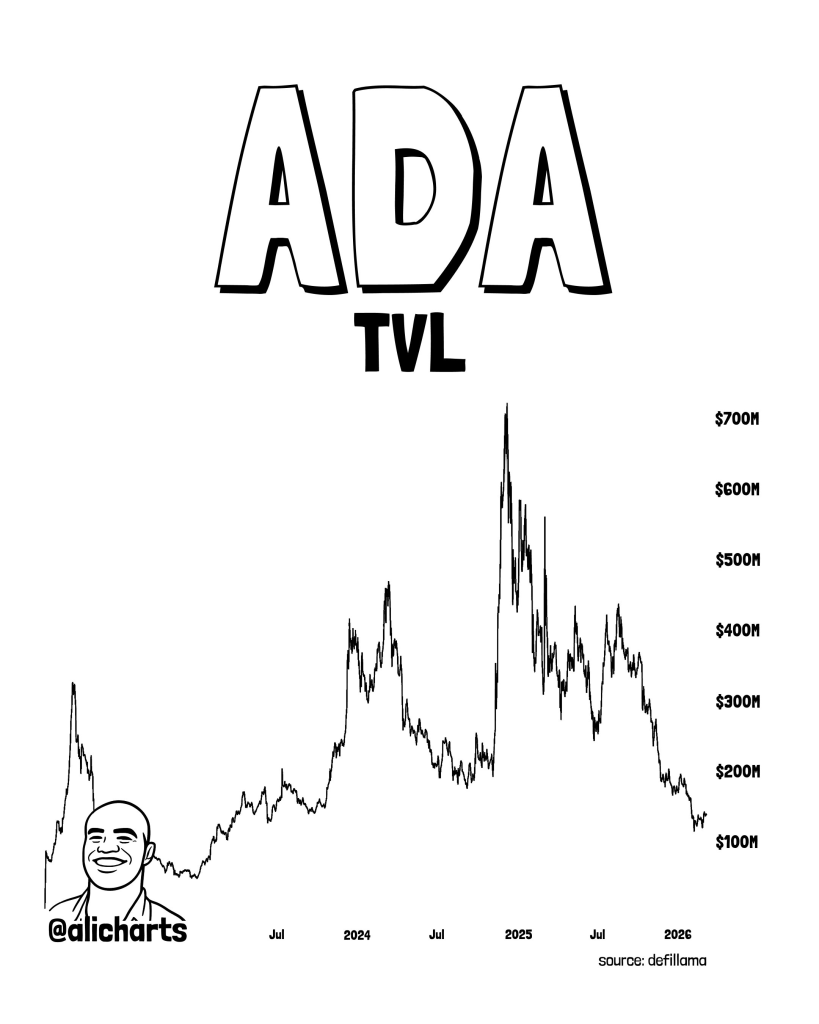
In his thread, Martinez pointed out that Cardano’s DeFi ecosystem has never exceeded $1 billion in total value locked (TVL). That figure represents the amount of capital currently being used across decentralized applications on the network.
While $1 billion may sound large on its own, it becomes far less impressive when compared to competing platforms.
Ethereum, for example, has built a massive DeFi ecosystem with tens of billions of dollars locked across lending platforms, decentralized exchanges, and derivatives protocols. Other newer networks have also managed to gain traction faster.
Source: X/@alicharts
Martinez noted that even newer blockchains such as Sui have already surpassed Cardano in terms of ecosystem activity.
This gap raises a bigger question. If a network is valued in the tens of billions of dollars, but only a small amount of capital is actively being used on the platform, the price may be supported more by speculation than real demand.
That is the core argument Martinez is making in his analysis.
Read also: Grok AI Predicts the Price of XRP, Cardano and Dogecoin if NATO Enters the War
Slow Development and Rising Competition
Another factor Martinez showed is the pace at which Cardano has introduced new features.
Cardano follows a research-driven development model that relies heavily on academic review and formal verification. Supporters often say this approach leads to stronger security and more reliable systems.
The downside, however, is speed.
Although Cardano launched in 2017, smart contracts did not arrive until 2021, giving other ecosystems several years to build larger developer communities and stronger network effects.
During that time, competitors such as Ethereum and Solana expanded rapidly. Ethereum became the dominant platform for decentralized finance, while Solana captured attention through high-speed applications and consumer-focused platforms.
Once a blockchain ecosystem reaches critical mass, it tends to attract more developers, more capital, and more users. That makes it increasingly difficult for slower networks to catch up later.
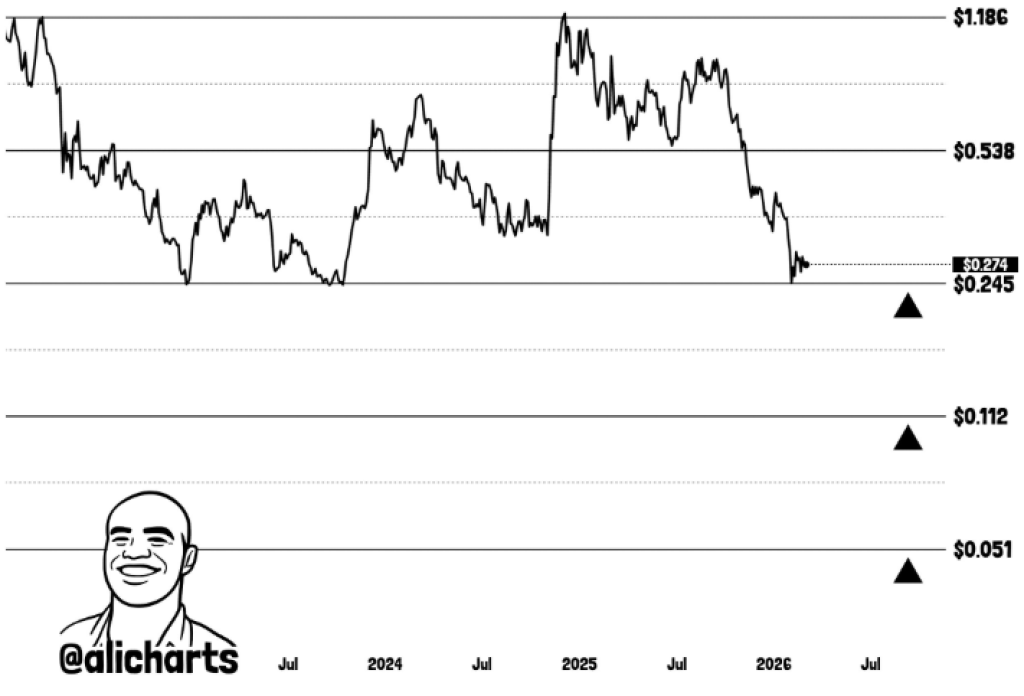
From a trading perspective, Martinez also pointed to an important technical level for ADA. He highlighted $0.245 as a key support zone. If the ADA price breaks below that level, he believes the next potential downside targets could sit around $0.112 or even $0.051, which would mean a possible 50% to 80% decline from that support.
Source: X/@alicharts
For now, that crash has not happened. But the level remains a key area many traders are watching closely as the debate around Cardano’s long-term adoption continues.
Read also: Cardano (ADA) vs. Solana (SOL): Which Altcoin Could Outperform In 2026?
Disclaimer: The information on this page may come from third parties and does not represent the views or opinions of Gate. The content displayed on this page is for reference only and does not constitute any financial, investment, or legal advice. Gate does not guarantee the accuracy or completeness of the information and shall not be liable for any losses arising from the use of this information. Virtual asset investments carry high risks and are subject to significant price volatility. You may lose all of your invested principal. Please fully understand the relevant risks and make prudent decisions based on your own financial situation and risk tolerance. For details, please refer to
Disclaimer.


