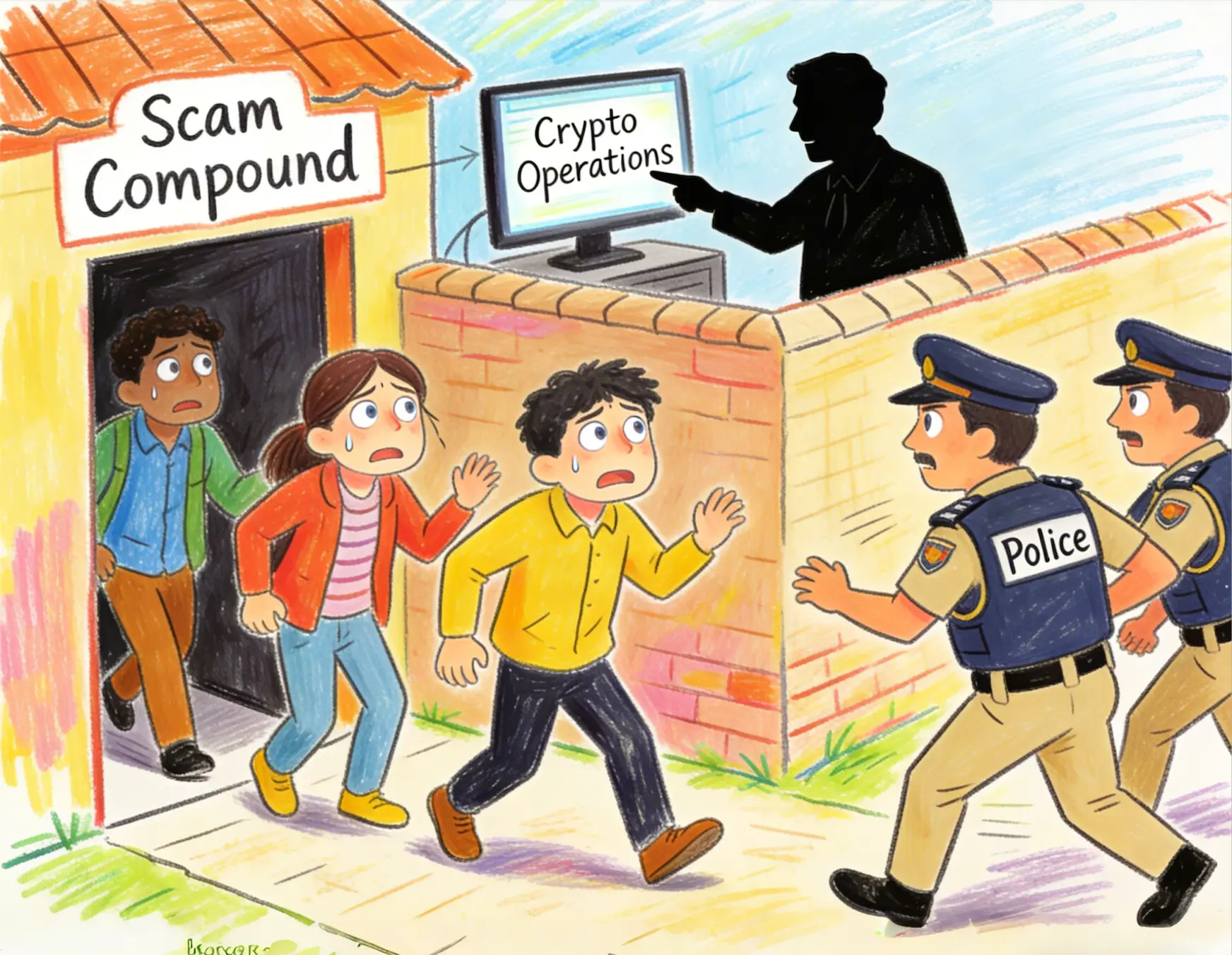
 India’s Central Bureau of Investigation (CBI) arrested Mumbai resident Sunil Nellathu Ramakrishnan on March 26, 2026, identifying him as a central kingpin in a transnational trafficking network that lured unsuspecting Indians with fake job offers before forcing them into crypto fraud compounds in Myanmar’s Myawaddy region.
Victims were transported from Delhi to Bangkok under the pretense of legitimate employment in Thailand, then clandestinely diverted to facilities such as KK Park, where they were forced to conduct digital arrest scams, romance frauds, and cryptocurrency investment schemes targeting victims globally. The arrest follows interviews with Indian nationals who escaped the compounds and were repatriated from Thailand in March and November 2025.
Arrest Details and Accusations
Suspect Profile
Ramakrishnan, also known as Krish, was arrested upon his return to India on March 26. Searches at his residence yielded digital evidence linking him to trafficking operations in Myanmar and Cambodia, according to the CBI. The agency stated that he played a crucial role in the illegal transportation and exploitation of victims in Southeast Asia, functioning as one of the main facilitators and kingpins in the trafficking network.
Modus Operandi
Victims were initially lured with lucrative job opportunities in Thailand. After being transported from Delhi to Bangkok, they were secretly diverted to Myanmar, where they were forced to work in cyber scam centers. Once trapped, victims were subjected to wrongful confinement, constant intimidation, physical and mental abuse, and severe restrictions on movement.
Victims’ Experiences and Scam Operations
Coerced Criminal Activity
Trafficked individuals were forced to execute various cyber frauds, including digital arrest scams, romance frauds, and cryptocurrency investment schemes targeting victims across the globe, including in India. The CBI’s investigation unravelled the modus operandi of rackets supplying manpower to these cyber slavery compounds through detailed interviews with victims who were repatriated from Thailand in 2025.
Broader Trafficking Networks
The CBI stated that its investigation has revealed the existence of organized transnational criminal syndicates operating across Myanmar and Cambodia. The agency said it is continuing to investigate other accused persons, including foreign nationals, and is working to uncover the full extent of operations spanning the region.
Global Context and Crackdown on Scam Compounds
International Designation
In November 2025, Interpol formally designated scam compound networks as a transnational criminal threat affecting victims from more than 60 countries, recognizing that crypto-related fraud now sits at the core of the sprawling industry.
Regional Enforcement Actions
China: In January 2026, Chinese authorities executed 11 members of the Ming family crime clan, which ran scam operations in northern Myanmar, generating more than $1.4 billion in fraudulent proceeds and linked to the deaths of at least 14 Chinese nationals
United States: In February 2026, the U.S. Attorney for D.C. announced that its Scam Center Strike Force had frozen and seized more than $580 million in crypto from networks operating across Burma, Cambodia, and Laos
U.S. Sentencing: A U.S. federal court sentenced pig butchering organizer Daren Li to 20 years in prison for his role in a $73 million crypto fraud scheme that he carried out from scam centers in Cambodia
Industry and Expert Perspectives
Crypto Forensics
Vedang Vatsa, Founder of Hashtag Web3, told Decrypt: “The larger opportunity is in strengthening crypto forensics capacity further” in cases involving scam compounds. He added that blockchain tracing tools are now a growing part of investigations globally, and Indian agencies are well-positioned to leverage these as they build on existing frameworks.
Impact on India’s Crypto Ecosystem
Krishnendu Chatterjee, CEO and co-founder of A2ZCryptoInvestment, stated: “CBI’s arrest of these scam network operators disrupts fraudulent schemes targeting gullible Indians, along with reducing crypto-related fraud risks, indirectly helping clean India’s crypto ecosystem, and encouraging legitimate adoption from Indian users.”
Frequently Asked Questions
Who was arrested and what was his role?
The CBI arrested Mumbai resident Sunil Nellathu Ramakrishnan, identifying him as a central kingpin in a transnational trafficking network that funneled unsuspecting Indians into crypto fraud compounds in Myanmar’s Myawaddy region, where victims were forced to conduct scams targeting people globally.
How were victims trafficked?
Victims were lured with fake job offers in Thailand, transported from Delhi to Bangkok, and then clandestinely diverted to Myanmar. Once inside compounds such as KK Park, they were subjected to wrongful confinement, physical abuse, and forced to execute digital arrest scams, romance frauds, and crypto investment schemes.
What broader actions are being taken against scam compounds?
Interpol has designated scam compound networks as a transnational criminal threat. Recent actions include China’s execution of 11 members of a crime clan operating in Myanmar, U.S. seizure of over $580 million in crypto from Southeast Asian networks, and the sentencing of a pig butchering organizer to 20 years in prison.
Disclaimer: The information on this page may come from third parties and does not represent the views or opinions of Gate. The content displayed on this page is for reference only and does not constitute any financial, investment, or legal advice. Gate does not guarantee the accuracy or completeness of the information and shall not be liable for any losses arising from the use of this information. Virtual asset investments carry high risks and are subject to significant price volatility. You may lose all of your invested principal. Please fully understand the relevant risks and make prudent decisions based on your own financial situation and risk tolerance. For details, please refer to
Disclaimer.


