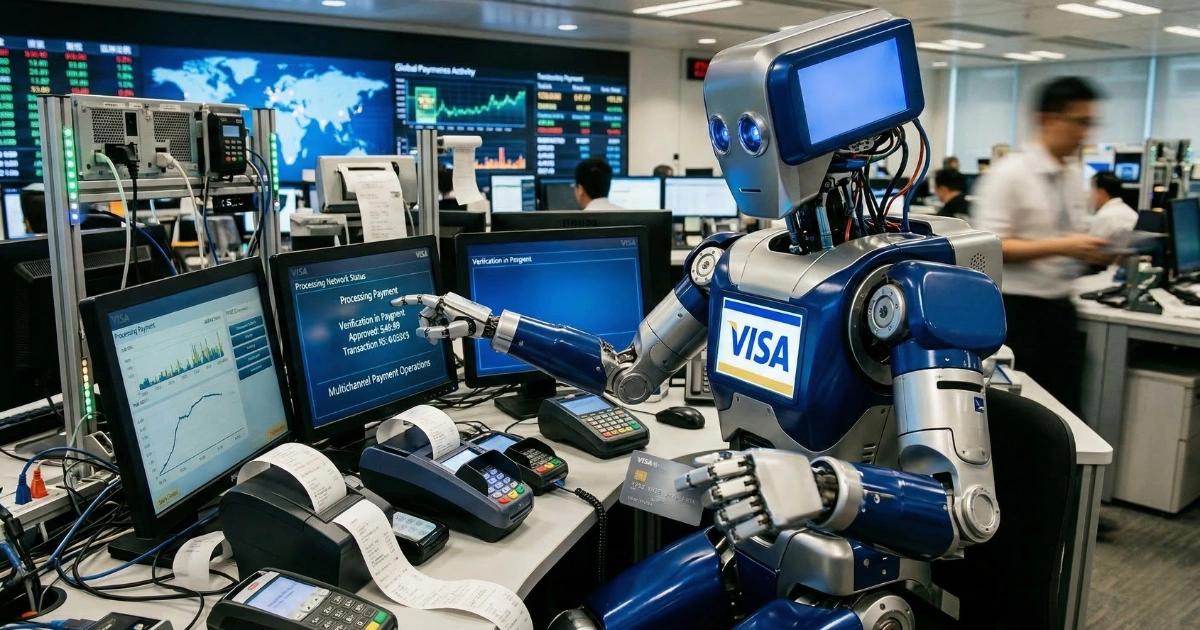
Visa Launches Visa CLI, Enabling AI Agents to Initiate Card Payments via Command Line, Combining MPP and x402 Standards to Open a New Era of Machine-to-Machine Commerce.
Visa Crypto Labs Launches Experimental Program, Pioneering “Command Line Commerce” with Scripted Transactions
Payment giant Visa has taken an important step into the intersection of cryptocurrency and artificial intelligence. Its Visa Crypto Labs has officially released an experimental product called “Visa CLI.” This tool is a command-line interface designed specifically for AI agents, allowing software agents to directly initiate payment processes within terminal environments.
Cuy Sheffield, head of Visa Crypto Labs, announced this project on the social platform X, stating that it is the lab’s first experimental product.
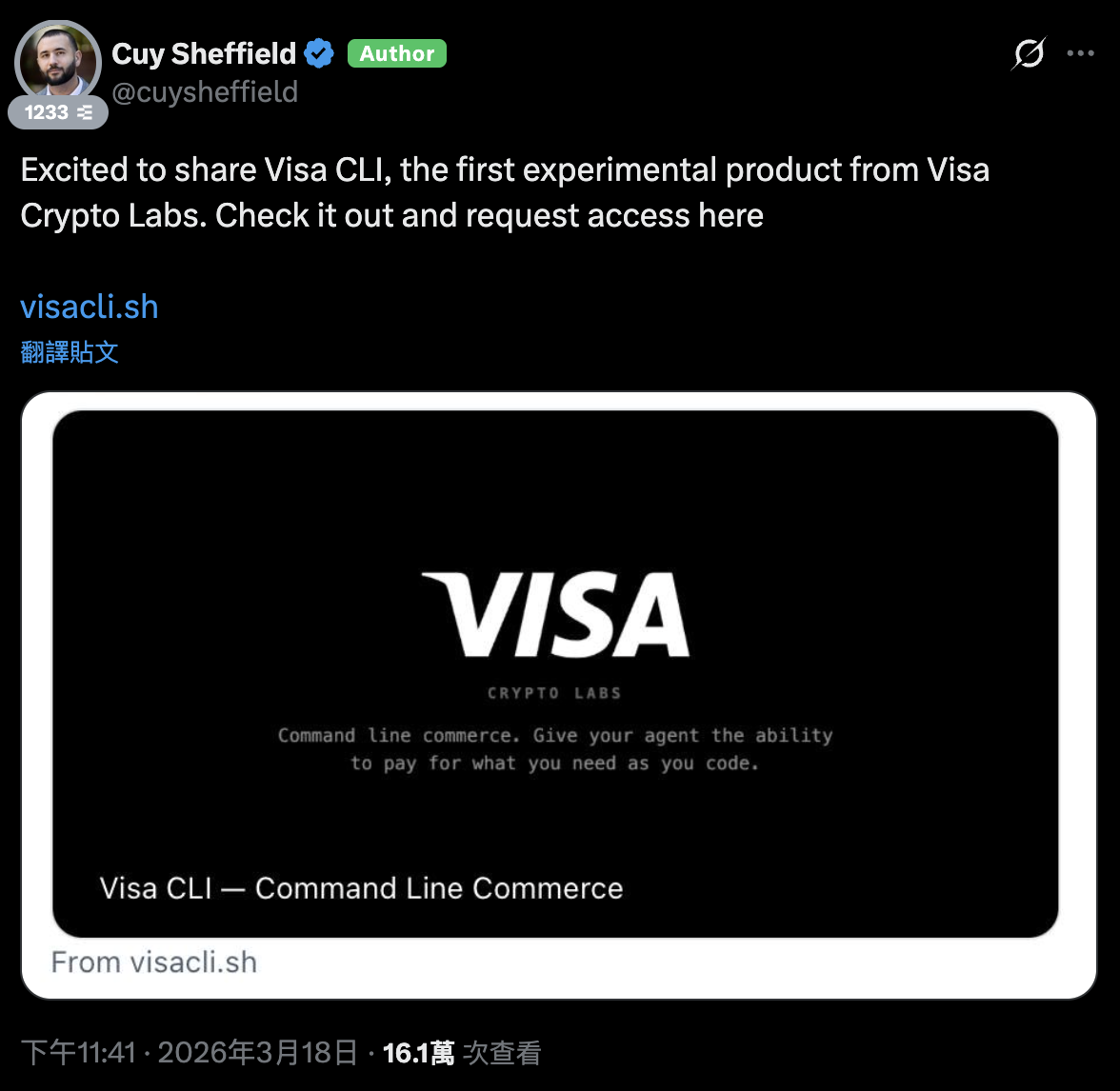
Image source: X/@cuysheffield Visa Crypto Labs Head Cuy Sheffield announces the official launch of the experimental product “Visa CLI”
The core vision of this technology is to promote “Command Line Commerce,” where transactions between machines can bypass human manual intervention. Traditional commerce models often rely on graphical user interfaces and manual authorization, but as AI agents perform increasingly complex tasks autonomously, existing payment infrastructure clearly cannot meet the demands of automated workflows.
Through Visa CLI, software agents, scripts, and automation processes can seamlessly pay for online services as if executing code. The product is currently in beta testing, and developers can apply for access via their GitHub accounts.
Breaking Free from API Key Management, Enabling True Autonomous Payments for AI Agents
For developers, one of the most attractive features of Visa CLI is its implementation of “Programmatic Card Payments,” eliminating the need to manage cumbersome API keys. In traditional automation systems, storing and managing API keys is a heavy operational burden and poses significant security risks. If keys are leaked, companies could face unpredictable losses.
This new tool operates entirely through text commands, allowing it to integrate perfectly into server environments, developer pipelines, and machine-to-machine processing workflows. According to official statements, its use cases are broad, including AI agents paying for image generation API costs on demand, accessing paid music generation endpoints to create audio, or retrieving proprietary datasets behind paywalls.
AI agents have evolved from simple question-answer bots to autonomous actors capable of executing tasks, coordinating services, consuming APIs, and purchasing computing resources. When payment capabilities are embedded in scripts, software can instantly buy cloud resources or data access rights as needed, greatly enhancing digital service efficiency.
Industry Standardization and Ecosystem Integration: Visa, Stripe, and Coinbase Collaborate to Build a New Ecosystem
Visa is not the only major player optimistic about the AI payment market. The industry is currently in a strategic phase of establishing native AI payment standards. Alongside Visa’s CLI launch, Coinbase and Cloudflare are collaborating on developing the “x402 Protocol,” primarily using stablecoins like $USDC as the payment backbone. Meanwhile, Stripe has partnered with Tempo to introduce the “Machine Payments Protocol (MPP),” aiming to standardize transaction flows driven by agents.
Visa has adopted an open and compatible approach, announcing its participation as a design partner in the development of the MPP standard and has already integrated MPP into its global network, enabling card payments to support this protocol. Visa CLI complements emerging standards like x402, together building a new ecosystem. With the launch of the Tempo mainnet, such standardized payment infrastructure will provide AI agents with more unified and secure transaction pathways.
Particularly in the micropayments industry, traditional card networks have struggled due to minimum transaction fees of around $0.30 per transaction, making sub-cent API calls or GPU compute costs difficult to support. Combining blockchain technology with stablecoins offers a key solution to fill this market gap.
From Human-Driven to Machine-Driven, Backend Payments Will Reshape the Digital Economy
As automated agents gain the ability to securely fund expenditures, the entire digital service buying and selling model will undergo a transformation.
Visa states that future commerce will evolve toward “backendization,” where transactions occur continuously in the background at a scale and speed far beyond human-driven systems. AI agents are shifting from simple Q&A to executing automated B2B workflows, including paying for cloud resources, machine-to-machine services, and microtransactions for digital assets.
If infrastructure evolves to support this high-frequency, low-value automated trading, the efficiency of the digital economy will reach unprecedented levels. Although Visa CLI is still in beta, its features and usability will continue to improve based on developer feedback. This initiative clearly points the way forward for the payments industry. As AI agents become more powerful, the payment infrastructure supporting them must also evolve to accommodate the command line commerce model.
This technological breakthrough deeply integrates traditional financial networks with modern program automation. In the future, most online transactions may be silently executed by machines within dense lines of code.
Disclaimer: The information on this page may come from third parties and does not represent the views or opinions of Gate. The content displayed on this page is for reference only and does not constitute any financial, investment, or legal advice. Gate does not guarantee the accuracy or completeness of the information and shall not be liable for any losses arising from the use of this information. Virtual asset investments carry high risks and are subject to significant price volatility. You may lose all of your invested principal. Please fully understand the relevant risks and make prudent decisions based on your own financial situation and risk tolerance. For details, please refer to
Disclaimer.


