OpenSea delays $SEA issuance, cancels the originally scheduled TGE on March 30, and offers 60 days of 0% transaction fees to cautiously respond to market fluctuations.
NFT trading platform OpenSea announced that it will postpone the launch of its native token SEA. The token generation event (TGE), originally planned for the first quarter of 2026, will no longer proceed on the original schedule. OpenSea co-founder and CEO Devin Finzer stated that the team initially planned to use the March 30 event as the launch of $SEA, but after evaluating the overall crypto market environment, they decided to delay to avoid rushing the launch during tough market conditions.
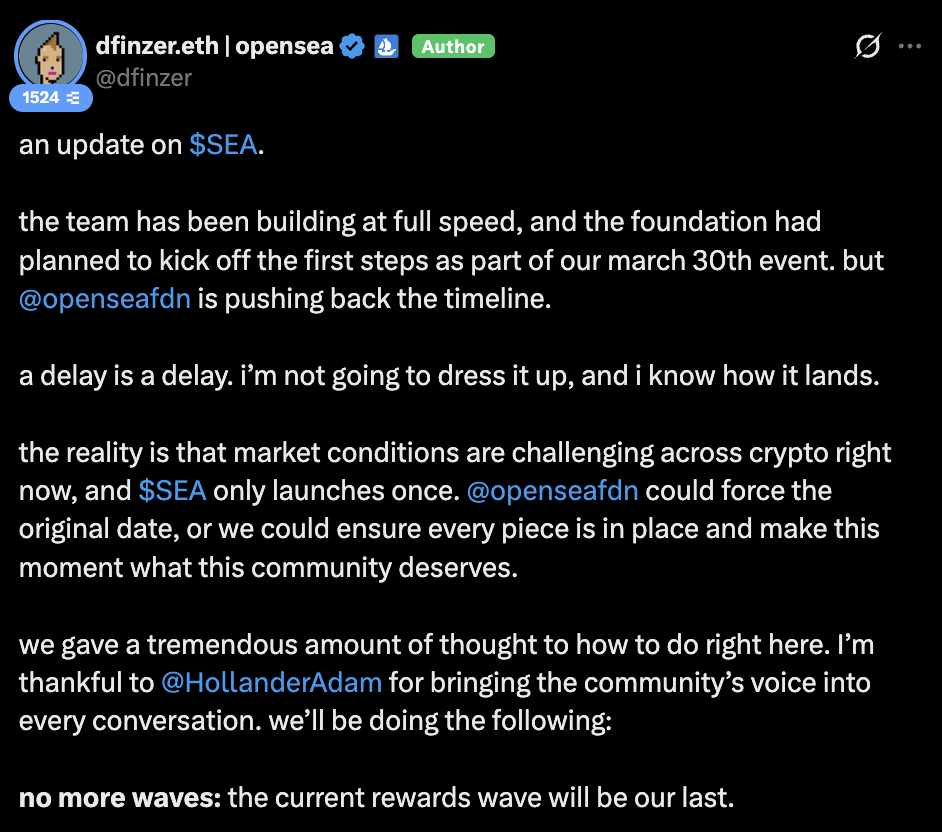
Image source: X/@dfinzer
Poor market conditions, OpenSea chooses to pause the launch
Finzer said on X that the team discussed whether to proceed as planned, but ultimately decided that $SEA’s issuance is a one-time opportunity. Instead of forcing a timely launch, they prefer to spend more time preparing the product, distribution, and overall plan to ensure the final outcome meets community expectations. He also straightforwardly stated, “Delaying is just delaying,” without trying to downplay the impact of this decision on the market and user sentiment.
$SEA was first revealed in October 2025 alongside OpenSea’s new strategy. At that time, OpenSea shifted from positioning itself solely as an NFT marketplace to aiming to become a “trade everything” platform covering a broader range of on-chain assets. The delay of $SEA now reflects the company’s cautious approach in balancing product transformation and the capital market atmosphere.
Further reading
OpenSea token airdrop! What is SEA? What is the pre-market price? Which users can claim it?
Reward program concludes, some users can opt for refunds
In addition to postponing the TGE, OpenSea also adjusted recent incentive arrangements. Finzer said this rewards wave will be the final one, and the platform will not open new reward rounds. For users participating in rounds 3 to 6, OpenSea will offer an option: they can apply for a refund of part of the fees collected during that period.
However, if users choose to refund, the corresponding Treasures rewards will be removed from their accounts; if they choose to keep the Treasures, the previous commitments related to TGE by the OpenSea Foundation remain valid, and these holdings will still be considered in future token distribution assessments.
60 days of zero fees starting March 31
To maintain platform activity during the delay of SEA’s launch, OpenSea introduced a new trading measure. According to Finzer, starting March 31, 2026, the platform will implement 60 days of 0% platform fees for token trades. After that, OpenSea will introduce a new fee structure aimed at providing more competitive costs for long-term traders.
This arrangement shows that although OpenSea has delayed its most anticipated token launch, it has not stopped driving traffic to the new platform or building user loyalty. Instead, the company seems to be laying the groundwork for a more complete $SEA launch through fee discounts and existing reward clearances. This indicates that $SEA is not just a simple airdrop or token issuance event but a core part of OpenSea’s product roadmap, community incentives, and long-term trading strategy.
Early announcement last year, now adopting a more cautious approach
Notably, Finzer also admitted in the latest statement that OpenSea’s premature external announcement last year caused unnecessary uncertainty. Therefore, the team has not announced a new $SEA issuance date and emphasizes that only when they can provide clearer and more cautious timelines will they update the public.
This stance also reflects that, after the NFT market cooled and overall crypto volatility increased, OpenSea’s external communication has become more focused on risk management and expectation setting. While delaying TGE may temporarily dampen community excitement, it could lead to more mature product design and clearer token narratives, which might not be entirely negative signals.
The timing of $SEA’s restart will become a market focus. Currently, OpenSea has not provided a new TGE schedule. The market’s next steps will focus on three key points: first, whether the platform’s new trading products and multi-chain features can continue to expand during the delay; second, how Treasures and existing reward mechanisms will ultimately map to token distribution; third, whether OpenSea will choose a more favorable window to reintroduce $SEA after the overall crypto market improves.
- This article is reprinted with permission from: 《Block Guest》
- Original title: 《OpenSea delays $SEA issuance, TGE postponed due to market difficulties》
- Original author: Xun
Disclaimer: The information on this page may come from third parties and does not represent the views or opinions of Gate. The content displayed on this page is for reference only and does not constitute any financial, investment, or legal advice. Gate does not guarantee the accuracy or completeness of the information and shall not be liable for any losses arising from the use of this information. Virtual asset investments carry high risks and are subject to significant price volatility. You may lose all of your invested principal. Please fully understand the relevant risks and make prudent decisions based on your own financial situation and risk tolerance. For details, please refer to
Disclaimer.


