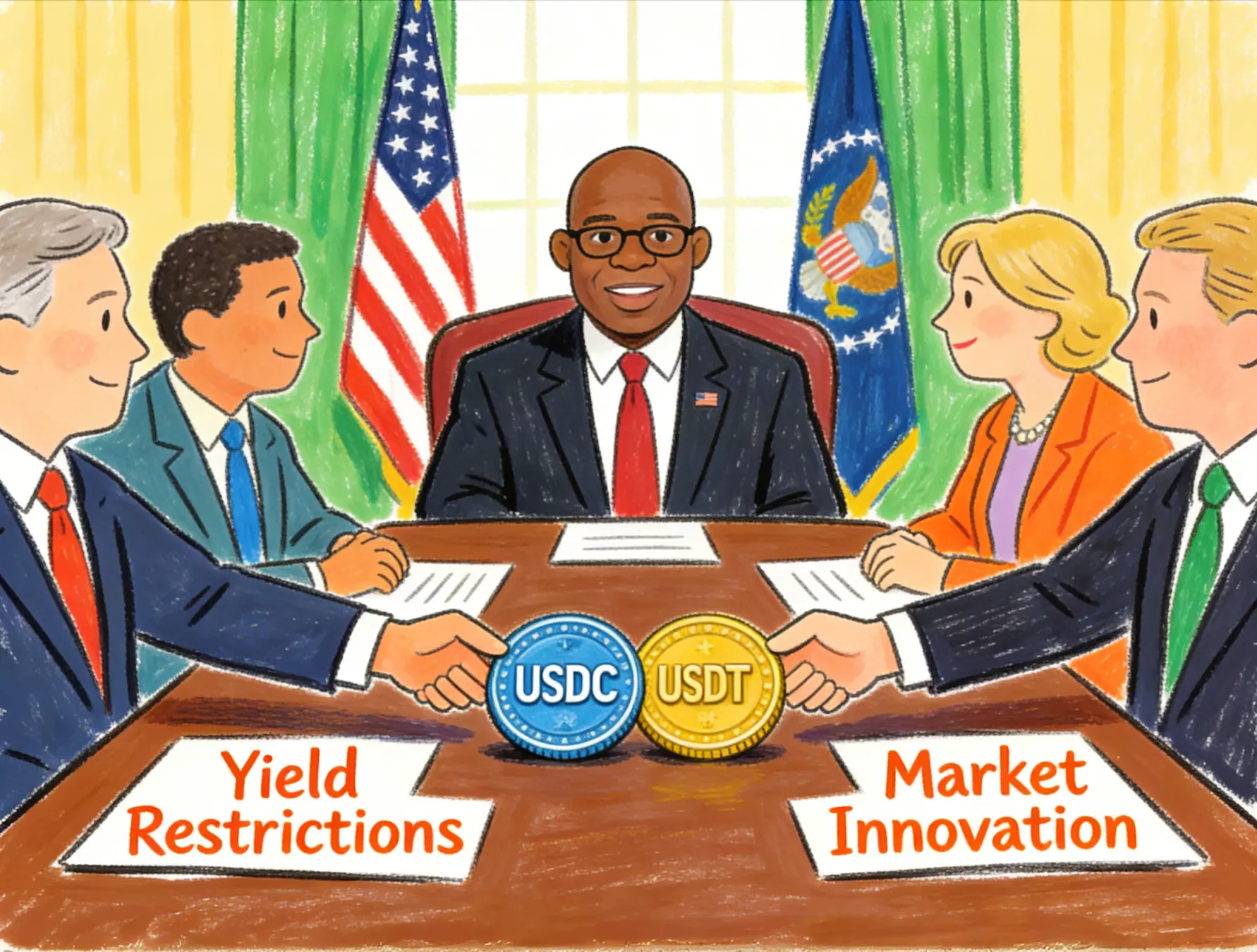
 Senator Tim Scott, Chairman of the Senate Banking Committee, announced on March 17, 2026, that he expects to receive a compromise proposal on stablecoin yield provisions before the end of the week, potentially resolving the most contentious issue stalling U.S. stablecoin legislation.
The yield question—whether stablecoin issuers should be permitted to pass interest earnings from reserve assets back to token holders—has divided banks, crypto advocates, and regulators, delaying the GENIUS Act framework since its passage out of committee earlier this year.
Scott indicated at the Digital Chamber’s DC Blockchain Summit that if the timeline holds, lawmakers will have concrete language to evaluate, marking significant progress on what he described as the “most publicly debated issue” in market structure legislation.
The Yield Debate: Core Controversy Explained
Current Mechanics
Stablecoin issuers such as Circle (USDC) and Tether (USDT) hold tens of billions of dollars in U.S. Treasuries and other short-term instruments as reserves backing their tokens. These reserves generate yield, which issuers currently retain as their primary revenue stream. The total stablecoin market capitalization now exceeds $230 billion, with USDT accounting for approximately $140 billion and USDC commanding about $55 billion.
Conflicting Interests
The legislative debate centers on whether issuers should be permitted to share reserve-generated yield with stablecoin holders, effectively creating products that resemble interest-bearing accounts or money market funds.
Banking sector opposition: Traditional financial institutions oppose yield-bearing stablecoins on competitive grounds. If stablecoins offered yields comparable to savings accounts or money market funds, the competitive pressure on traditional deposit products would intensify significantly. Bank lobbyists have pushed for either outright prohibition of yield-bearing stablecoins or requirements that such products operate under full banking regulation.
Crypto industry position: Digital asset advocates argue that blocking yield protects bank margins at consumer expense. They contend that stablecoin yield merely passes through market-generated returns and that restricting it would undermine the value proposition of dollar-denominated digital assets.
Legislative Context and Timeline Pressure
GENIUS Act Status
The GENIUS Act, which would establish a federal framework for stablecoin issuance, passed out of the Senate Banking Committee earlier in 2026 but stalled on the Senate floor amid bipartisan concerns. Two primary issues have prevented advancement: anti-money laundering provisions and the yield question that remains unresolved.
Negotiation Participants
Scott credited several individuals for their efforts on the yield compromise, including Democratic Senator Angela Alsobrooks, Republican Senator Thom Tillis, and White House representative Patrick Witt. Their engagement suggests coordinated negotiation between congressional leadership, the administration, and interested stakeholders.
Additional Outstanding Issues
Beyond yield, Scott indicated progress on several other legislative sticking points over the past month:
Ethics concerns: Lawmakers had raised questions about U.S. President Donald Trump and his family’s crypto projects, with Scott stating “we’re very close to landing the plane on the ethics issue”
Commissioner quorum: The lack of bipartisan commissioners at major regulatory agencies has been addressed through pending nominations
DeFi provisions: Senator Mark Warner has maintained focus on decentralized finance (DeFi) issues
AML regulations: Anti-money laundering requirements remain under negotiation as a priority for some Democrats
Potential Market Implications
Yield Permitted Scenario
If the compromise leans toward permitting yield—even in restricted form—it would represent a significant catalyst for stablecoin adoption. A regulated, yield-bearing dollar stablecoin would compete directly with money market funds, savings accounts, and Treasury bills for retail capital, accessing a substantial addressable market.
Regulatory Clarity Value
For existing stablecoin issuers, regulatory clarity itself holds value independent of specific yield provisions. Institutional players have consistently cited regulatory uncertainty as their primary barrier to deeper stablecoin integration. A federal framework would enable broader participation from banks, asset managers, and payment companies.
Restrictive Outcome Risk
The countervailing risk is that compromise produces a framework so restrictive that yield-bearing stablecoins become commercially impractical. Such an outcome would satisfy banking sector concerns but potentially push innovation offshore. The distinction between “issuers may offer yield with a state license” versus “issuers may offer yield with a federal banking charter” represents the difference between an accessible market and a regulatory moat.
Frequently Asked Questions
Why has the yield question stalled stablecoin legislation?
The yield debate centers on whether stablecoin issuers should be allowed to pass interest earnings from reserve assets back to token holders. Banks oppose this as competitive pressure on traditional deposit products, while crypto advocates argue blocking yield protects bank margins at consumer expense. This fundamental disagreement has prevented the GENIUS Act from advancing beyond committee despite broad agreement on the need for stablecoin regulation.
What form might the compromise proposal take?
While specific details have not been disclosed, prior discussions have floated options ranging from yield caps to requiring issuers to obtain specific licenses before offering interest to holders. The critical distinction will be whether yield-bearing stablecoins can operate under state licensing frameworks or will require federal banking charters, which would significantly affect market accessibility.
What other issues are being negotiated alongside yield?
Senator Scott indicated progress on ethics concerns related to presidential crypto projects, commissioner quorum at regulatory agencies through pending nominations, DeFi provisions championed by Senator Mark Warner, and anti-money laundering requirements. He expressed optimism that these issues are nearing resolution as part of the broader legislative package.
Disclaimer: The information on this page may come from third parties and does not represent the views or opinions of Gate. The content displayed on this page is for reference only and does not constitute any financial, investment, or legal advice. Gate does not guarantee the accuracy or completeness of the information and shall not be liable for any losses arising from the use of this information. Virtual asset investments carry high risks and are subject to significant price volatility. You may lose all of your invested principal. Please fully understand the relevant risks and make prudent decisions based on your own financial situation and risk tolerance. For details, please refer to
Disclaimer.


