
The Bitcoin Policy Institute (BPI) announced on Wednesday that it will submit public comments on the Federal Reserve’s upcoming bank capital rule proposal, aiming to ensure that U.S. regulators treat Bitcoin fairly when implementing the Basel Committee on Banking Supervision framework. Currently, under the Basel framework, Bitcoin is assigned a 1250% risk weight, which BPI describes as “almost higher than all other asset classes” and the “most severe classification” within the entire framework.
The Practical Impact of the 1250% Risk Weight: Why Bitcoin Banking Is So Difficult
(Source: Conner Brown X)
According to the Basel framework, capital requirements are directly linked to the risk weights of assets: when Bitcoin is assigned a 1250% risk weight, it means that banks must support holdings of Bitcoin with approved collateral on a 1:1 basis—holding $1 worth of Bitcoin requires holding an equivalent amount of capital buffer.
In comparison, here are the risk weights for other major asset classes under Basel:
Cash: 0% risk weight
Physical Gold: 0% risk weight
Government Debt (Treasuries): 0% risk weight
This stark difference makes it far more costly for banks to engage in Bitcoin-related activities than with traditional assets. Brown notes, “This risk weight makes it very difficult for banks to provide financial services to Bitcoin holders and Bitcoin companies.”
BPI’s Position and the Federal Reserve’s Regulatory Intent
Last month, Brown described Bitcoin’s treatment within the Basel capital framework as a “category error,” arguing that placing Bitcoin in the same category as high-risk speculative assets does not reflect its actual risk profile as a digital asset.
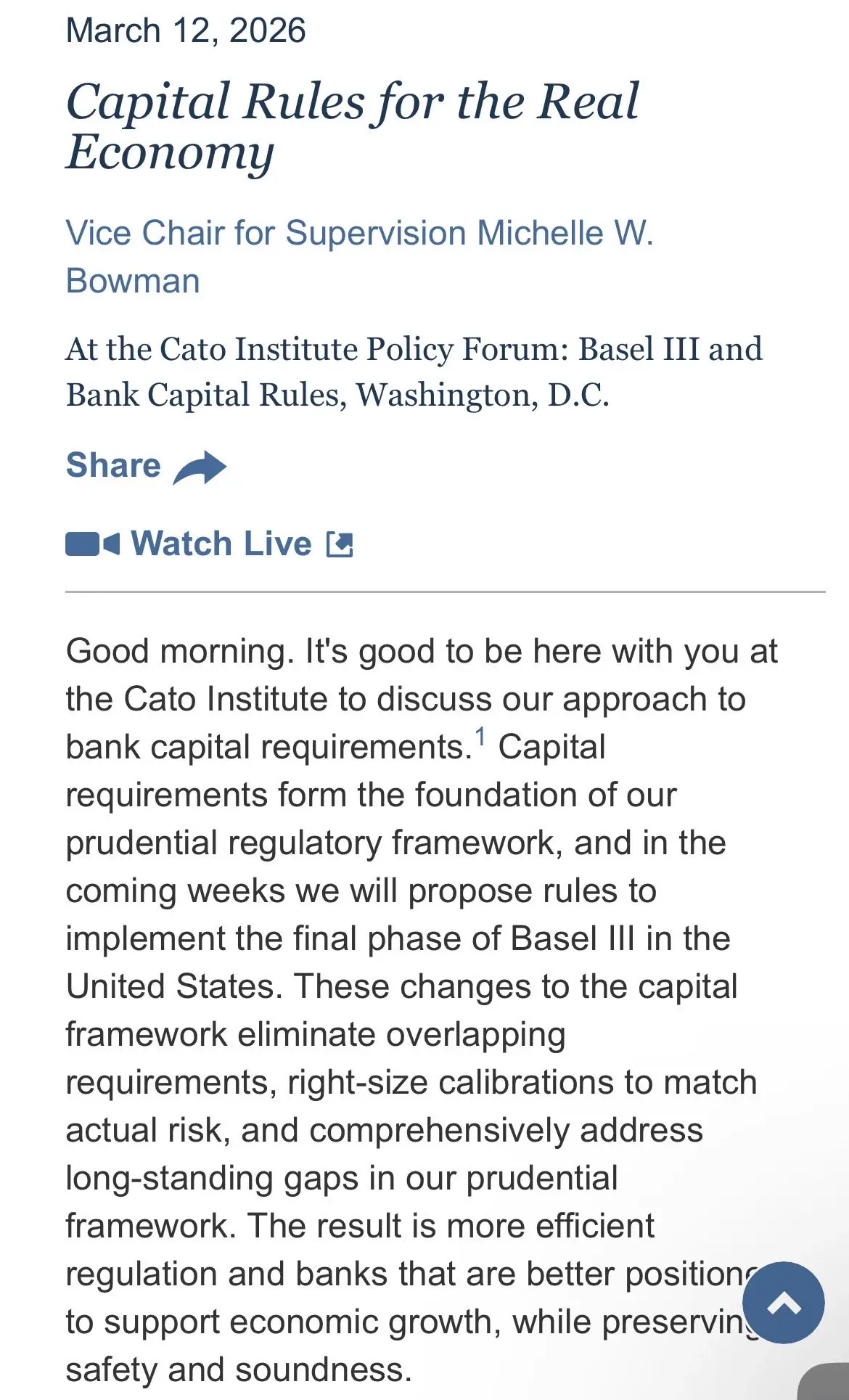
Federal Reserve Vice Chair Michelle Bowman stated on Thursday that the Fed will propose rules in the coming weeks to advance the final implementation of Basel agreements for U.S. banks. Her official goal is “to improve regulatory efficiency, enabling banks to better support economic growth while maintaining safety and soundness.”
In 2021, the Basel Committee proposed including cryptocurrencies in its high-risk “Group 2” assets, where bank holdings are limited to 1% of “Group 1” assets, laying the foundation for Bitcoin’s harsh treatment under the current regulatory system.
Frequently Asked Questions
What does the 1250% risk weight under Basel mean specifically for Bitcoin?
A 1250% risk weight means that if a bank holds Bitcoin, it must support it with approved collateral on a 1:1 basis—holding $1 worth of Bitcoin requires holding $1 of capital buffer. In contrast, cash, gold, and government bonds all have a risk weight of 0%, making Bitcoin holdings significantly more costly for banks compared to other assets.
How does BPI plan to respond to the Basel treatment of Bitcoin?
BPI plans to submit public comments after the Federal Reserve officially releases the Basel implementation rule proposal, to ensure U.S. regulators adopt a fair risk classification for Bitcoin in the final rules. Conor Brown, BPI’s general manager, believes the current 1250% risk weight is a “category error” that does not reflect Bitcoin’s actual risk profile.
Why is the Fed pushing forward with the new Basel proposals now?
Vice Chair Michelle Bowman stated that the goal is “to improve regulatory efficiency, enabling banks to better support economic growth while maintaining safety and soundness.” This is part of the final phase of Basel implementation, and the classification of Bitcoin within this framework will be a key issue for advocacy groups like BPI.
Disclaimer: The information on this page may come from third parties and does not represent the views or opinions of Gate. The content displayed on this page is for reference only and does not constitute any financial, investment, or legal advice. Gate does not guarantee the accuracy or completeness of the information and shall not be liable for any losses arising from the use of this information. Virtual asset investments carry high risks and are subject to significant price volatility. You may lose all of your invested principal. Please fully understand the relevant risks and make prudent decisions based on your own financial situation and risk tolerance. For details, please refer to
Disclaimer.


