
Ethereum has officially deployed ERC-8004 to the mainnet, a universal identity, reputation, and verification standard for AI agents. As of launch, over 10,000 agents have registered on the mainnet, and more than 20,000 feedback entries have been accumulated on the testnet. According to official statements, under this standard, AI agents are now “accountable economic actors.”
Three Core Features of ERC-8004: Identity, Reputation, and Discoverability
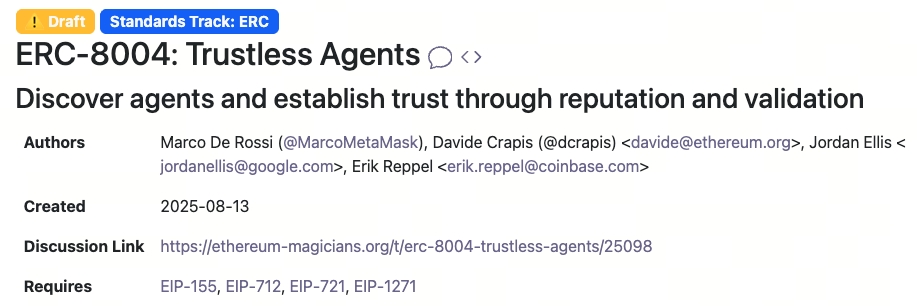 (Source: EIPS)
Before ERC-8004, the AI agent ecosystem faced three fundamental trust gaps: malicious agents leaving no trace, unreliable discovery across platforms, and reputation records resetting when switching platforms.
Universal Agent Identity (UAI): ERC-8004 enables each AI agent to establish a unique, verifiable identity on the blockchain. Previously, there was no mechanism to prevent malicious agents from disappearing after charging fees; no on-chain records or accountability measures existed. ERC-8004, through an immutable on-chain identity, allows the complete tracking of an agent’s behavior history for the first time.
Cross-Platform Discoverability: Every agent registered under ERC-8004 enters a global directory accessible to all builders, not locked into any single platform. Ethereum explains: “A2A and MCP enable agent communication; ERC-8004 helps them find each other.”
Portable Reputation System: Reputation belongs to the agent itself, not the platform. When agents migrate across platforms, their feedback history remains intact and continues to accumulate, not reset to zero. “On-chain history distinguishes quality from noise,” providing clients with trustworthy signals without relying on centralized intermediaries.
Integration with x402 Payment: Unified Task, Reputation, and Payment Layer
The combination of ERC-8004 with the x402 payment standard enables programmable agent payment mechanisms:
Unified Task, Evaluation, and Payment Layer: During operation, task execution, reputation assessment, and payment transactions are handled within the same protocol layer, eliminating the need for separate verification and payment systems.
Programmable Reputation Verification: Builders can automatically verify an agent’s reputation via code before granting access, directly integrating agents into high-risk DeFi protocols as safer economic actors.
Automated Reputation Filtering: Reputation checks can be embedded directly into protocol logic, allowing high-risk financial applications to have built-in trustworthiness filtering for agents.
Developer Onboarding Process: Three Steps to Mint an Agent Identity
Builders wishing to adopt ERC-8004 can do so without rewriting existing code. The onboarding process involves three steps: first, generate a JSON registration file containing the agent’s endpoint and specifications; second, host the file on IPFS or HTTP; third, call the identity registration smart contract.
For development tools, Agent0 SDK offers TypeScript and Python versions, and ChaosChain SDK is also available. Agents can be searched and managed via 8004scan.io or agentscan.info.
Frequently Asked Questions
What is ERC-8004, and why is it important for AI agents?
ERC-8004 is a universal standard designed for Ethereum-based AI agents, integrating identity, reputation, and verification into a single layer. It addresses key trust gaps in the AI agent ecosystem—malicious agents operating invisibly and high-quality agents being unreliable across platforms. ERC-8004 makes AI agents “accountable economic actors” with verifiable on-chain identities.
How does the reputation system in ERC-8004 work?
An agent’s reputation is linked to its on-chain identity, not tied to any specific platform. When an agent switches platforms, its feedback history remains complete and continues to grow, not reset. This means high-reputation agents can carry their history across all ERC-8004-supported platforms, enabling clients to identify trustworthy agents without relying on centralized intermediaries.
How can developers integrate existing agents with ERC-8004?
The process involves three steps: generate a JSON file with the agent’s endpoint and specifications, host it on IPFS or HTTP, and then call the Ethereum identity registration smart contract. The entire process requires no rewriting of existing code, and tools like Agent0 SDK (available in TypeScript and Python) and ChaosChain SDK can be used.
Disclaimer: The information on this page may come from third parties and does not represent the views or opinions of Gate. The content displayed on this page is for reference only and does not constitute any financial, investment, or legal advice. Gate does not guarantee the accuracy or completeness of the information and shall not be liable for any losses arising from the use of this information. Virtual asset investments carry high risks and are subject to significant price volatility. You may lose all of your invested principal. Please fully understand the relevant risks and make prudent decisions based on your own financial situation and risk tolerance. For details, please refer to
Disclaimer.


