
AI agent software OpenClaw is sparking a craze in China, with Tencent Holdings and Alibaba Group both launching entry-level services to help users quickly access the platform. Bloomberg Intelligence analyst Robert Lea points out that although regulatory scrutiny is increasing, it is unlikely to fundamentally hinder the widespread adoption of OpenClaw in China. Informed sources reveal that China has initially limited the use of the software to state-owned enterprises and government departments.
OpenClaw’s Differentiation Advantage: Why Are Chinese Tech Giants Competing to Integrate It?
OpenClaw’s core competitiveness in the AI agent (Agentic AI) sector lies in its ability to autonomously perform multi-step tasks. Traditional AI chatbots mainly respond to questions, whereas OpenClaw can plan and execute complex workflows across multiple applications on behalf of users. This capability is especially attractive to enterprise clients and government agencies.
For Tencent and Alibaba, the significance of the OpenClaw trend lies in two dimensions: First, by integrating and offering services related to OpenClaw, both companies can increase customer stickiness on their cloud platforms and AI infrastructure. Second, the widespread application of OpenClaw drives demand for computing resources, which could directly boost their cloud business revenues. Bloomberg Intelligence’s analysis indicates that Tencent is better positioned to handle geopolitical and macroeconomic headwinds than its peers, while Alibaba’s progress in commercializing the Qwen AI platform provides an important window into its AI strategy execution.
Recent Performance Outlook for Tencent and Alibaba
Tencent (700 HK): Q4 revenue is expected to grow 13% year-over-year. Bloomberg Intelligence believes that although profit growth may slow this year due to geopolitical and economic headwinds, Tencent’s ability to respond to such challenges remains superior to industry peers. Additionally, Tencent is reportedly interested in investing in Paramount Skydance and may be involved in indirect participation with Warner Bros. Discovery, which warrants ongoing attention.
Alibaba (BABA US): Facing fierce competition in the food delivery market, weakness in e-commerce operations may continue into the next quarter. The market’s three main focuses are: the latest disclosure of the three-year capital expenditure budget (reflecting investment in AI infrastructure), progress in commercializing the Qwen AI platform, and management’s outlook on business prospects amid rising geopolitical risks.
Broader Macro Context in the Asia-Pacific Region
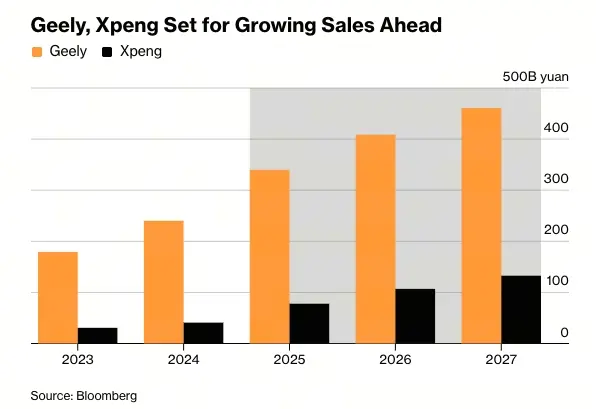
(Source: Bloomberg)
The surge of OpenClaw combined with rapid geopolitical developments is shaping the short-term landscape of the Asia-Pacific tech sector:
Hon Hai Precision (2317 TT): Q4 sales exceeded market expectations, mainly driven by strong performance in cloud and internet services, as well as over-sales of iPhone 17.
Geely Auto (175 HK): February sales continued to surpass BYD for the second consecutive month, creating the largest sales gap since 2022, with early signs of brand streamlining.
Xpeng Motors (XPEV US): Full-year revenue growth may reach a new high since 2021, as the company actively expands into autonomous taxis and humanoid robots.
COSCO Shipping (1919 HK): With the Strait of Hormuz effectively closed, new orders to and from certain regional ports have been suspended.
CK Hutchison (1 HK): Plans to sell its global port operations to Blackstone Group have stalled after a Panamanian court temporarily took over two of its ports.
Frequently Asked Questions
What is the core difference between OpenClaw and DeepSeek?
DeepSeek is a large language model focused on language understanding and question answering, similar to ChatGPT. OpenClaw, on the other hand, is an AI agent platform capable of autonomously planning and executing multi-step tasks across applications—such as managing email priorities or planning entire trips—without continuous human intervention. This proactive, labor-automating capability, rather than passive answering, is the fundamental reason for its stronger appeal in enterprise applications.
Will China’s regulatory restrictions hinder OpenClaw’s market expansion?
According to Robert Lea of Bloomberg Intelligence, current restrictions (initially limited to state-owned enterprises and government departments) are unlikely to fundamentally impede widespread adoption. China’s previous tech regulation approach typically involves initial restrictions followed by gradual liberalization. The features of OpenClaw that help government and state enterprises improve efficiency may even encourage regulators to expand authorization over time.
How do Tencent and Alibaba specifically benefit from the OpenClaw trend?
There are three main pathways: First, providing OpenClaw integration services to expand enterprise customer bases on their cloud platforms; second, the increased demand for computing resources driven by AI agent workflows directly boosts cloud infrastructure revenue; third, integrating OpenClaw with their own AI models (Alibaba’s Qwen, Tencent’s Hunyuan, etc.) to create ecosystem stickiness, attracting enterprises to choose them as comprehensive AI transformation solution providers.
Disclaimer: The information on this page may come from third parties and does not represent the views or opinions of Gate. The content displayed on this page is for reference only and does not constitute any financial, investment, or legal advice. Gate does not guarantee the accuracy or completeness of the information and shall not be liable for any losses arising from the use of this information. Virtual asset investments carry high risks and are subject to significant price volatility. You may lose all of your invested principal. Please fully understand the relevant risks and make prudent decisions based on your own financial situation and risk tolerance. For details, please refer to
Disclaimer.


