
MissAV is blocked by New Taipei City under the “Sex Crime Prevention Act,” shifting focus from piracy to the suspected circulation of criminal sexual images, sparking discussions about the principle of proportionality and the legitimacy of administrative sanctions.
The adult piracy platform MissAV has been blocked by the New Taipei City government since March 11, prompting widespread online discussion. However, what’s most noteworthy about this incident is not the controversy surrounding the website itself, but the legal basis for the block, which has shifted from the common Copyright Act to the “Sex Crime Prevention Act.”
This means that the focus of this matter is no longer “piracy” but “blocking the circulation of suspected criminal sexual images.” Are veteran internet users now being warned?
Not about piracy: The blocking page references the “Sex Crime Prevention Act”
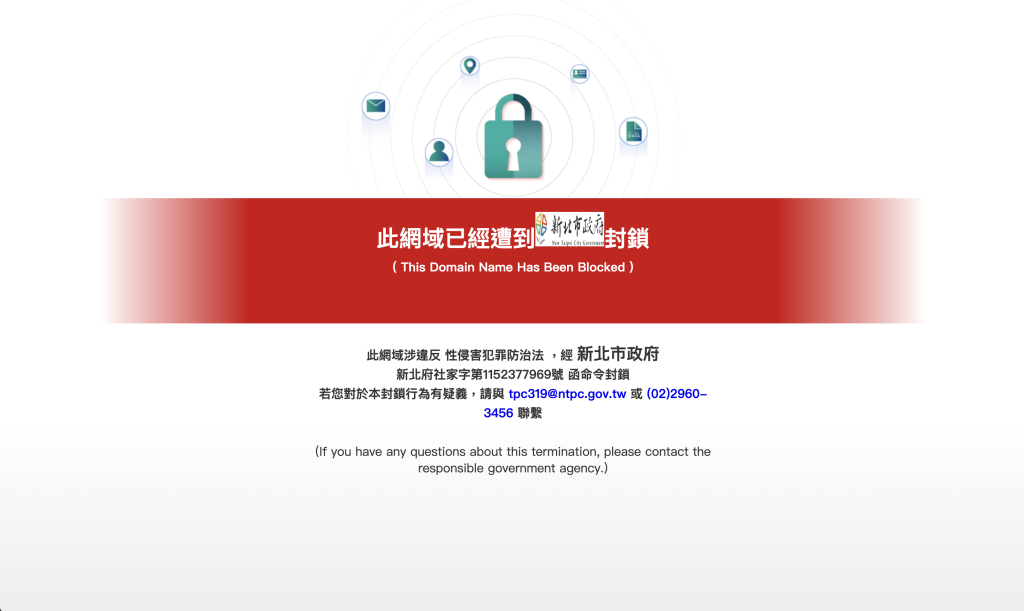
Image source: Taiwan Industrial Safety and Health Association, New Taipei Vocational Training Center
According to media reports and online screenshots, since March 11, 2026, some Taiwanese users accessing MissAV have seen a blocking notice referencing a letter from the New Taipei City government. The blocking page cites Article 13 of the “Sex Crime Prevention Act” as the legal basis and displays the document number “New Taipei Prefecture Social and Family No. 1152377969.”
Long considered a platform mainly hosting pirated adult videos, most netizens initially linked this incident to copyright issues. However, the blocking page explicitly cites the “Sex Crime Prevention Act,” not the Copyright Act, indicating that the legal implications extend far beyond simply “piracy site enforcement.”
As of now, the New Taipei City government has not published a full administrative order or official press release on its website detailing the specific facts, scope, and duration of the sanctions, which remain to be clarified by the authorities.
Copyright law protects content creators; the Sex Crime Prevention Act protects victims: the fundamental difference between two approaches
Understanding why this incident warrants attention requires clarifying the fundamental differences in processing logic between copyright law and the “Sex Crime Prevention Act.”
If the issue were solely “a platform uploading commercial adult videos without authorization,” the more straightforward legal approach would be under copyright law: rights holders report, the platform removes content, and civil or criminal proceedings follow. This logic primarily aims to protect the property rights of content creators and copyright holders.
Image source: Chinese Society of Industrial Safety and Health, New Taipei Vocational Training Center
However, the “Sex Crime Prevention Act” takes a completely different approach:
According to Article 13 of the Act, internet platform providers, application service providers, and access service providers must, upon knowing or suspecting sexual assault crimes, restrict access to or remove related web content. In other words, this framework focuses not on “rights holder loss,” but on protecting victims, immediately blocking the circulation of sexual images, and the legal obligations of platforms and access providers to cooperate.
In other words, this incident may not be about “government handling of piracy,” but rather “government handling of suspected illegal circulation of sexual images.” The two are fundamentally different in legal purpose.
Blocking is not just a technical action: “Restricting access” is an official administrative measure
According to regulations published by the Ministry of Health and Welfare’s Sexual Image Processing Center, Article 46 of the “Sex Crime Prevention Act” grants authorities the power to take further “restriction of access” measures if internet operators fail to comply. Article 17 of the “Implementation Rules of the Sex Crime Prevention Act” further clarifies that restrictions imposed by authorities under this law are formal administrative sanctions, which must include the start and end dates of the restriction in the official order. If internet operators object, they can file administrative appeals or lawsuits.
This means that “blocking” is not merely a technical action but a clear administrative legal measure, which should be accompanied by an official order specifying the duration and providing the affected party with remedies.
This also raises further questions: What exactly is in the administrative order issued by the New Taipei City government? What are the scope, duration, and basis for the restriction?
Is it a single video or the entire website? The principle of proportionality comes into question
The law originally states that the restriction should target problematic web content related to crimes, not necessarily the entire website.
However, what the public observed was the entire domain being blocked, not just specific videos taken down. The question arises: Did the government determine that certain content was illegal, or did it consider the entire platform risky and thus blocked access entirely? If only some content was problematic, why not just request removal rather than blocking the entire site?
Additionally, some netizens noticed that only one entry point was blocked, while other related domains or mirror sites still seem accessible. This raises further doubts: For platforms hosted overseas with mirror sites or alternative URLs, how effective is blocking a single domain?
Currently, official information has not clarified what specific content prompted the block, nor how the scope of the restriction was determined.
Therefore, the real issue worth discussing is not just MissAV’s blockage, but how the government handles platforms involved in piracy, licensing disputes, and suspected illegal content—what methods are ultimately used, and whether these methods are transparent and reasonable.
- This article is reprinted with permission from: 《Chain News》
- Original title: “MissAV was blocked by New Taipei City, but why wasn’t the Copyright Law used?”
- Original author: Kenny
Disclaimer: The information on this page may come from third parties and does not represent the views or opinions of Gate. The content displayed on this page is for reference only and does not constitute any financial, investment, or legal advice. Gate does not guarantee the accuracy or completeness of the information and shall not be liable for any losses arising from the use of this information. Virtual asset investments carry high risks and are subject to significant price volatility. You may lose all of your invested principal. Please fully understand the relevant risks and make prudent decisions based on your own financial situation and risk tolerance. For details, please refer to
Disclaimer.


