Extreme slippage incident occurs on Ethereum blockchain, exchanging 50.4 million USDT for only about $36,000 worth of AAVE. Aave emphasizes no vulnerability and is exploring enhanced protections.
50 million USDT exchanged for 30,000 USD AAVE, on-chain transaction shocks market
Recently, a rare large-scale slippage event happened on the Ethereum blockchain. A crypto whale attempted to swap about 50.4 million USDT for AAVE but only received approximately 327 AAVE tokens, worth about $36,000, resulting in an instant loss of roughly $50 million in assets.
On-chain data shows the transaction took place on the Ethereum network, completed in about 30 seconds. The address initially withdrew about 50.4 million USDT (actually aEthUSDT) from the Aave protocol, then used CoW Protocol’s routing system to exchange tokens.
After the transaction, funds were converted into about 327 AAVE tokens and re-deposited into the Aave V3 protocol as aEthAAVE assets. Due to the huge discrepancy between the final tokens received and the original transaction amount, this event quickly sparked widespread discussion in the crypto market.
Low liquidity caused extreme slippage, arbitrage bots quickly exploited the price gap
According to on-chain transaction records, the trade involved multiple decentralized liquidity pools, including Uniswap V3 and SushiSwap.
Because the trade size far exceeded available market liquidity, the system experienced extreme price impact during execution. Ultimately, the slippage exceeded 99%, causing assets worth $50 million to be exchanged for only a small amount of AAVE.
In DeFi markets, such situations are usually rapidly exploited by arbitrage bots. When the trading price deviates significantly from the market price, arbitrage traders immediately use liquidity pools to reverse the trade, turning the price difference into profit.
As a result, after the transaction was completed, a large amount of value difference was quickly absorbed by market arbitrageurs and routing systems, making the loss nearly irrecoverable.
Aave team states multiple warnings about slippage risks before the trade
In response to this incident, Aave founder Stani Kulechov explained on social platform X that the transaction was executed via the CoW Swap routing system integrated into the Aave interface. The overall process did not involve protocol vulnerabilities or malicious attacks.
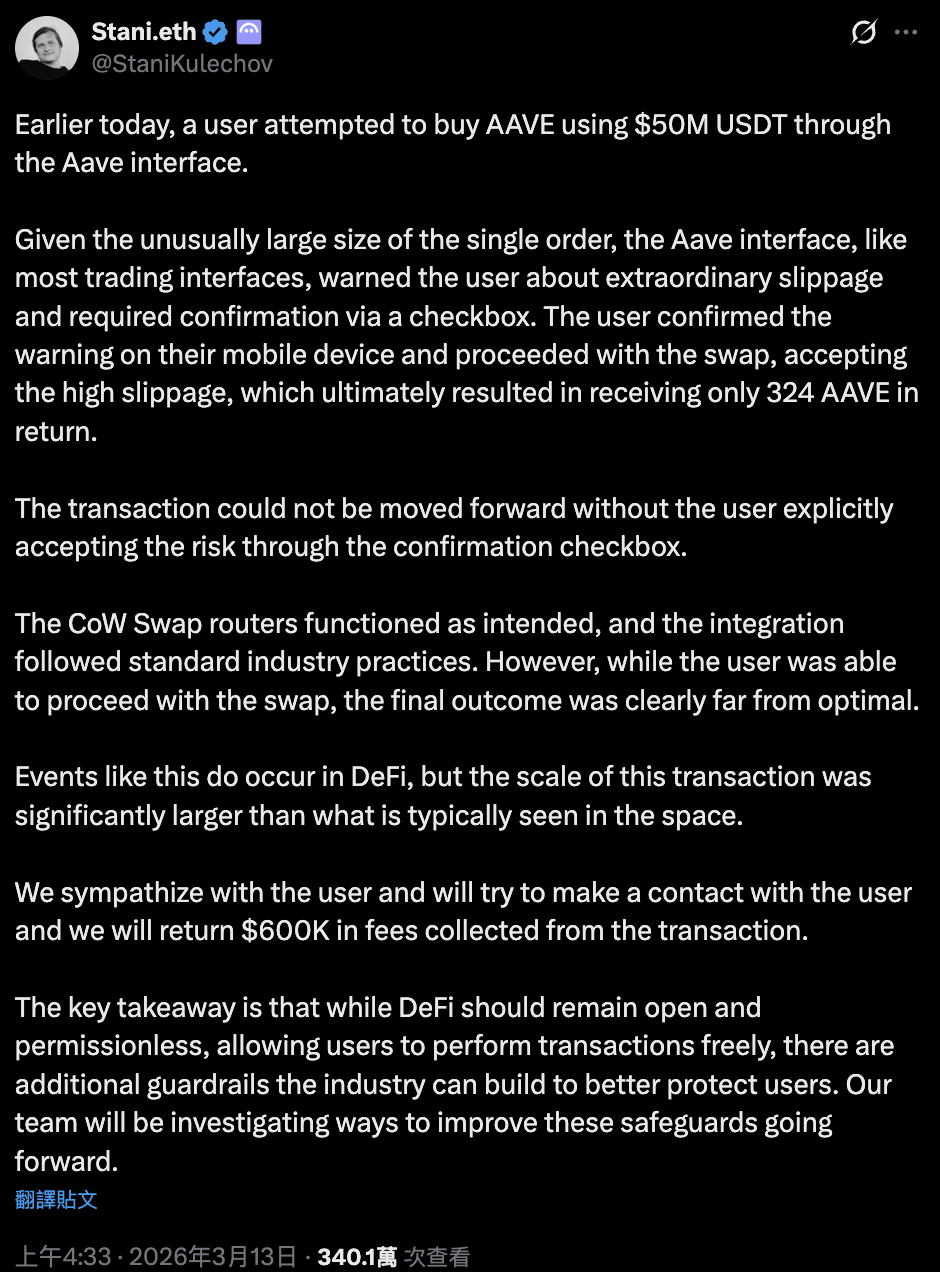
Image source: X/@StaniKulechov Aave founder Stani Kulechov explains that the transaction was executed through the CoW Swap routing system integrated into the Aave interface, with no protocol bugs or malicious attacks.
He stated that due to the enormous size of the order, the system clearly displayed an “extreme slippage” warning before the transaction, and required the user to manually confirm the risk before proceeding.
According to his explanation, the user confirmed the risk alert on a mobile device and completed the transaction. In other words, the system had already clearly indicated the potential price impact before execution, but the trader chose to proceed anyway.
Aave engineer Martin Grabina also pointed out that the core issue was not the slippage setting itself, but the significant price impact of the order. The quote before execution already showed that about 50 million USDT could only exchange for less than 140 AAVE, indicating the order was inherently highly unfavorable at submission.
Massive DeFi transaction risks emerge, Aave to study stronger security measures
Aave team states that although the outcome was extremely unfavorable, the system operated as designed, with no protocol vulnerabilities or security issues. CoW Protocol also noted that there is currently no evidence suggesting attack or system malfunction. To reduce user losses, Aave plans to contact the transaction address and refund approximately $600,000 in transaction fees.
Industry consensus is that large trades on decentralized exchanges, if not split into multiple orders or executed with professional strategies, are prone to huge price impacts due to insufficient liquidity. Professional traders typically split large orders into smaller parts or use algorithmic trading to minimize market impact.
This incident is also viewed by some market participants as one of the largest slippage events in DeFi history. As Aave’s usage continues to grow, the team says they will consider whether to implement additional safety mechanisms to balance decentralized trading freedom with reducing extreme operational risks to users.
Disclaimer: The information on this page may come from third parties and does not represent the views or opinions of Gate. The content displayed on this page is for reference only and does not constitute any financial, investment, or legal advice. Gate does not guarantee the accuracy or completeness of the information and shall not be liable for any losses arising from the use of this information. Virtual asset investments carry high risks and are subject to significant price volatility. You may lose all of your invested principal. Please fully understand the relevant risks and make prudent decisions based on your own financial situation and risk tolerance. For details, please refer to
Disclaimer.


