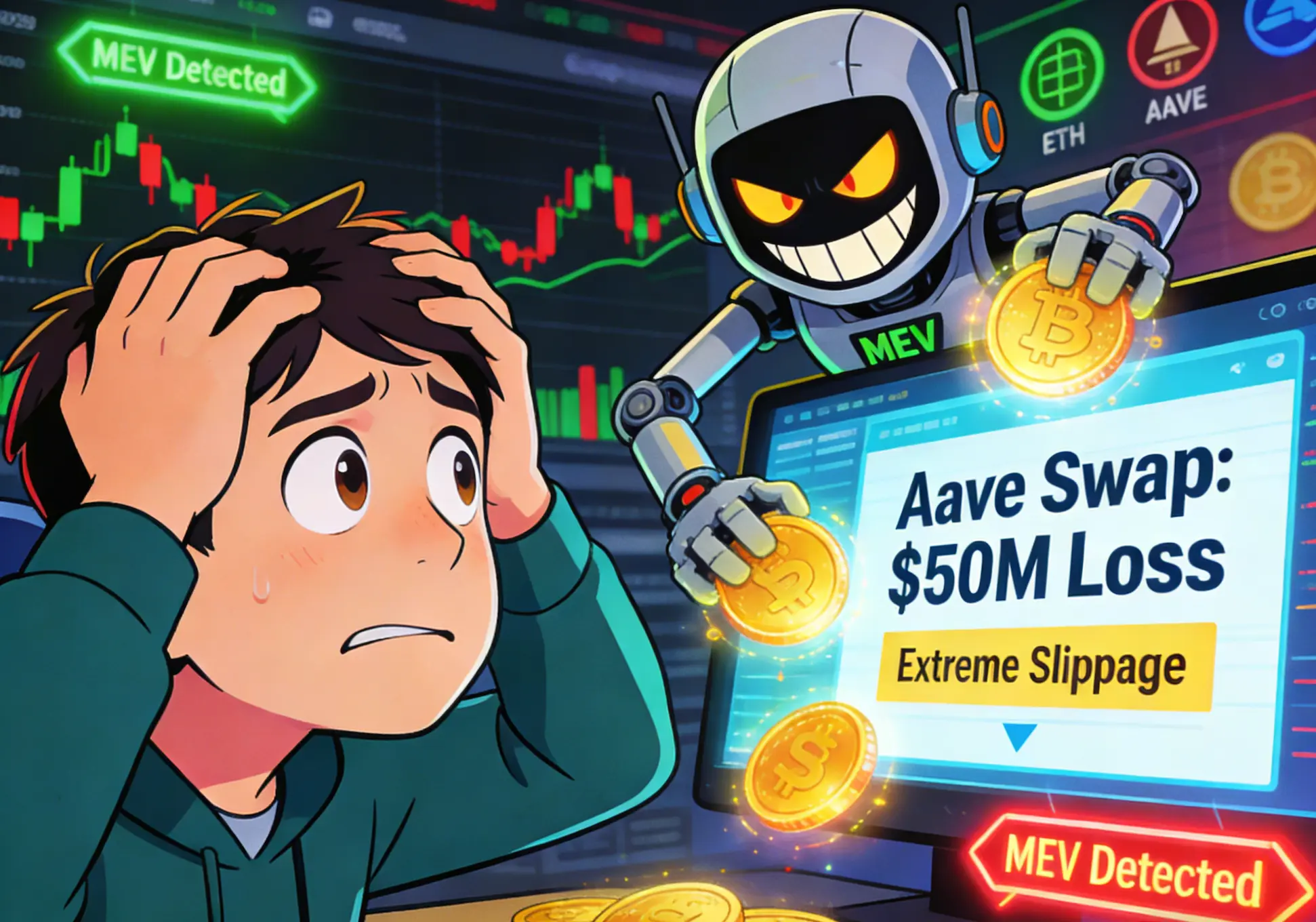
 A trader lost approximately $50 million on March 12, 2026, after swapping 50.4 million aEthUSDT for AAVE through the Aave mobile interface, receiving only 324 tokens worth about $36,000 due to extreme price impact and insufficient liquidity.
The transaction, which proceeded despite interface warnings about “extraordinary slippage,” resulted in a MEV searcher bot capturing the majority of the value, paying nearly 16,927 ETH ($34.8 million) to a block builder to secure the transaction bundle.
Transaction Details and Execution
The Swap
Blockchain data from Etherscan shows the trader first burned approximately 50.43 million aEthUSDT—an interest-bearing version of USDT used within the Aave lending protocol—to withdraw the same amount of regular USDT. The funds were then routed through a trade executed via CoW Protocol, a platform designed to aggregate liquidity and find optimal trade routes across decentralized exchanges.
Instead of receiving an equivalent value of tokens, the wallet ended up with only about 324 AAVE tokens, worth roughly $36,000 at the time of the transaction. On paper, this represents over $50 million exchanged for a tiny fraction of its value.
Warning System Activated
Aave founder Stani Kulechov addressed the incident publicly, stating: “Earlier today, a user attempted to buy AAVE using $50M USDT through the Aave interface. Given the unusually large size of the single order, the interface warned the user about extraordinary slippage and required confirmation via a checkbox. The user confirmed the warning on their mobile device and proceeded with the swap.”
Kulechov emphasized that “the transaction could not be moved forward without the user explicitly accepting the risk.” He added that Aave sympathizes with the user and will attempt to return $600,000 in fees collected from the transaction.
Technical Analysis of the Failure
Price Impact Root Cause
Aave engineer Martin Grabina clarified that the catastrophe wasn’t about the slippage tolerance slider itself. “In this case, the user sent a market order with the suggested 1.21% slippage. But the core issue wasn’t slippage, it was just the accepted quote with 99% price impact,” Grabina wrote.
He explained that the order included a quote field showing the original rate—50 million USDT for fewer than 140 AAVE—presented to the user before fees and slippage. “It was already a very bad rate,” Grabina stated. He confirmed that the user even received a 0.7% surplus from CoW Protocol’s auction mechanics, demonstrating the swap mechanics worked exactly as intended.
Liquidity and Routing Issues
The transaction resulted in only 327 AAVE tokens, a minuscule amount relative to the token’s overall liquidity and market capitalization. Investigators tracking the transaction say the funds originated from a wallet that had recently withdrawn assets from Binance. Routing the swap through a relatively thin liquidity pair involving Aave’s aToken wrapper dramatically amplified the damage.
Uniswap founder Hayden Adams commented: “Something is off on the routing. Just sending to Uniswap should still get you like $7m, not $40k.” A centralized exchange order of similar size would likely have moved the market but not resulted in such catastrophic losses.
MEV Extraction and Value Distribution
Searcher Bot Activity
Onchain data indicates that a MEV searcher bot captured the lion’s share of the value, exploiting the massive price distortion created by the order. To secure its spot in the block, the bot paid 16,927 ETH—about $34.8 million—to Titan Builder, a major Ethereum block builder.
Titan Builder then reportedly passed 568 ETH, roughly $1.2 million, to the validator that proposed the block. Data from Arkham Intelligence later showed Titan allegedly depositing the extracted funds to Coinbase.
Systemic Implications
The incident demonstrates how Ethereum’s MEV infrastructure operates as designed, with searchers, builders, and validators extracting value from transaction ordering. In crypto terms, this represents textbook MEV extraction rather than protocol malfunction.
Market Impact and Response
Minimal Market Effect
Despite the eye-catching numbers, the incident is unlikely to move the market for Aave. The transaction resulted in only 324 AAVE tokens, a very small amount relative to the token’s overall liquidity and market capitalization of approximately $2.5 billion.
Platform Safeguards
For the Aave team, the episode is instructive. Developers say they’re exploring stronger safeguards, such as smarter trade limits or additional friction for massive orders, while still preserving DeFi’s core principle of permissionless access. Platforms can add guardrails, but they cannot prevent users from executing trades they explicitly approve.
Community Reaction
As the story spread across social media, reactions ranged from sympathetic to sarcastic. Some users suggested DeFi apps should require traders to type out dramatic confirmations before executing such trades. The wallet owner has remained silent publicly.
FAQ: Aave $50 Million Trading Incident
Q: What exactly happened in the Aave trade?
A: A trader swapped approximately 50.4 million aEthUSDT for AAVE through the Aave mobile interface on March 12, 2026. Due to extreme price impact (approximately 99%) and insufficient liquidity, the transaction returned only about 324 AAVE tokens worth roughly $36,000.
Q: Did Aave malfunction during the transaction?
A: No. Aave founder Stani Kulechov confirmed the interface displayed multiple warnings about extraordinary slippage and required the trader to check a confirmation box acknowledging the risk before allowing the transaction to proceed. The swap mechanics worked exactly as designed.
Q: Where did the lost value go?
A: On-chain data shows a MEV searcher bot captured much of the value, paying nearly 16,927 ETH ($34.8 million) to Titan Builder, a major Ethereum block builder, to include the transaction bundle. Titan then passed approximately 568 ETH to the validator that proposed the block.
Q: Will the trader receive any compensation?
A: Aave plans to return approximately $600,000 in fees collected from the transaction, though the vast majority of the loss appears unrecoverable. This represents a goodwill gesture rather than a protocol obligation.
Disclaimer: The information on this page may come from third parties and does not represent the views or opinions of Gate. The content displayed on this page is for reference only and does not constitute any financial, investment, or legal advice. Gate does not guarantee the accuracy or completeness of the information and shall not be liable for any losses arising from the use of this information. Virtual asset investments carry high risks and are subject to significant price volatility. You may lose all of your invested principal. Please fully understand the relevant risks and make prudent decisions based on your own financial situation and risk tolerance. For details, please refer to
Disclaimer.


