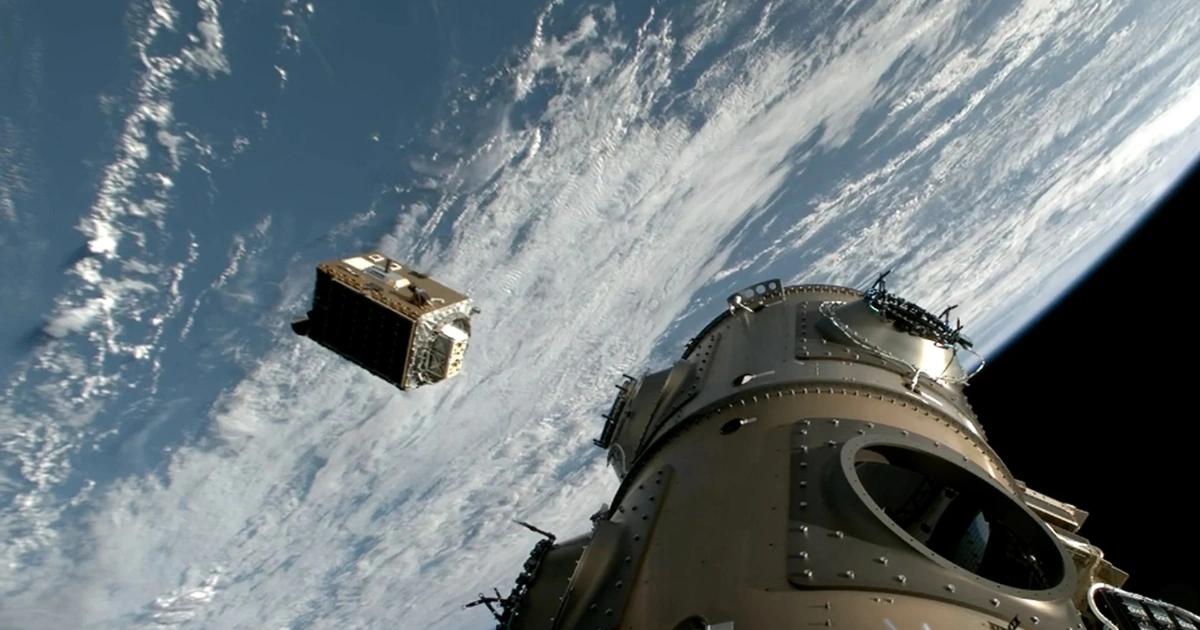
NVIDIA supports Starcloud’s orbital data center deployment, planning to launch space Bitcoin mining after this year’s launch to explore new solar energy computing models.
NVIDIA-backed orbital data center project, Starcloud, plans space computing
Supported by NVIDIA, the new space startup Starcloud announced plans to officially start Bitcoin mining operations after launching its second spacecraft this year. The company stated that if the plan proceeds smoothly, Starcloud will become the world’s first company to conduct Bitcoin mining in space. CEO Philip Johnston said on social platform X that space computing will gradually become a new generation of infrastructure, and Bitcoin mining is one of the most attractive applications. The company aims to provide computing power through orbital data centers while exploring the use of space-based energy for cryptocurrency mining.

Image source: X/@PhilipJohnston Starcloud CEO Philip Johnston states that space computing will gradually become a new generation of infrastructure, and Bitcoin mining is one of the most attractive applications
Founded in early 2024, Starcloud’s goal is to build large-scale data centers in Earth’s orbit to address the energy demands caused by the rapid growth of artificial intelligence and high-performance computing. By November 2025, the company successfully launched a satellite equipped with NVIDIA H100 GPUs into orbit, becoming the first system to operate high-end AI GPUs in space.
The planned orbital data center will consist of approximately 88,000 satellites, mainly powered by solar energy, forming a distributed computing platform through satellite networks. This architecture is seen as a potential solution for future AI and high-performance computing needs.
ASIC miners’ efficiency advantage makes space mining more cost-effective
Starcloud believes one key reason Bitcoin mining is suitable for deployment in space computing environments is the energy efficiency and cost advantages of ASIC miners. Philip Johnston pointed out that, compared to GPUs used for AI, ASIC miners have much lower cost per watt of computation. Based on current market prices, a NVIDIA B200 GPU with about 1 kW power consumption might cost around $30,000, while an ASIC miner with the same power consumption costs approximately $1,000.
This cost difference means deploying ASIC miners in space can achieve large-scale computing power at lower costs. Johnston believes that the economic efficiency of Bitcoin mining in space will far surpass that on Earth.
He noted that the global Bitcoin mining industry currently consumes about 20 GW of electricity. If space data centers expand in scale, some mining activities could shift to orbital computing platforms. Therefore, Starcloud views Bitcoin mining as a key application for space computing power and also as a way to validate the energy and computing models of orbital data centers.
Combining space computing and cryptocurrencies to explore interplanetary financial infrastructure
As space computing and blockchain technology increasingly intersect, some tech companies are exploring cross-planetary digital asset transmission. Last year, entrepreneurs Jose E. Puente and Carlos Puente proposed a theoretical scheme that uses NASA or Starlink’s optical communication links and a new interplanetary timestamp system to enable Bitcoin transactions to be transmitted between Earth and Mars.
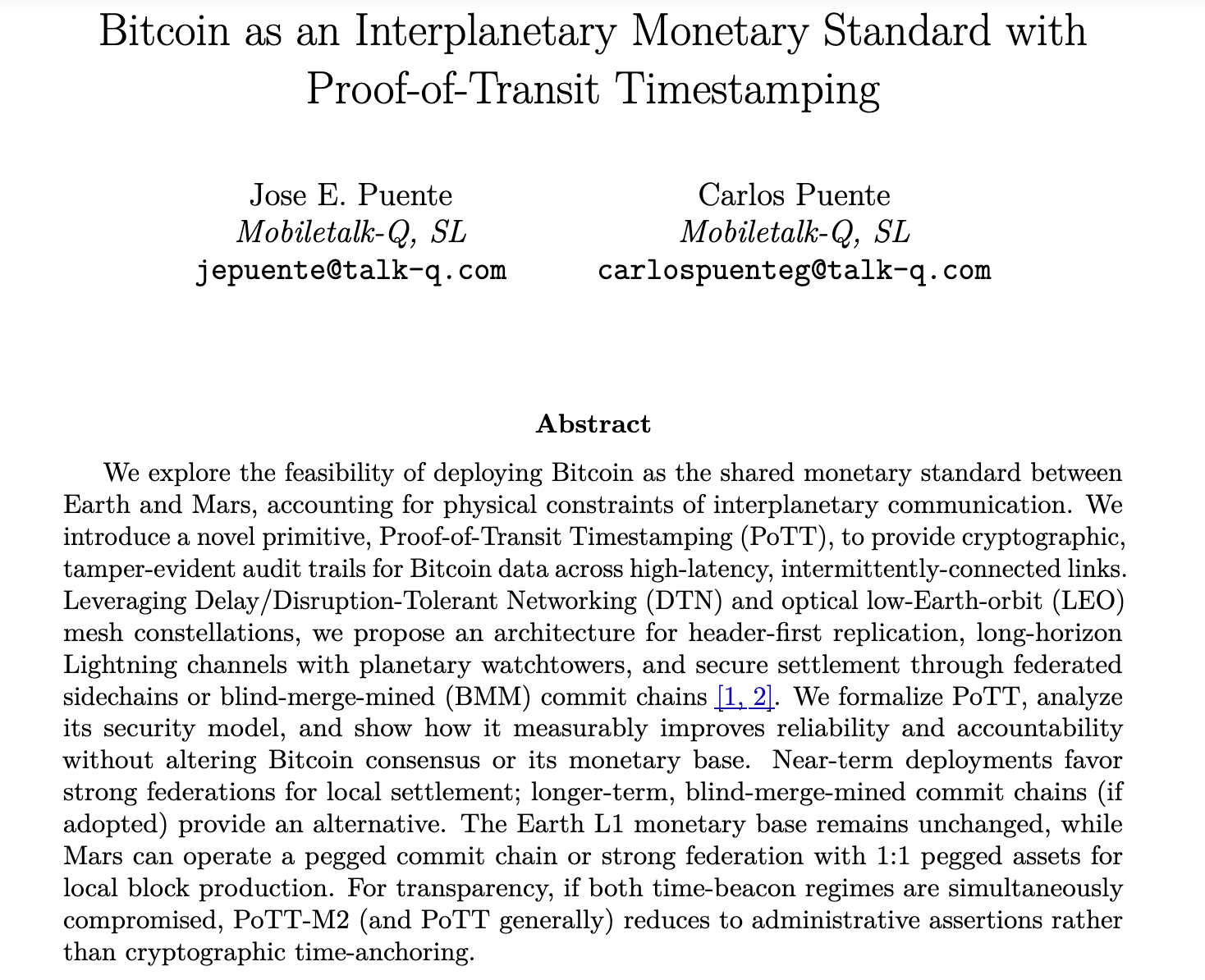
Image source: Arxiv Entrepreneurs Jose E. Puente and Carlos Puente proposed using NASA or Starlink’s optical communication links to transmit Bitcoin transactions between Earth and Mars
In an ideal scenario, Bitcoin transactions could be transmitted via Earth satellites, lunar relay stations, or deep space communication networks, with the shortest transfer time of about 3 minutes to reach Mars. However, researchers also pointed out that due to the high latency between Earth and Mars, mining Bitcoin on Mars is not practically feasible.
These ideas demonstrate that the integration of cryptocurrencies and space communication infrastructure is becoming a new research direction, potentially forming a cross-planetary digital financial system in the future.
Mining industry pressure increases, space energy becomes a new option
In recent months, profit margins in the Bitcoin mining industry have been shrinking. Bitcoin price fell nearly 48% from a high of about $126,000 in October 2025, showing significant market volatility. Meanwhile, Bitcoin mining difficulty reached a record high of approximately 155.9 trillion in November 2025 before declining, now around 145 trillion, a drop of about 7%. The decrease in difficulty provides miners with a brief respite, but overall mining cost pressures remain.
Against the backdrop of rising energy costs and infrastructure demands, some companies are exploring new computing and energy models. Starcloud’s orbital data center project aims to combine solar energy with orbital computing capabilities, offering an alternative solution for energy-intensive computing industries.
As AI computing demands and cryptocurrency mining continue to grow, whether space computing platforms can become part of future infrastructure is increasingly a focus for the tech and financial sectors.
Disclaimer: The information on this page may come from third parties and does not represent the views or opinions of Gate. The content displayed on this page is for reference only and does not constitute any financial, investment, or legal advice. Gate does not guarantee the accuracy or completeness of the information and shall not be liable for any losses arising from the use of this information. Virtual asset investments carry high risks and are subject to significant price volatility. You may lose all of your invested principal. Please fully understand the relevant risks and make prudent decisions based on your own financial situation and risk tolerance. For details, please refer to
Disclaimer.


