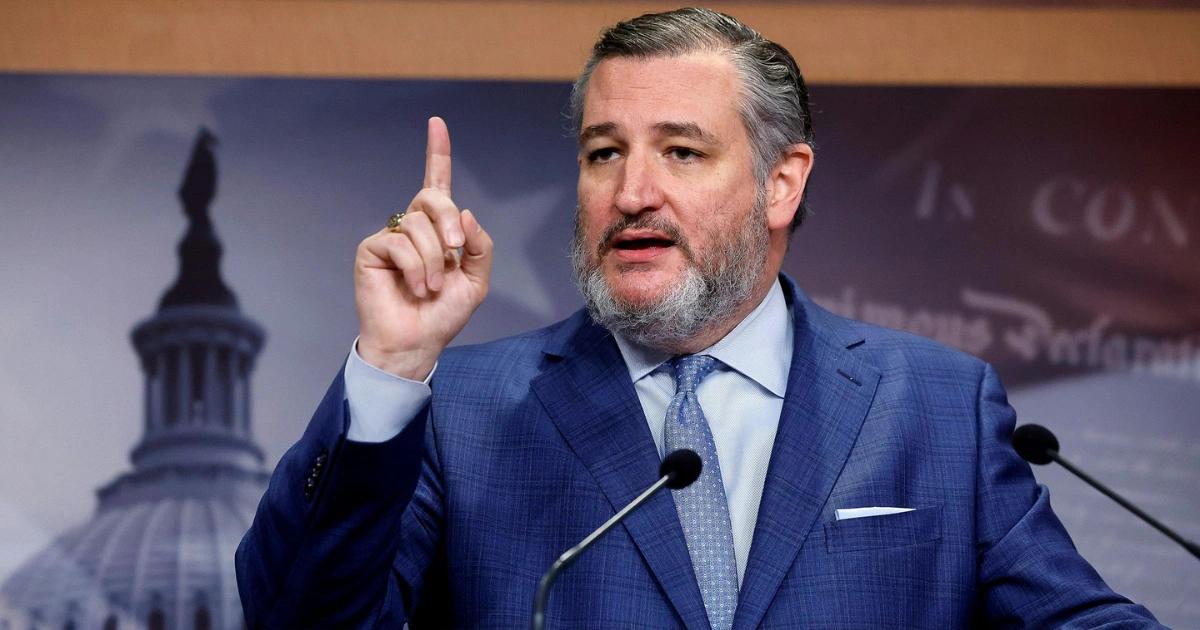
Cruz proposes removing the sunset clause on the CBDC ban, aiming to permanently prohibit the Federal Reserve from issuing digital dollars, intensifying congressional debate over digital currency.
Senator introduces amendment advocating permanent ban on U.S. issuance of CBDC
The debate in the U.S. Congress over Central Bank Digital Currency (CBDC) policies has heated up again. According to reporter Eleanor Terrett, Republican Senator Ted Cruz recently submitted an amendment to the Senate, proposing to remove the “sunset clause” on the CBDC ban in the original bill. If the amendment passes, the Federal Reserve would be permanently prohibited from issuing a CBDC.
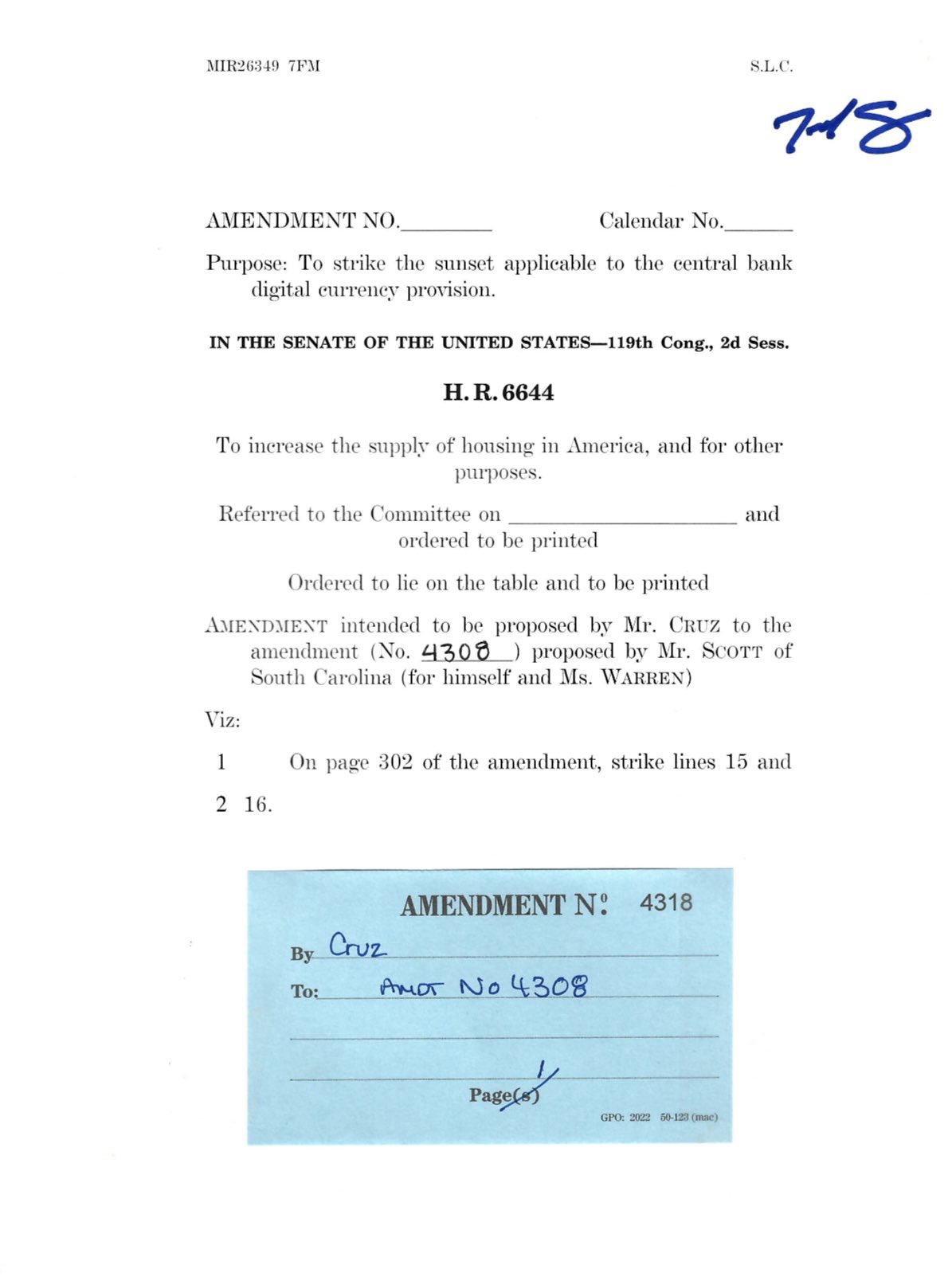
Image source: X/@EleanorTerrett Senator Ted Cruz recently submitted an amendment to the Senate, proposing to remove the sunset clause on the CBDC ban
Currently, this provision is included in the “21st Century ROAD to Housing Act” (HR 6644). This comprehensive housing reform bill, approximately 300 pages long, was introduced by the Senate Banking, Housing, and Urban Affairs Committee in March 2026. Its main goal is to address the long-term housing supply shortage in the U.S. However, unexpectedly, this bill has become a key battleground for CBDC policy debates.
According to the original language, the bill would prohibit the Federal Reserve from issuing a CBDC before December 31, 2030, but this ban is a temporary measure. Cruz’s proposed amendment (SA 4318) directly removes the deadline from the relevant provisions, meaning the ban would no longer be a delay but a permanent prohibition. Reports indicate Cruz plans to push for a Senate vote on this amendment. If ultimately approved, it would be one of the strongest anti-CBDC legislative actions in U.S. history.
Further reading
Reject CBDC! U.S. Housing Bill Proposal: Federal Reserve Banned from Issuing Digital Currency Before 2031
Multiple lawmakers sign letter opposing CBDC, citing risks of financial surveillance
Opposition to CBDC is not limited to a single lawmaker. U.S. Representative Michael Cloud recently co-signed a letter with 28 members of Congress to congressional leaders, urging stronger legislation to outright ban the U.S. from issuing a CBDC.
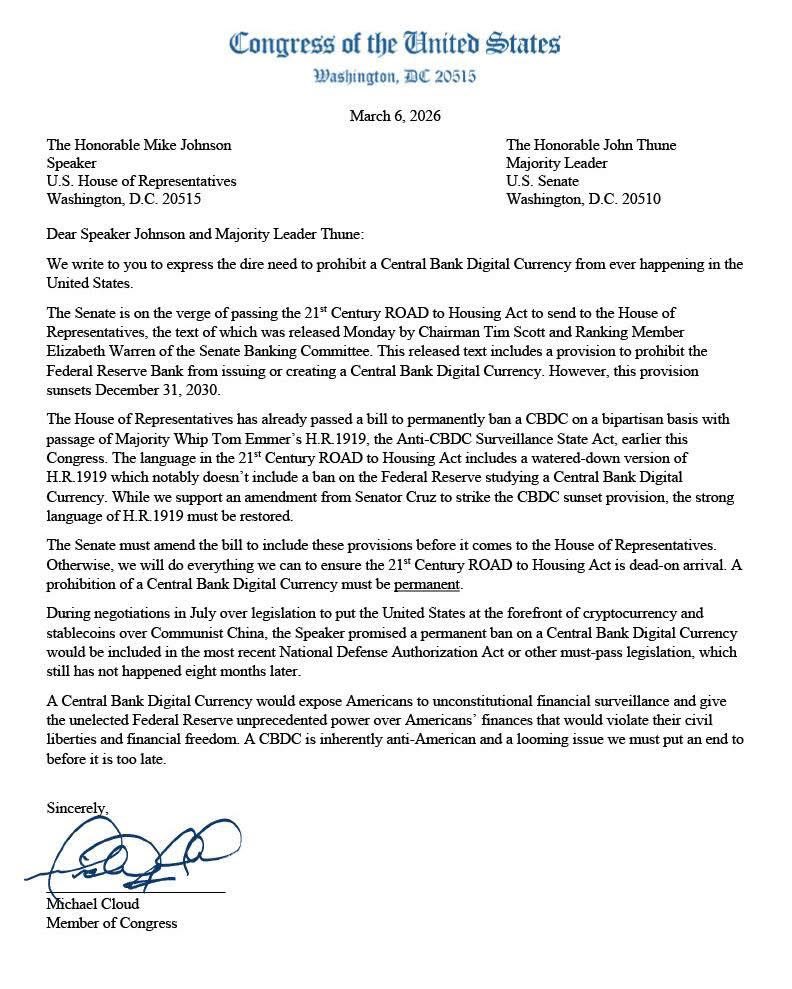
Image source: X/@RepRalphNorman 28 members of Congress sign letter urging stronger legislation to outright ban the U.S. from issuing CBDC
In the letter addressed to House Speaker Mike Johnson and Senate Majority Leader John Thune, lawmakers stated that the current bill’s temporary ban is insufficient to protect Americans’ financial freedoms. They argue that once a CBDC is launched, it could grant the government excessive financial surveillance powers, threatening citizens’ privacy and financial autonomy.
The letter notes that CBDC could enable unelected Federal Reserve officials to gain unprecedented control, monitoring individual transactions and influencing financial activities. Lawmakers believe such digital currency systems could violate constitutional rights and should be “completely prohibited” at the policy level. Some Republican members further argue that the design of CBDC fundamentally conflicts with American free-market values. They contend that once the government has the ability to control issuance and transaction monitoring, it could establish a highly centralized financial regulatory framework.
These lawmakers emphasize that Congress should enact clear legislation on CBDC while the policy is still under discussion, rather than waiting until the technology matures or government experiments begin.
Repeated CBDC Bills Stall in Congress
In fact, the U.S. Congress has proposed multiple bills to ban CBDC in recent years. In June 2025, Republican Representative Tom Emmer introduced the “Anti-CBDC Surveillance State Act” (HR 1919), aiming to prohibit the Federal Reserve from issuing retail CBDC. The bill was passed by the House in July 2025 but has yet to complete final review in the Senate.
Additionally, Senator Mike Lee introduced the “No CBDC Act” (S 464) in 2025, also seeking to ban the Federal Reserve and U.S. Treasury from launching a CBDC. However, this bill has stalled in congressional proceedings and has not advanced to substantive legislation.
Supporters of Cruz’s amendment believe that the CBDC provisions in the housing bill are just a “weakened” version of the policy. They advocate restoring the clearer prohibitions from the Emmer bill to ensure the Federal Reserve cannot introduce a digital dollar in the future.
However, it’s worth noting that even with current ban provisions, the Federal Reserve’s research into CBDC technology is not fully prohibited. The existing language only restricts issuance, not policy research or technological exploration. This is a key reason some lawmakers want to amend the bill. They believe that as long as research continues, CBDC could still be revived through policy shifts in the future.
Debate over CBDC Widens, Digital Currency Policy Becomes New Congressional Battleground
Cruz’s amendment also highlights the deep divisions in Congress over digital currency policy.
- Supporters argue that a permanent ban on CBDC can protect financial privacy and citizens’ freedoms;
- Opponents worry that excessive restrictions could cause the U.S. to fall behind in global digital financial competition.
Some policy researchers point out that multiple countries and regions are researching or testing CBDC, including China, the European Union, and several emerging markets. Completely excluding the U.S. from CBDC development could limit future innovation in financial infrastructure.
Moreover, discussions about CBDC are increasingly spilling over from financial regulation into broader policy areas. For example, this controversy arose within the housing reform bill, illustrating how digital currency issues are intersecting with other policy debates.
The Senate is expected to vote on Cruz’s amendment soon. The final outcome will not only influence the future of CBDC policy in the U.S. but could also serve as a significant reference for major economies worldwide in digital currency governance.
Disclaimer: The information on this page may come from third parties and does not represent the views or opinions of Gate. The content displayed on this page is for reference only and does not constitute any financial, investment, or legal advice. Gate does not guarantee the accuracy or completeness of the information and shall not be liable for any losses arising from the use of this information. Virtual asset investments carry high risks and are subject to significant price volatility. You may lose all of your invested principal. Please fully understand the relevant risks and make prudent decisions based on your own financial situation and risk tolerance. For details, please refer to
Disclaimer.


