The escalating crisis in the Strait of Hormuz — where military conflict, mine threats, and a near-halt in shipping have rattled global energy flows — is now rippling through financial markets, leaving investors juggling oil shocks, geopolitical risk, and a still-fragile global economy.
The Strait of Hormuz Crisis Sends Shockwaves Through Markets
The confrontation stems from Operation Epic Fury, the Feb. 28 joint U.S.-Israeli strikes on Iran that killed Iran’s Supreme Leader Ali Khamenei and triggered a wave of retaliatory missile and drone attacks across the region. Iran’s Revolutionary Guard quickly warned ships against transiting the Strait of Hormuz — a narrow but essential waterway responsible for moving roughly 20% of the world’s oil supply, about 15 million barrels per day.
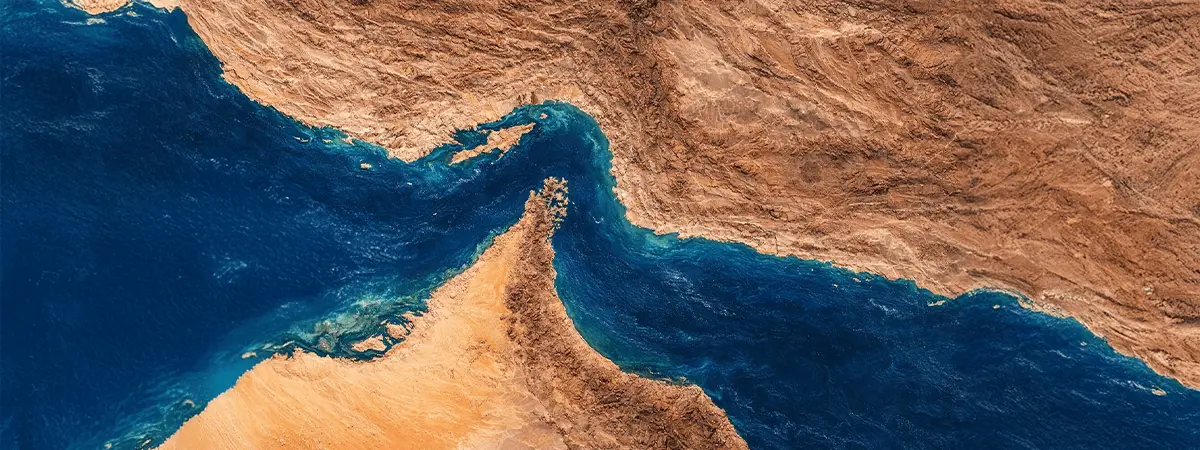 Strait of Hormuz.
That warning has had immediate consequences. Maritime data shows vessel traffic through the strait collapsing from its usual daily transits before the conflict to just a trickle, with more than 150 ships anchoring outside the chokepoint and nearly 1,000 vessels worth an estimated $25 billion stuck in nearby waters. For global energy markets, that’s the equivalent of turning down a giant faucet that fuels the modern economy.
Strait of Hormuz.
That warning has had immediate consequences. Maritime data shows vessel traffic through the strait collapsing from its usual daily transits before the conflict to just a trickle, with more than 150 ships anchoring outside the chokepoint and nearly 1,000 vessels worth an estimated $25 billion stuck in nearby waters. For global energy markets, that’s the equivalent of turning down a giant faucet that fuels the modern economy.
Tankers, Transponders, and a Bit of Creative Identity
In a sign of how tense conditions have become, some ships attempting to pass through the strait have reportedly altered their tracking signals to claim connections to China — apparently hoping Tehran will think twice before targeting vessels linked to its largest oil customer.
Shipping tracker data analyzed by AFP shows vessels broadcasting messages such as “CHINA OWNER” or “ALL CREW CHINESE” while crossing the waterway. One Panama-flagged cargo ship changed its destination to “CHINA OWNER” before successfully making the passage. Another bulk carrier briefly adopted the same identity before switching back after clearing Omani waters.
Trade risk analysts say these signals appear to be precautionary tactics rather than proof of Chinese ownership. In short, ships are essentially holding up a digital sign reading: “Nothing to see here — definitely not Western.”
Mines, Missiles, and a Naval Standoff
U.S. intelligence officials say Iran may now be preparing to deploy naval mines in the Strait of Hormuz, potentially escalating the crisis further. According to reports, small Iranian vessels capable of carrying two to three mines each could seed the shipping lane with explosives designed to deter traffic or damage tankers.
The Pentagon has already targeted Iranian mine-laying vessels, while officials say the U.S. Navy could escort ships through the strait if necessary. History suggests the threat is real. During the Iran-Iraq War in 1988, Iranian mines struck the USS Samuel B. Roberts, nearly sinking the frigate and prompting a major U.S. retaliation.
U.S. President Trump has issued a blunt warning, stating:
“If Iran does anything that stops the flow of oil within the Strait of Hormuz, they will be hit by the United States of America twenty times harder than they have been hit thus far,” he said.
Markets React: Oil, Stocks, Crypto, and Safe Havens
Financial markets are reacting exactly as one might expect when a vital global shipping lane turns into a geopolitical chessboard.
Oil prices initially rocketed above $100 per barrel, with Brent crude briefly approaching $120 — levels not seen since the early months of the Ukraine war in 2022. U.S. gasoline prices climbed to about $3.45 per gallon, up more than 50 cents in a week.
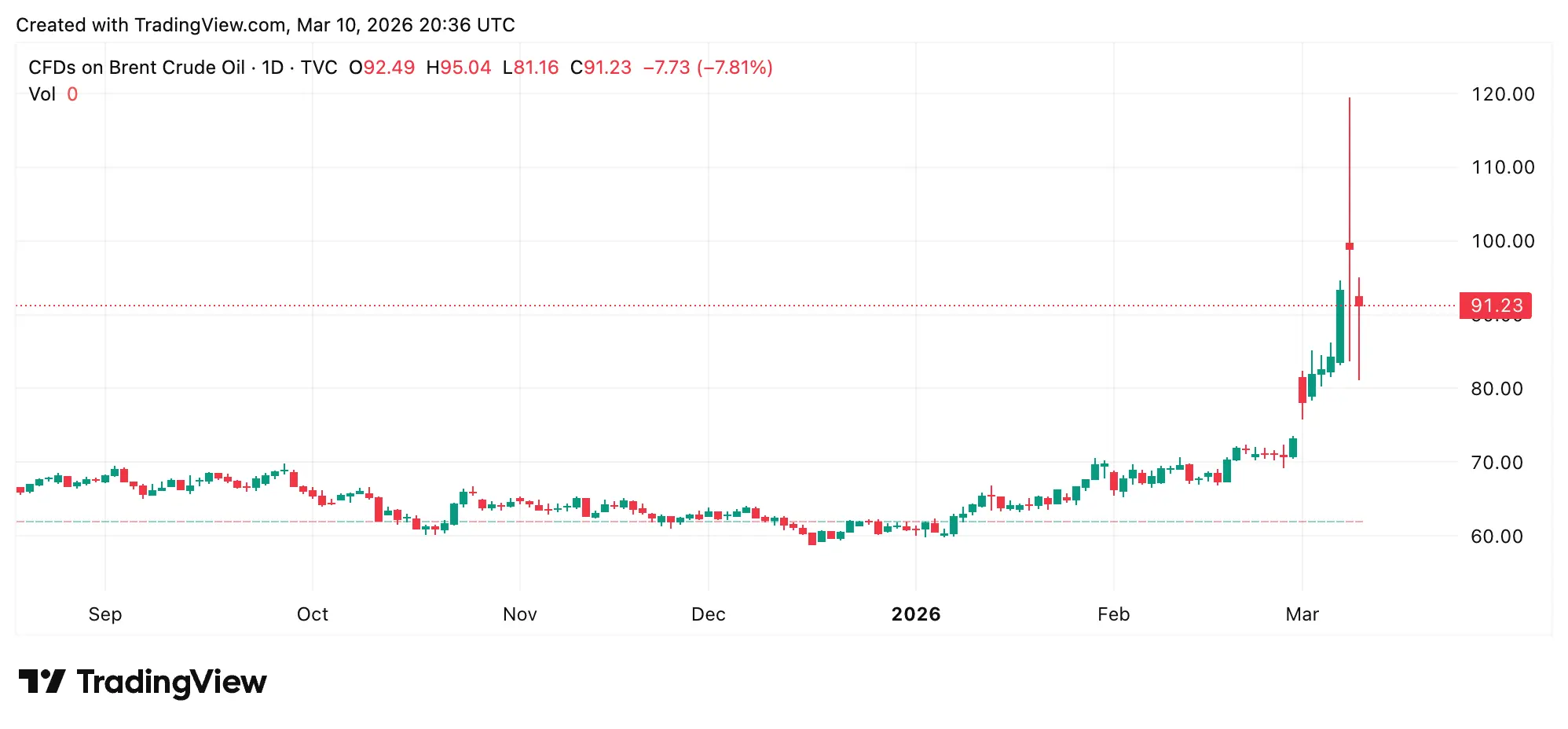 Brent crude via tradingview.com.
On Tuesday, however, oil pulled back sharply after comments from President Trump suggested the conflict might end sooner than feared. WTI crude settled near $84, down more than 9% on the day after wild intraday swings, and Brent was around $90.
Brent crude via tradingview.com.
On Tuesday, however, oil pulled back sharply after comments from President Trump suggested the conflict might end sooner than feared. WTI crude settled near $84, down more than 9% on the day after wild intraday swings, and Brent was around $90.
U.S. stocks finished a volatile session slightly lower as investors weighed war risks against hopes for de-escalation. The Dow Jones Industrial Average closed at 47,705.48, down 0.07%. The S&P 500 ended at 6,778.57, off 0.26%. Alongside this, the Nasdaq Composite finished at 22,667.95, slipping 0.12%.
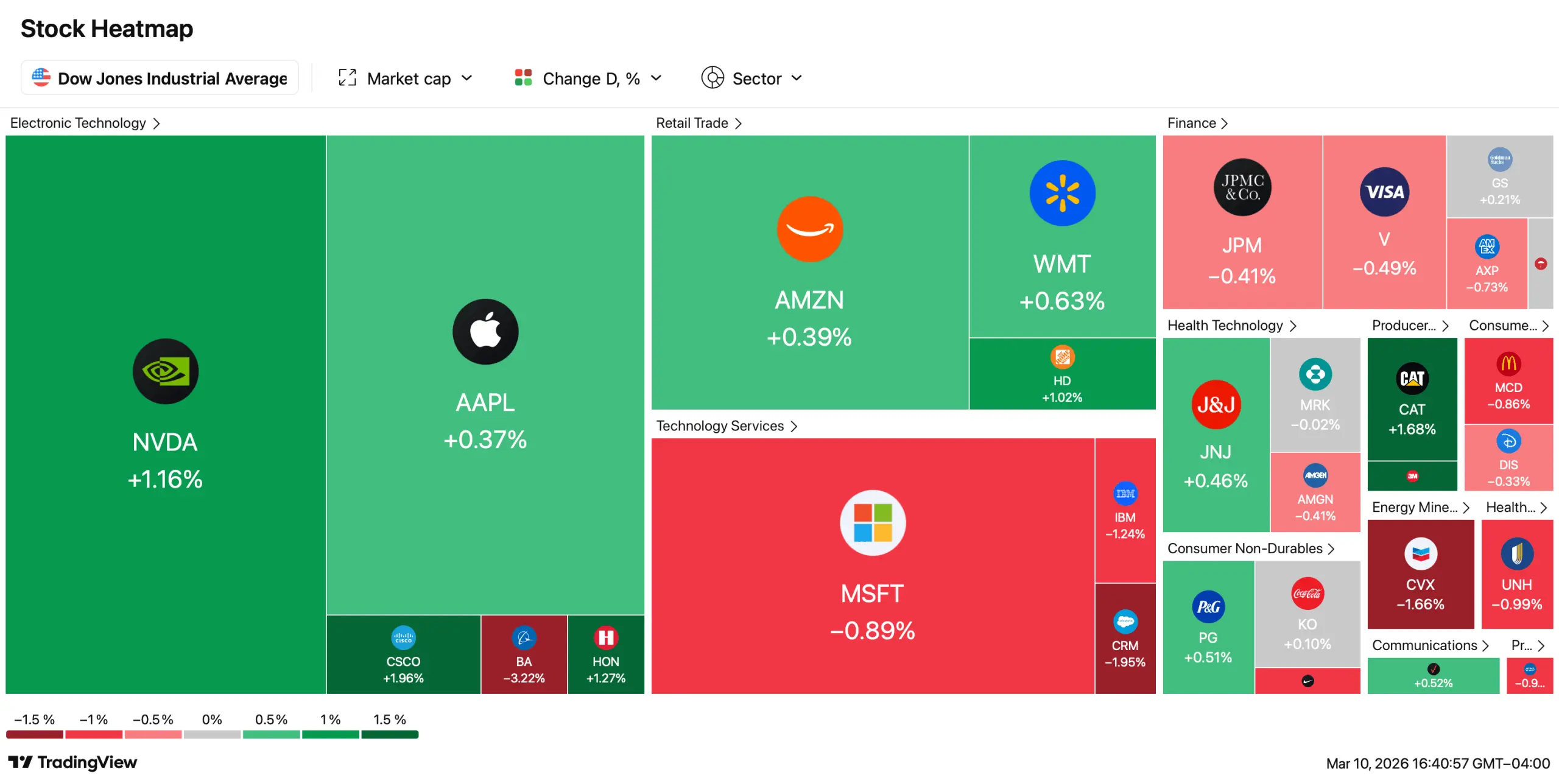 Dow Jones Industrial Average heat map via tradingview.com.
European equities jumped roughly 2% as oil retreated, highlighting how closely global markets are tethered to energy prices. Meanwhile, cryptocurrencies showed surprising composure. Bitcoin hovered around $69,989 to $70,295, up about 1.6% after almost reaching $72,000, while ethereum traded near $2,036. Institutional demand and a modest improvement in risk sentiment helped stabilize digital asset prices.
Dow Jones Industrial Average heat map via tradingview.com.
European equities jumped roughly 2% as oil retreated, highlighting how closely global markets are tethered to energy prices. Meanwhile, cryptocurrencies showed surprising composure. Bitcoin hovered around $69,989 to $70,295, up about 1.6% after almost reaching $72,000, while ethereum traded near $2,036. Institutional demand and a modest improvement in risk sentiment helped stabilize digital asset prices.
Safe-haven assets told a different story. Gold climbed near $5,200 per ounce, while silver rose more than 4%, reflecting persistent geopolitical anxiety. Treasury markets moved more cautiously. The 10-year U.S. Treasury yield hovered around 4.14%, barely budging as investors weighed inflation risks from higher energy costs against the possibility of economic slowdown.
China’s Energy Exposure
Analysts warn the crisis could also create ripple effects for China, which relies heavily on energy shipments through the strait.
Gatestone Institute senior fellow Gordon Chang noted that between 15% and 23% of China’s seaborne oil imports originate from Iran, much of it passing through the Strait of Hormuz. If those discounted barrels disappear for long, Chinese manufacturers could feel the pinch within months.
Beijing has already urged all parties to keep the strait open, emphasizing the route’s importance to global trade.
The Economy Watches the Strait
For now, markets remain deeply tied to headlines coming out of the Middle East. If tanker traffic resumes and oil prices stabilize below $90, investors could breathe easier. If the strait stays closed — or worse, becomes mined — inflation risks and energy shortages could return to center stage.
In other words, the world economy is watching a 21-mile-wide stretch of water with unusual intensity.
FAQ 🇺🇸 🇮🇷
- Why is the Strait of Hormuz important to the global economy?
The strait carries roughly 20% of the world’s oil supply, making it one of the most critical energy chokepoints on the planet.
- How are financial markets reacting to the Hormuz crisis?
Oil and precious metals initially jumped while stocks fluctuated and cryptocurrencies held relatively steady amid geopolitical uncertainty.
- Why are ships altering tracking signals near the strait?
Some vessels appear to claim Chinese connections in their tracking data to reduce the risk of being targeted during the conflict.
- Could the Strait of Hormuz closure impact inflation and the U.S. economy?
Yes, prolonged disruptions could push energy prices higher, increasing inflation pressures and complicating Federal Reserve policy decisions.


