Within today’s crypto ecosystem, Bitcoin has long been viewed as “digital gold,” but its capabilities in financial applications remain relatively limited. In contrast, Ethereum has developed a mature DeFi ecosystem, prompting the market to explore the concept of “BitcoinFi.” Mezo emerges in this context, aiming to build a financial layer that enables BTC to participate in core financial activities such as lending and stablecoin issuance.
From a broader blockchain perspective, Mezo represents an effort to integrate Bitcoin into a programmable financial system. Its value lies not only in unlocking BTC liquidity but also in advancing cross-chain financial infrastructure.
What Is Mezo (MEZO)?
As a financial layer protocol designed for the Bitcoin ecosystem, Mezo’s core function is to transform BTC into a collateral asset usable in DeFi, and to generate stablecoins, such as MUSD, based on that collateral.

At its core, Mezo can be understood as a “Bitcoin-native Maker-style system.” The key difference is that its underlying asset is BTC rather than Ethereum-based assets. By depositing BTC as collateral, users enter a process similar to “collateralizing BTC to mint stable assets,” which forms the foundation of Mezo’s operating logic.
This framework can be broken down into three core components:
-
BTC collateralization and asset mapping
-
Stablecoin issuance mechanism
-
On-chain financial operations
Together, these modules form the foundation of its BitcoinFi financial layer.
Why Does Bitcoin Need a Financial Layer? What Problems Is Mezo Solving?
Bitcoin’s design prioritizes security and decentralization, but its scripting capabilities are limited, making it difficult to support complex financial logic. As a result, despite being one of the largest crypto assets, BTC cannot directly participate in DeFi.
This limitation appears in several ways:
First is capital efficiency. BTC holders who want liquidity typically have to sell their assets, rather than using them as collateral to access funding without selling, as is common in Ethereum.
Second is the lack of application scenarios. The Bitcoin network lacks core infrastructure such as stablecoins and lending protocols, restricting its role in the on-chain economy.
Third is reliance on cross-chain solutions. Most BTC DeFi activity today depends on wrapped assets like wBTC, which introduces additional trust and security risks.
Mezo is designed to address these issues by building a native financial layer for Bitcoin, enabling BTC to participate in on-chain finance while reducing dependence on other blockchains.
How Does Mezo Work? Core Mechanisms and System Flow
Mezo’s core process revolves around “BTC collateral → stablecoin minting → on-chain usage → liquidation mechanism.”
Users first deposit BTC into the system, where it is mapped into a usable on-chain asset through mechanisms similar to tBTC. These assets are then used as collateral, and stablecoins (MUSD) are minted based on the collateral ratio.
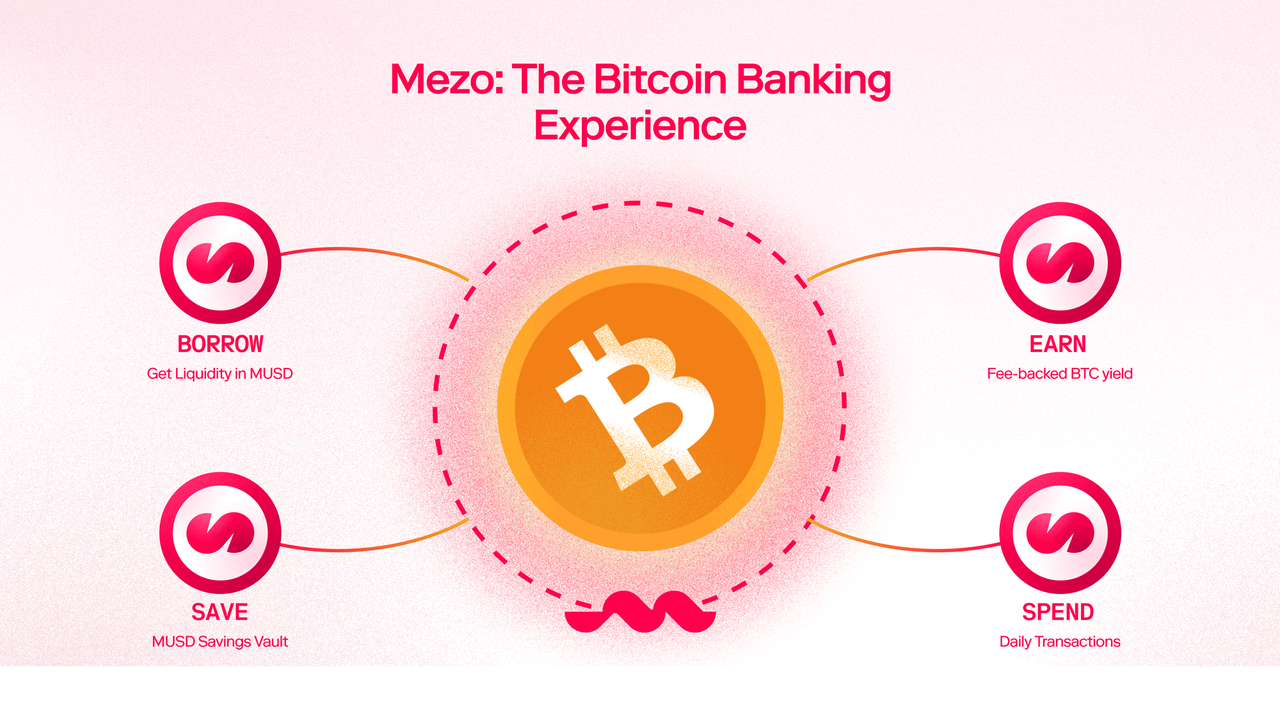
The minted stablecoins can circulate within the ecosystem, used for trading, payments, or participation in other DeFi applications. If the collateral ratio falls below a safety threshold, the system triggers liquidation to maintain overall stability.
This process resembles the Collateralized Debt Position (CDP) model. Its full lifecycle typically includes collateral locking, stablecoin minting, asset utilization, and risk monitoring with liquidation. This mechanism forms the core operational logic of Mezo’s financial layer.
Mezo’s Dual-Token Model: How BTC and MEZO Work Together
Mezo adopts a dual-token structure, assigning different roles to BTC and MEZO.
BTC serves as the system’s primary collateral asset. It underpins the value of the stablecoin and forms the foundation of the entire system. MEZO, on the other hand, is typically used for protocol-level functions such as governance, incentives, or fee mechanisms. By introducing MEZO, the system enables more flexible economic designs, such as incentivizing liquidity providers or participants.
This dual-layer structure produces two key effects:
This design mirrors the common DeFi pattern of “collateral asset + protocol token,” balancing stability and scalability.
What Is Mezo’s Technical Architecture? tBTC, EVM, and Multichain Support
Mezo’s architecture consists of three key components:
First is the cross-chain bridge mechanism, such as tBTC, which brings BTC into a programmable environment. This involves asset locking and on-chain representation, forming the foundation of BitcoinFi.
Second is an EVM-compatible environment, allowing developers to build smart contract applications on Mezo. This is critical for integrating DeFi, as it lowers the barrier to development.
Third is multichain support, enabling Mezo to interact with other blockchain ecosystems and expand its use cases.
Overall, Mezo’s architecture can be understood as:
“BTC security layer + cross-chain bridge + smart contract execution layer”
This layered design allows it to maintain Bitcoin’s security while introducing programmable financial capabilities.
What Are Mezo’s Advantages? How Does It Differ from Traditional Bitcoin Usage?
Compared to traditional Bitcoin usage, Mezo offers expanded capabilities across several dimensions.
First is liquidity unlocking. By using BTC as collateral instead of selling it, users can access funds while maintaining exposure to their assets.
Second is expanded financial functionality. Mezo introduces mechanisms such as stablecoins and lending, allowing BTC to participate in more complex financial activities.
Third is ecosystem compatibility. With EVM support, Mezo can integrate with existing DeFi ecosystems rather than building from scratch.
Compared to the traditional model of simply holding or transferring BTC, Mezo functions more like a complete financial system rather than just a store of value.
Risks and Potential Challenges of Mezo
While Mezo introduces new financial capabilities, its design also brings a range of risks.
First is cross-chain bridge security. The mapping of BTC relies on bridging mechanisms, which are often prime targets for attacks.
Second is liquidation risk. In extreme market volatility, collateralized assets may be liquidated rapidly.
Third is liquidity dependence. The stability of the stablecoin depends on market demand and liquidity support.
Additionally, system complexity can introduce new risks, such as smart contract vulnerabilities or design flaws.
These factors collectively determine the system’s real-world stability.
Mezo vs MakerDAO: Comparing Collateralized Stablecoin Models
Both Mezo and MakerDAO use collateralized stablecoin models, but their underlying logic differs significantly.
| Dimension |
Mezo |
MakerDAO |
| Collateral |
BTC |
ETH / Multi-asset |
| Network Base |
Bitcoin + Cross-chain |
Ethereum |
| Stablecoin |
MUSD |
DAI |
| Technical Dependency |
Cross-chain bridge + EVM |
Native smart contracts |
| Risk Source |
Bridging risk |
Contract and market risk |
The key distinction is that Mezo brings Bitcoin into DeFi, whereas MakerDAO is a native DeFi system. This difference affects their security models, scalability, and ecosystem dependencies.
Mezo’s Position in the BitcoinFi Landscape: How Does It Differ from Ethereum DeFi?
The core difference between BitcoinFi and Ethereum DeFi lies in their underlying assets and technical capabilities.
Ethereum supports smart contracts natively, which has enabled a highly developed DeFi ecosystem. BitcoinFi, by contrast, requires additional layers, such as Mezo, to achieve similar functionality.
Mezo positions itself as a “financial middleware layer,” connecting BTC with DeFi applications.
This model expands Bitcoin’s application boundaries by integrating it into programmable finance and building cross-chain financial infrastructure.
In this sense, Mezo functions as a “DeFi gateway layer” within the Bitcoin ecosystem.
Conclusion: Could Mezo Become a Key Infrastructure Layer for Bitcoin Finance?
Mezo provides a pathway for integrating BTC into DeFi. Through collateral mechanisms, stablecoin issuance, and cross-chain architecture, it enables Bitcoin to participate in more complex financial activities.
Its core value lies in improving BTC’s capital efficiency and advancing the BitcoinFi ecosystem.
However, its long-term impact will depend on several factors, including cross-chain security, liquidity scale, and ecosystem adoption.
Structurally, Mezo represents a typical attempt at building a financial layer for Bitcoin, and its development trajectory may significantly influence the broader BitcoinFi landscape.
FAQs
What is Mezo’s core operational process?
It includes BTC mapping, collateralization, stablecoin minting, and liquidation mechanisms.
Why is tBTC needed?
tBTC enables BTC to enter a programmable environment and participate in smart contract operations.
Is MUSD fully backed by BTC?
Its value is primarily supported by BTC collateral and maintained through an over-collateralization mechanism.
What happens if BTC price drops?
If the collateral ratio falls below a safety threshold, the system triggers liquidation.
Is Mezo similar to other DeFi protocols?
It follows a similar collateralized stablecoin logic, but differs in its underlying assets and technical approach.
How do users exit Mezo?
By repaying MUSD and unlocking their collateral, users can withdraw their original BTC.