THINK: Redefining the Standard for Decentralized AI

Beginner
Quick Reads
Last Updated 2026-03-29 22:41:25
Reading Time: 1m
THINK is an innovative AI protocol built on a Soul-Mind-Body framework, combining blockchain and artificial intelligence to deliver an evolvable, decentralized intelligent agent system—an AI that is genuinely owned by the user.

What Is THINK?

THINK is an open protocol designed for building decentralized intelligent agents. Using a modular architecture, it brings the construction and evolution of artificial intelligence into the blockchain ecosystem. THINK establishes a standard composed of three core components—Soul, Mind, and Body—enabling AI to autonomously develop, learn, and interact within the Web3 environment.

Unlike traditional AI solutions that rely on large centralized platforms, THINK prioritizes user-owned agents. It leverages NFI (Non-Fungible Intelligence) tokens to provide both identity verification and behavioral consistency across different contexts.

The Three Core Components of a THINK Agent
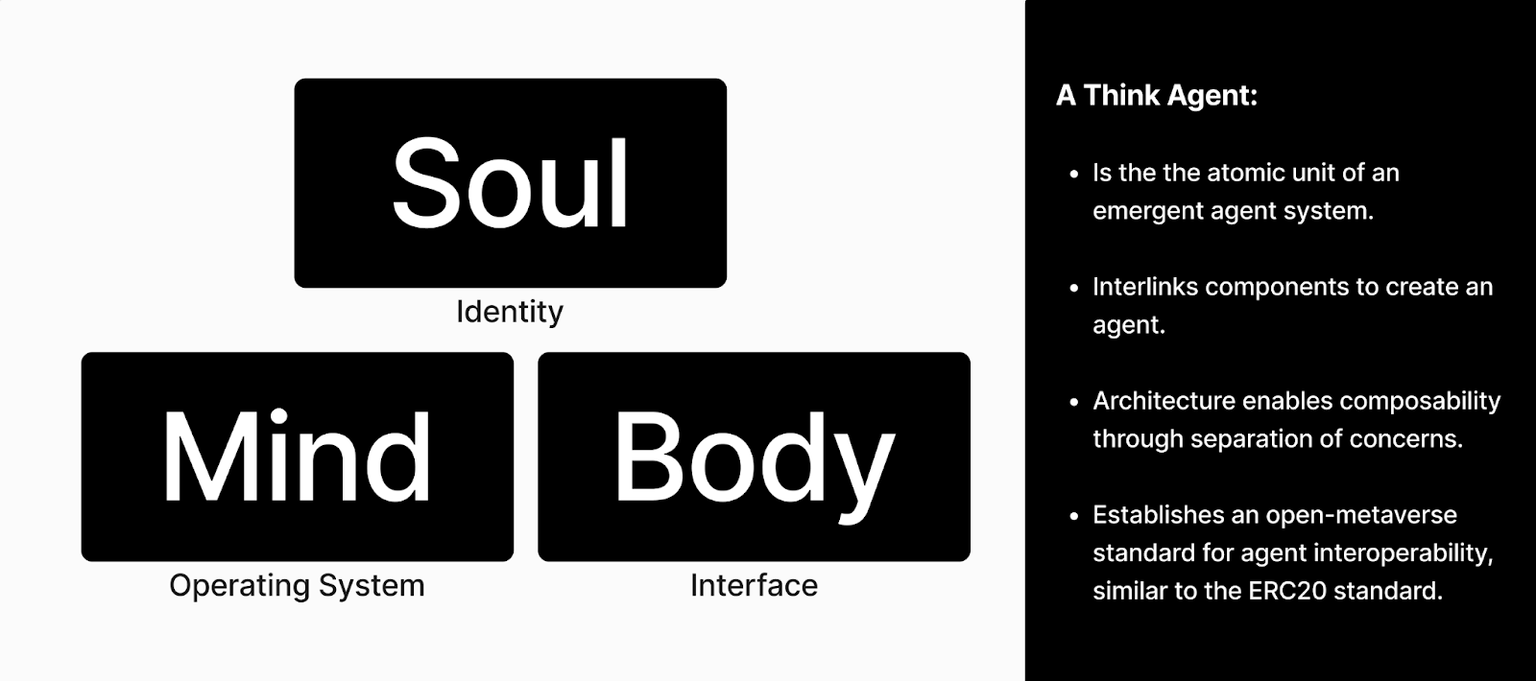

Image: https://docs.thinkagents.ai/whitepaper/think-agent-standard

  • Soul: The Soul is an NFI (Non-Fungible Intelligence) token representing each agent’s unique identity. It contains a “gene matrix” that defines personality, skills, and interaction style. This ensures consistent behavior across multiple platforms.
  • Mind: The Mind is the agent’s central processor, responsible for memory, decision-making, and communication. It supports a plug-in learning model, allowing the integration of open-source projects, custom logic, or third-party services. This enables exceptional adaptability.
  • Body: The Body represents the agent’s physical or digital form within the environment. This might include 3D avatars, user interfaces, or robotics hardware. The body manages environmental interactions, records behavioral history, and influences future decisions.

How THINK Differs from Traditional AI

Key characteristics of the THINK agent system:

  • Decentralized: Free from control by any single platform
  • Modular: Plug-and-play components for flexible combinations
  • Evolutionary: Continuous optimization via feedback mechanisms
  • Interoperable: Operates across blockchains and applications
  • Self-Growing: Dynamically adjusts behavior based on market performance using the Reinforcement Learning from Market Feedback (RLMF) mechanism (RLMF)

THINK Token: Utility and Economic Model

THINK serves as the core token of the protocol, powering a wide range of functions, including:

  • Minting and upgrading THINK agents
  • Paying for agent services and operational fees
  • Facilitating transactions between agents
  • Accessing advanced models, computing resources, and plug-ins
  • Enabling developer tools and permissioned systems

Token distribution overview:

  • Community & Ecosystem: 28.5%
  • Foundation: 10%
  • Team & Contributors: 14.5%
  • Investors & Partners: 15%
  • Emission Mechanism: 30%
  • Liquidity: 2%

THINK supports two types of staking—governance staking and agent support staking—and offers an Ecosystem Pool to reward contributors.

Use Cases and Future Outlook

Potential applications for THINK agents include:

  • AI NPCs in Web3 gaming
  • DeFi trading bots
  • Personal scheduling assistants
  • AI research and innovation systems
  • Intelligent governors within autonomous organizations

The mainnet launch and $THINK token listing are significant milestones. The ecosystem is set for rapid expansion in Q3–Q4. Looking ahead, THINK aims to become the standard interface for open AI networks, enabling broader user access to AI capabilities.

THINK is available for spot trading on Gate: https://www.gate.com/trade/THINK_USDT

Author: Max
Disclaimer
* The information is not intended to be and does not constitute financial advice or any other recommendation of any sort offered or endorsed by Gate.
* This article may not be reproduced, transmitted or copied without referencing Gate. Contravention is an infringement of Copyright Act and may be subject to legal action.

Related Articles

What is Fartcoin? All You Need to Know About FARTCOIN
Intermediate

What is Fartcoin? All You Need to Know About FARTCOIN

Fartcoin (FARTCOIN) is a representative meme coin within the Solana ecosystem based on an AI-driven narrative. Its core concept originated from an experiment aimed at exploring the "boundaries between AI Agents and humor." More than just a digital asset with social attributes, the project deeply couples absurd humor culture with on-chain financial logic by integrating autonomous AI interaction models.
2026-04-04 22:01:19
Gold Price Forecast for the Next Five Years: 2026–2030 Trend Outlook and Investment Implications, Could It Reach $6,000?
Beginner

Gold Price Forecast for the Next Five Years: 2026–2030 Trend Outlook and Investment Implications, Could It Reach $6,000?

Analyze current gold price trends alongside authoritative five-year forecasts, integrating an evaluation of market risks and opportunities. This gives investors insight into the potential trajectory of gold prices and the main drivers expected to shape the market over the next five years.
2026-03-25 18:13:30
Aster vs Hyperliquid: Which Perp DEX Will Prevail?
Beginner

Aster vs Hyperliquid: Which Perp DEX Will Prevail?

Aster and Hyperliquid are the two representative protocols of the "purpose-built L1 path" within the current decentralized perpetual exchange (Perp DEX) sector. As a pioneer in the field, Hyperliquid has built a deep liquidity moat through its highly mature order book architecture and strong community consensus. Conversely, Aster, as a rising challenger, seeks to leapfrog the competition in high-performance trading through more aggressive multi-chain aggregation logic, private transaction modules, and an underlying execution environment optimized for 2026 market demands.
2026-03-24 11:58:33
AI-Native Settlement Layers: How United Stables Is Building the Next Financial Rail
Beginner

AI-Native Settlement Layers: How United Stables Is Building the Next Financial Rail

Stablecoins were originally designed as dollar substitutes within exchanges, primarily used for asset pricing and trade settlement. As on-chain financial ecosystems have matured, their role has expanded beyond simple payments to include collateral assets, cross-chain liquidity mediums, and unified settlement units. In particular, as AI systems and automated agents begin to participate directly in economic activity, demand has risen sharply for programmable value units capable of instant settlement. This shift is pushing stablecoins toward the role of foundational financial infrastructure.
2026-03-25 03:16:17
Aerodrome Tokenomics: How ve(3,3) Powers Base's Most Profitable DEX
Beginner

Aerodrome Tokenomics: How ve(3,3) Powers Base's Most Profitable DEX

AERO is the native token of Aerodrome Finance, a core decentralized exchange and liquidity protocol in the Base ecosystem. It is primarily used for liquidity incentives and ecosystem operations. veAERO is a governance NFT that users receive by locking AERO, representing both voting power and the right to share protocol revenue. Through a dual track structure of AERO as a utility token and veAERO as a governance credential, Aerodrome separates liquidity usage value from long term governance power, allowing participants to act as liquidity providers, governance decision makers, and revenue sharers within the same system.
2026-03-25 06:40:31
The ve(3,3) Flywheel Explained: How AERO Tokenomics Powers Aerodrome’s DeFi Economy
Beginner

The ve(3,3) Flywheel Explained: How AERO Tokenomics Powers Aerodrome’s DeFi Economy

In the competition for DeFi liquidity, high-inflation mining alone is no longer enough to build lasting advantages. Aerodrome applies the ve(3,3) economic model to redesign token emissions, voting mechanisms, and revenue distribution, creating a liquidity flywheel centered on governance and cash flow. This article examines AERO tokenomics, the veAERO locking mechanism, and protocol revenue models to explain how Aerodrome builds a sustainable DeFi economic system.
2026-03-25 06:41:58





