Hyperliquid’s Deep Intervention in Financial Processes — Polished PR on the Surface, Strategic Pressure on Competitors Beneath
Hyperliquid: Overview and Market Standing
Hyperliquid has quickly emerged as a breakout player in decentralized derivatives trading, rapidly capturing significant market attention and user traffic. Within the highly competitive DeFi perpetual contracts segment, Hyperliquid has carved out a distinct presence by delivering a high-frequency trading experience and consistently expanding liquidity.
Public data shows that Hyperliquid’s daily trading volume has repeatedly set new interim highs, placing it among the leading decentralized derivatives platforms at various times. Meanwhile, both user activity and on-chain interaction frequency have continued to climb, indicating this growth is not just driven by short-term hype but is building lasting user engagement. The platform’s simultaneous expansion in “trading volume + user activity” has made Hyperliquid a formidable force in the current DeFi derivatives landscape.
Recent Price Action and Market Performance
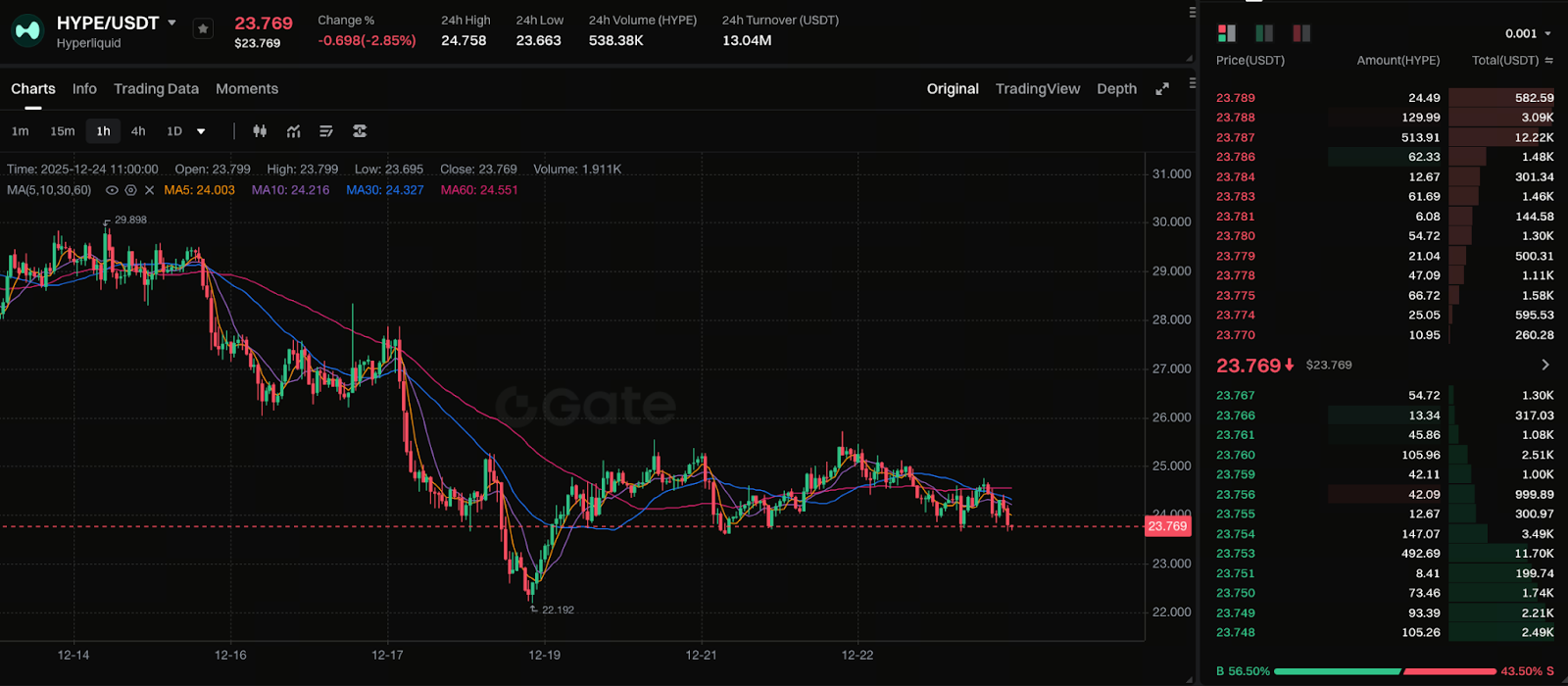
Chart: https://www.gate.com/trade/HYPE_USDT
In the secondary market, Hyperliquid’s native token HYPE has recently exhibited pronounced volatility. The price surged over 10% in a short window, then entered a consolidation phase, signaling that the market is still digesting shifts in supply and demand as well as broader macro sentiment.
The short-term rebound was mainly driven by a broader crypto market recovery and improved sentiment from rising platform trading volumes. Structurally, however, the current price action reflects more of a capital rotation phase than a clear breakout trend.
At the same time, Hyperliquid’s platform metrics remain robust across both centralized exchanges and decentralized ecosystems. Key indicators like daily transaction count and TVL continue to rise, helping to offset negative sentiment from price swings and demonstrating that market interest in the protocol has not meaningfully cooled during periods of volatility.
Deeper Financial Process Involvement: A PR Perspective
Recently, the Hyperliquid team has placed greater emphasis on “deep involvement in financial processes” in its external communications. Officially, these initiatives are positioned as steps to enhance platform transparency and governance, such as bolstering audit mechanisms, disclosing financial structures, and optimizing internal oversight procedures.
Given the ongoing trust challenges in the DeFi sector, these statements send a strong positive signal, reinforcing a brand image of “stable operations and managed risk” and strengthening the trust foundation for potential users and capital partners.
On closer inspection, however, these PR moves are not just about compliance or governance upgrades—they likely reflect deeper strategic market intentions.
Strategic Motives: Narrative Competition and Shaping the Landscape
In the highly commoditized DeFi derivatives sector, narrative advantage often sways user decisions and capital flows as much as technical superiority. By repeatedly highlighting its proactive approach to financial processes, risk management, and transparent audits, Hyperliquid is deliberately positioning itself as a “safer, more reliable infrastructure platform.”
This narrative strategy creates a subtle contrast with other platforms. During periods of sharp market swings or extreme events, Hyperliquid’s handling of risk is frequently compared to competitors—often casting implicit doubt on their risk controls.
Thus, these seemingly neutral PR actions serve both as brand-building and as a form of soft competition, setting standards and raising expectations that indirectly constrain other platforms’ market space.
Risks and Industry-Level Concerns
Hyperliquid’s strategy is not without controversy. Some industry commentators point out that as decentralized platforms focus more on “transparency” and “process control,” they may also centralize more decision-making power—especially in core financial and risk management areas—creating potential friction with the ethos of decentralization.
Additionally, liquidation performance during periods of extreme price volatility has frequently drawn scrutiny. In highly volatile markets, the platform has experienced large-scale liquidations, sparking debate over its risk models and system resilience. These issues remind investors that even fast-growing platforms remain exposed to structural risks.
How Should Investors Assess Hyperliquid’s Future?
For investors, it’s crucial to understand Hyperliquid’s current development stage and strategic trajectory. Its recent PR and governance initiatives may boost market attention and provide a short-term sentiment premium, but long-term competitiveness will depend on sustained delivery of core fundamentals.
Key focus areas include:
- Key support and resistance levels for HYPE’s price,
- The real-world effectiveness of platform governance and financial transparency efforts,
- Shifts in the competitive landscape with other DeFi platforms and centralized exchanges.
In the highly volatile, competitive crypto market, opportunity and risk are always intertwined. Every investment decision should be grounded in structural analysis—not driven by isolated events or PR narratives.
Conclusion
Hyperliquid’s deep involvement in financial processes has both elevated its brand visibility and may represent a carefully crafted competitive strategy. As the DeFi derivatives sector continues to evolve, the ability to balance PR narratives, governance enhancements, and technical strength will be critical for Hyperliquid to maintain a long-term competitive edge.
Share
Content


Related Articles

2025 BTC Price Prediction: BTC Trend Forecast Based on Technical and Macroeconomic Data

Flare Crypto Explained: What Is Flare Network and Why It Matters in 2025

How to Use a Crypto Whale Tracker: Top Tool Recommendation for 2025 to Follow Whale Moves

Pi Coin Transaction Guide: How to Transfer to Gate.com

What is N2: An AI-Driven Layer 2 Solution