As Web3 applications like DeFi, NFT, and DAO evolve rapidly, blockchain data volumes are surging. Smart contract transactions, on-chain asset statuses, and user interactions generate massive amounts of data daily. However, this information is typically stored as raw transaction logs on the blockchain, making it inefficient to read and difficult for developers to quickly access what they need. As a result, on-chain data access has become a critical bottleneck for Web3 application scaling.
The Graph was developed to address this challenge. As a decentralized data indexing protocol within the Web3 ecosystem, The Graph organizes complex on-chain data into structured, easily queryable information, offering developers a data access experience comparable to traditional APIs.
How Does The Graph Work?
The Graph’s primary objective is to transform complex, unreadable blockchain data into interfaces that enable fast access. Its architecture centers on three core components—Subgraph, Indexer, and GraphQL—that together create a seamless data indexing workflow.
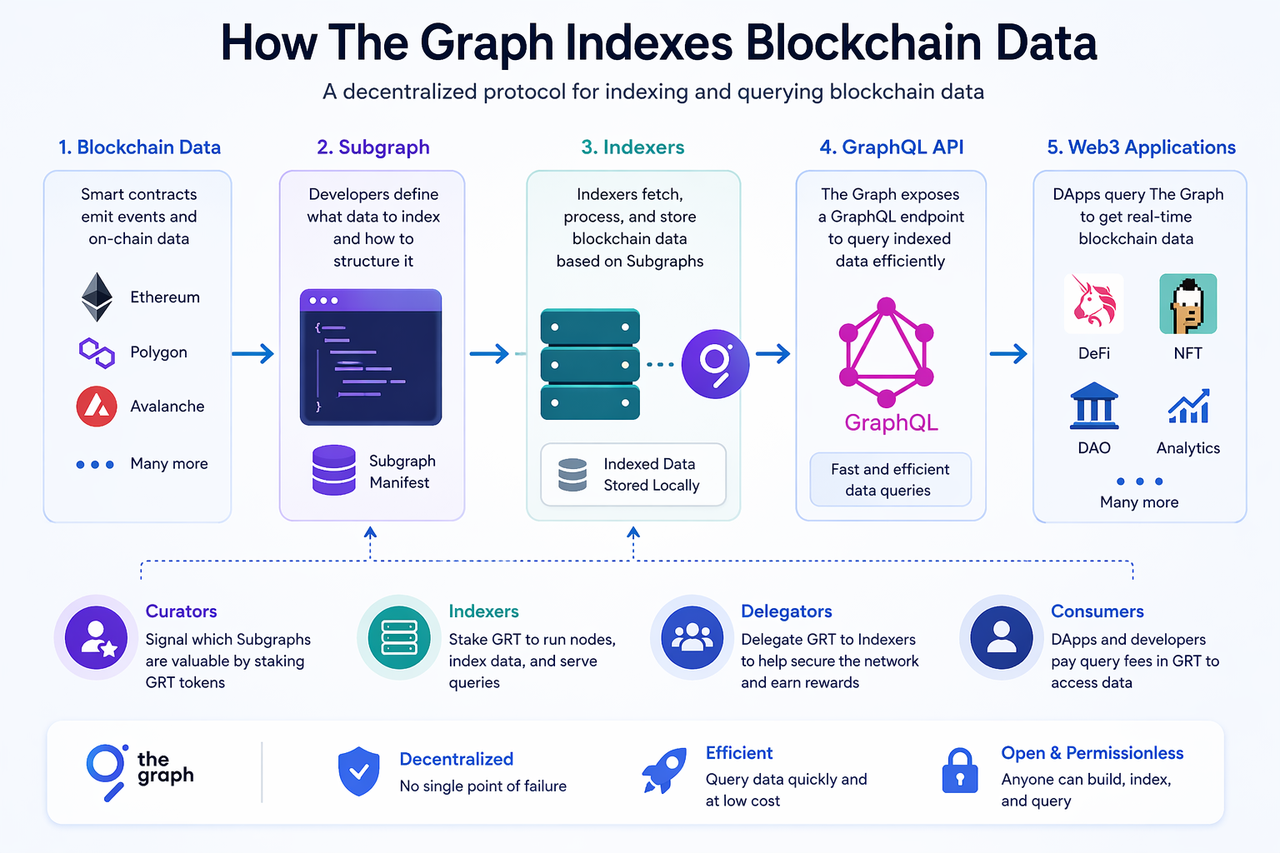
In essence, developers first define the data they need to index using Subgraph. Indexer nodes then capture and process on-chain data according to these rules. Finally, applications access the indexed data via the GraphQL query interface. This design enables efficient, decentralized data retrieval.
Subgraph: The Core Logic for Data Indexing Rules
Subgraph forms the foundation of The Graph network—it’s essentially a set of rules for indexing on-chain data. Developers create Subgraphs to specify which smart contract events to monitor, which fields to extract, and how the data should be structured and stored.
For example, if a decentralized exchange needs to display trading activity and liquidity metrics, developers can configure a Subgraph to index Swap, Mint, and Burn events from trading contracts. The Graph network automatically captures and organizes this data based on the rules, allowing applications to retrieve it efficiently.
Subgraph eliminates the need for developers to manually parse blockchain logs, significantly reducing data processing complexity. This is key to The Graph’s ability to support extensive DApp data requirements.
Indexer: The Node That Executes Data Indexing
Indexers are node operators in The Graph network, responsible for indexing data and responding to queries. They run Graph Node software, capturing blockchain data and building indexes according to Subgraph specifications.
When developers or DApps submit queries, Indexers return the relevant data and earn query fee rewards. To ensure network security and service quality, Indexers must stake GRT to participate in the network.
This mechanism incentivizes nodes to provide continuous service and guarantees decentralized data indexing. As The Graph adoption grows, Indexers become increasingly critical, and their earning potential is directly influenced by network usage.
GraphQL: The High-Efficiency Query Interface
GraphQL is The Graph’s query language, enabling developers to quickly retrieve specific on-chain data. Unlike traditional blockchain query methods, GraphQL lets developers request only the fields they need, avoiding unnecessary data traversal.
For instance, developers can query a particular address’s transaction history or the liquidity status of a specific trading pool without downloading the entire blockchain dataset. This dramatically improves query efficiency and reduces development and operational costs.
By introducing GraphQL, The Graph delivers a development experience akin to Web2 APIs, which is a major driver of its widespread adoption.
The Graph’s Complete Data Indexing Workflow
The Graph’s data indexing process follows these steps:
First, developers create and deploy Subgraphs, defining the data indexing rules. Next, Indexers monitor on-chain events and capture relevant data based on the Subgraph. This data is then processed and stored in a format suitable for querying. Finally, developers access the required data through the GraphQL interface and display it in their applications.
This workflow automates the transformation of raw blockchain data into visualized application data, greatly enhancing Web3 data access efficiency.
What Roles Do Curator and Delegator Play in The Graph?
Beyond Indexers, The Graph network features two other key participants: Curators and Delegators.
Curators evaluate which Subgraphs are most valuable and signal their importance to the network by staking GRT, helping Indexers prioritize high-quality data sources. This improves resource allocation efficiency.
Delegators are users who delegate GRT to Indexers. Without running nodes themselves, they can earn returns by supporting Indexers, lowering the participation barrier and strengthening network security.
Through the collaboration of Indexers, Curators, and Delegators, The Graph establishes a robust decentralized indexing ecosystem.
Why Is The Graph’s Data Indexing Mechanism Critical?
In traditional internet infrastructure, search engines and database indexes are fundamental to data access. In Web3, The Graph plays a similar role—building indexes for blockchain data so developers can quickly access the information they need.
Without a data indexing mechanism, DApp developers would need to run their own nodes and process complex on-chain data, incurring substantial costs. The Graph standardizes data query services, lowering the development threshold and accelerating Web3 innovation.
As blockchain applications proliferate, demand for on-chain data queries continues to grow, making The Graph’s indexing mechanism a cornerstone of Web3 infrastructure.
How Does The Graph’s Mechanism Support GRT Value?
The Graph’s operational model directly drives demand for GRT. Developers and applications use GRT to pay query fees, while Indexers, Curators, and Delegators must stake GRT to participate in the network.
As more applications are deployed on The Graph, rising query demand boosts GRT utilization. Simultaneously, node participants’ staking reduces circulating supply, reinforcing GRT’s value.
Thus, The Graph’s data indexing mechanism is both the foundation of protocol operation and a core source of GRT token value.
Summary
The Graph leverages Subgraph, Indexer, and GraphQL to build a comprehensive decentralized data indexing system, enabling developers to rapidly access blockchain data. Subgraph defines the indexing rules, Indexer executes data processing, and GraphQL offers efficient query interfaces—together forming The Graph’s operational core. As Web3 applications continue to expand, this data indexing capability will become increasingly vital and provide long-term value support for GRT.
FAQs
What is Subgraph’s role in The Graph?
Subgraph is The Graph’s data indexing rule template, defining which on-chain data to monitor and how to organize it. It is the core foundation of the data indexing workflow.
How do Indexers earn returns in The Graph?
Indexers earn query fees and protocol rewards by running nodes that process data indexing and query requests. They must stake GRT to participate in network operations.
Why does The Graph use GraphQL?
GraphQL enables developers to precisely query the data they need, improving on-chain data access efficiency and reducing application costs. It is a key tool for The Graph’s efficient data services.
How does The Graph’s mechanism affect GRT value?
Developers pay query fees and node participants stake GRT, jointly driving demand for GRT. As The Graph network usage grows, GRT’s value is further supported.







