Harvest Finance (FARM) is a leading yield aggregation protocol launched in 2020, designed to simplify and optimize automated yield farming across multiple DeFi protocols. Operating on Ethereum through decentralized smart contracts, Harvest enables users to maximize returns while minimizing manual management complexity through innovative farming strategies. The platform utilizes FARM governance tokens, allowing holders to participate in protocol decisions and earn 5% of platform fee revenues. As of January 2026, Harvest maintains 15,413 token holders and a circulating supply of 672,183 FARM tokens, trading at $16.82 with substantial 1-year price decline reflecting broader DeFi market dynamics. This comprehensive guide explores Harvest's technical architecture, market performance, ecosystem applications, governance mechanisms, and community landscape. Whether you're a beginner seeking passive income or an experienced DeFi participant, Harvest offers transparent, blockchain-based yield optimization opportunities
Harvest (FARM)'s Positioning and Significance
In 2020, the Harvest Finance team launched Harvest (FARM), designed to address inefficiencies in DeFi yield farming and the complexity of managing multiple protocols.
As a yield aggregation protocol, Harvest plays a key role in DeFi farming and automated yield optimization.
As of 2026, Harvest has established itself as an automated yield optimization platform with over 15,400 token holders and an active development community.
This article will analyze its technical architecture, market performance, and future potential.
Origin and Development History
Background
Harvest was created by the Harvest Finance team in September 2020, aiming to solve the complexity and time-consuming nature of manually managing yield farming across multiple DeFi protocols.
It emerged during the explosive growth of the DeFi ecosystem, with the goal of providing automated yield optimization and simplifying the farming process for users through innovative technology.
The launch of Harvest brought new possibilities for DeFi users seeking efficient yield generation.
Key Milestones
- 2020: Mainnet launched on Ethereum, implementing automated yield farming strategies across major DeFi protocols.
- Ongoing development has focused on optimizing farming techniques and expanding supported protocols.
- The platform has maintained continuous operation, serving holders who participate in governance decisions.
- The FARM token serves as the governance token, allowing holders to vote on treasury management proposals and earn fee revenue from platform operations.
With support from the community and development team, Harvest continues to refine its strategies, security measures, and real-world applications.
How Does Harvest Work?
Decentralized Operation
Harvest operates on the Ethereum blockchain network, functioning without centralized banking or governmental control.
The protocol utilizes smart contracts to automate yield farming strategies, ensuring transparent operations and reducing reliance on intermediaries, giving users greater control over their assets while enhancing network resilience.
Blockchain Foundation
Harvest's operations are built on Ethereum's blockchain, a public and immutable digital ledger that records all protocol transactions.
Transactions are grouped into blocks and linked through cryptographic hashing to form a secure chain.
Anyone can verify the records, establishing trust without intermediaries.
The protocol leverages Ethereum's smart contract capabilities to automate complex farming strategies across multiple DeFi platforms.
Governance Mechanism
Harvest employs a governance token model where FARM holders can vote on proposals regarding treasury management and protocol operations.
Token holders participate in governance decisions to maintain protocol direction and development, earning 5% of fees generated from Harvest operations as rewards.
The governance structure emphasizes community participation and decentralized decision-making.
Secure Transactions
Harvest utilizes Ethereum's public-private key cryptography to protect transactions:
- Private keys (similar to secret passwords) are used to authorize transactions
- Public keys (similar to account numbers) are used to verify ownership
This mechanism ensures fund security while maintaining pseudonymous transaction privacy.
The protocol operates through audited smart contracts deployed at address 0xa0246c9032bC3A600820415aE600c6388619A14D on the Ethereum network.
Circulation Overview
As of January 26, 2026, Harvest (FARM) has a circulating supply of 672,183.45 tokens, with a total supply of 690,420 tokens, representing a circulation ratio of approximately 97.36%. The maximum supply is capped at 690,420 tokens, indicating a fixed supply model with no inflationary mechanism.
The token distribution mechanism operates through governance decisions made by FARM holders, who receive 5% of fees generated from Harvest operations. This economic model directly ties token circulation to platform usage and governance participation.
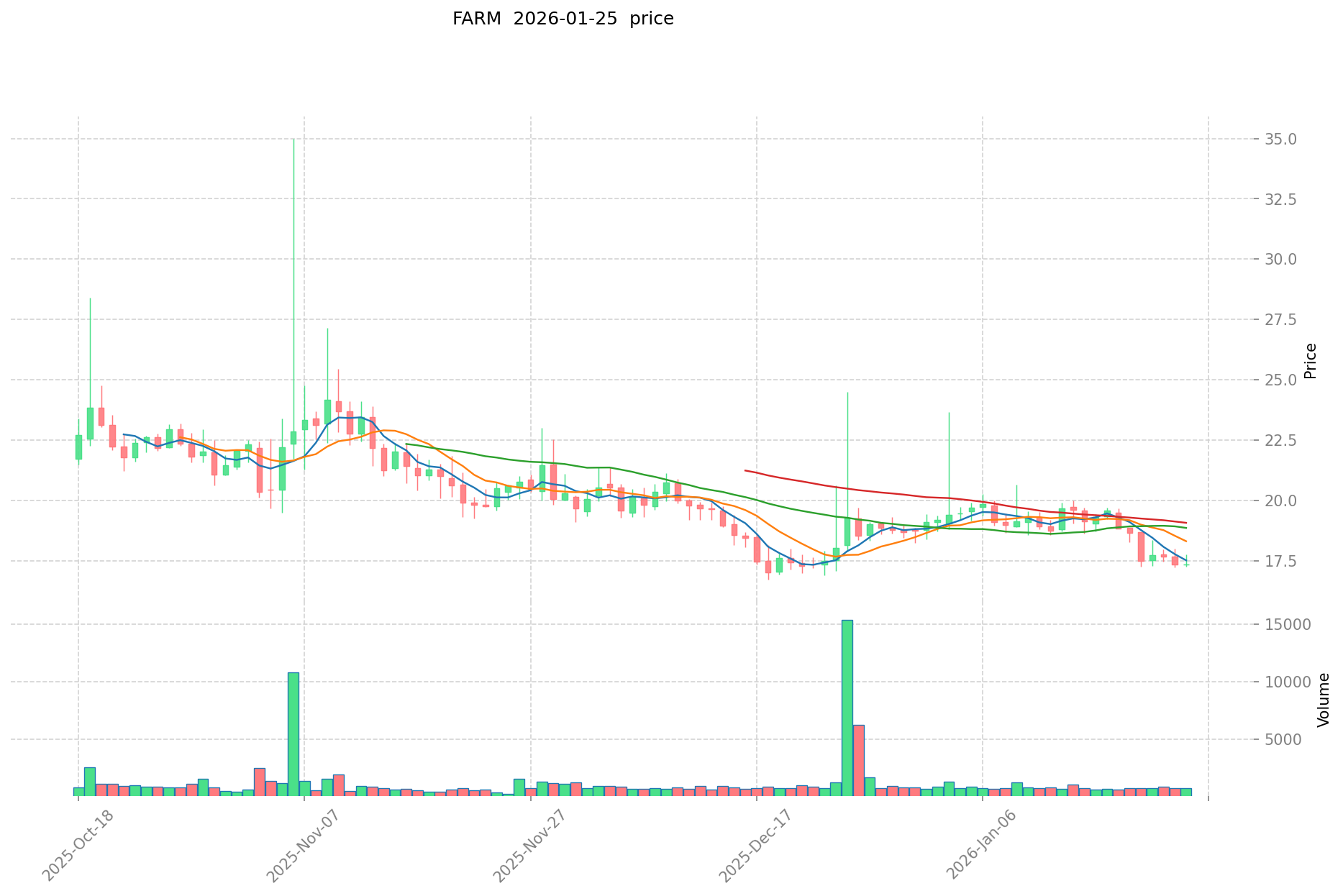
Price Volatility
FARM reached its all-time high of $628.46 on September 2, 2020, during the early DeFi summer period when yield farming protocols experienced significant market enthusiasm and capital inflows. This peak reflected strong investor interest in automated yield optimization strategies.
The token recorded its all-time low of $16.80 on December 19, 2025, influenced by broader market corrections and shifts in DeFi sector dynamics. As of January 26, 2026, FARM is trading at $16.82, showing minimal deviation from this historical low.
Recent price movements indicate:
- 1-hour change: -2.17% (-$0.37)
- 24-hour change: -3.55% (-$0.62)
- 7-day change: -14.63% (-$2.88)
- 30-day change: -9.78% (-$1.82)
- 1-year change: -57.87% (-$23.10)
These fluctuations reflect evolving market sentiment toward yield aggregation protocols, competitive pressures within the DeFi ecosystem, and broader cryptocurrency market conditions.
Click to view current FARM market price
On-Chain Metrics
- Market Capitalization: $11,306,125.64, representing 0.00037% of the total cryptocurrency market
- Fully Diluted Valuation: $11,612,864.40
- 24-Hour Trading Volume: $12,624.51, indicating current market liquidity levels
- Token Holders: 15,413 addresses, reflecting the size of the governance community
- Exchange Listings: Available on 13 cryptocurrency exchanges, providing multiple access points for traders
Harvest Ecosystem Applications and Partners
Core Use Cases
Harvest's ecosystem supports multiple applications:
- DeFi (Decentralized Finance): Harvest Finance provides automated yield farming by maximizing returns from the latest DeFi protocols using optimized farming strategies.
- Yield Optimization: The platform aggregates yields across various protocols, enabling users to earn passive income through liquidity provision and staking.
Strategic Partnerships
Harvest has established collaborations within the DeFi ecosystem to enhance its technical capabilities and market presence.
These partnerships provide a solid foundation for Harvest's ecosystem expansion.
Controversies and Challenges
Harvest faces the following challenges:
- Technical Issues: The platform needs to continuously adapt to evolving DeFi protocols and maintain competitive yield strategies.
- Regulatory Risks: DeFi platforms face increasing scrutiny from regulatory bodies worldwide, which may impact future operations.
- Competitive Pressure: The rise of competing yield aggregation platforms and DeFi protocols presents ongoing challenges to market positioning.
These issues have sparked discussions within the community and markets, driving Harvest's continued innovation.
Fan Enthusiasm
Harvest's community remains engaged, with the platform maintaining an active presence in the DeFi space.
On X platform, related posts and hashtags (such as #FARM) generate ongoing discussions among yield farming enthusiasts.
Community interest is driven by yield optimization opportunities and protocol updates.
Sentiment on X presents mixed perspectives:
- Supporters praise Harvest's automated yield farming capabilities and optimized returns, viewing it as a valuable tool for passive income generation.
- Critics focus on market volatility, platform risks, and competition from newer protocols.
Recent trends show sentiment fluctuating with broader DeFi market conditions.
Hot Topics
X users actively discuss Harvest's yield strategies, protocol security, and competitive positioning in the yield aggregation space,
showcasing both its innovative potential and the challenges of operating in the competitive DeFi landscape.
- Official Website: Visit Harvest Finance for features, use cases, and latest updates.
- White Paper: Detailed technical documentation is available through the official channels, outlining the platform's architecture, objectives, and vision.
- X Updates: On X platform, Harvest Finance maintains an active presence at @harvest_finance,
with posts covering protocol updates, yield strategies, and community announcements, generating engagement from the DeFi community.
Harvest Future Roadmap
- Continuous Development: Enhancement of yield optimization algorithms and protocol integrations to improve returns and user experience
- Ecosystem Goals: Expansion of supported protocols and yield farming opportunities
- Long-term Vision: Establishing Harvest as a leading yield aggregation platform in the DeFi ecosystem
How to Participate in Harvest?
- Purchase Channels: Acquire FARM tokens on Gate.com and other cryptocurrency exchanges
- Storage Solutions: Use compatible wallets such as MetaMask to securely store FARM tokens
- Participate in Governance: FARM holders can vote on proposals regarding operational treasury management and platform development
- Build the Ecosystem: Visit Harvest Finance GitHub to contribute to development or explore integration opportunities
Summary
Harvest Finance leverages blockchain technology to redefine yield farming, providing automated optimization, transparent operations, and competitive returns.
Its active community, open-source development, and market presence position it as a notable player in the DeFi yield aggregation space.
Despite facing regulatory uncertainties and competitive pressures, Harvest's innovation-driven approach and focus on yield optimization maintain its relevance in the evolving DeFi landscape.
Whether you are a newcomer or experienced DeFi participant, Harvest Finance offers opportunities worth exploring.
FAQ
What is the FARM token in cryptocurrency and what are its main functions?
FARM is a governance token for the Harvest Finance protocol, a yield farming aggregator. Its main functions include governance rights, fee discounts, and protocol participation rewards. FARM token holders can vote on platform decisions and earn yields through liquidity provision.
How does Yield Farming work? How much money can you earn?
Yield Farming lets you deposit crypto into liquidity pools to earn rewards from transaction fees and token incentives. Returns typically range from 10% to 500% APY depending on pool risk and market conditions. Higher yields usually correlate with greater volatility and project risk.
What are the risks of participating in crypto FARM mining? How to mitigate these risks?
Main risks include smart contract vulnerabilities, impermanent loss, liquidity risks, and market volatility. Mitigate by diversifying assets, using audited protocols, starting with small amounts, and regularly monitoring your positions to adjust strategies accordingly.
What is the difference between FARM and Staking? Which one is more suitable for beginners?
FARM involves yield farming by providing liquidity or staking assets to earn rewards from protocol fees. Staking is simpler—lock tokens to validate networks and earn passive income. Staking is more beginner-friendly due to lower complexity and reduced impermanent loss risks compared to farming.
How should I start participating in DeFi yield farming? What do I need to prepare?
To start DeFi yield farming, you need a crypto wallet, digital assets (stablecoins or tokens), and knowledge of smart contracts. Connect your wallet to a DeFi protocol, deposit liquidity into farming pools, and begin earning rewards. Start with small amounts to minimize risk while learning.
How to assess the security of crypto FARM projects? How to identify scam projects?
Evaluate FARM projects by checking smart contract audits, team credentials, and transparency. Identify scams by verifying official channels, avoiding unrealistic promises, reviewing transaction volume legitimacy, and confirming regulatory compliance. Always research community feedback and whitepaper details thoroughly.
* The information is not intended to be and does not constitute financial advice or any other recommendation of any sort offered or endorsed by Gate.