What is Competitive Benchmarking Analysis: How to Compare Crypto Projects by Market Cap, Performance, and User Base in 2026
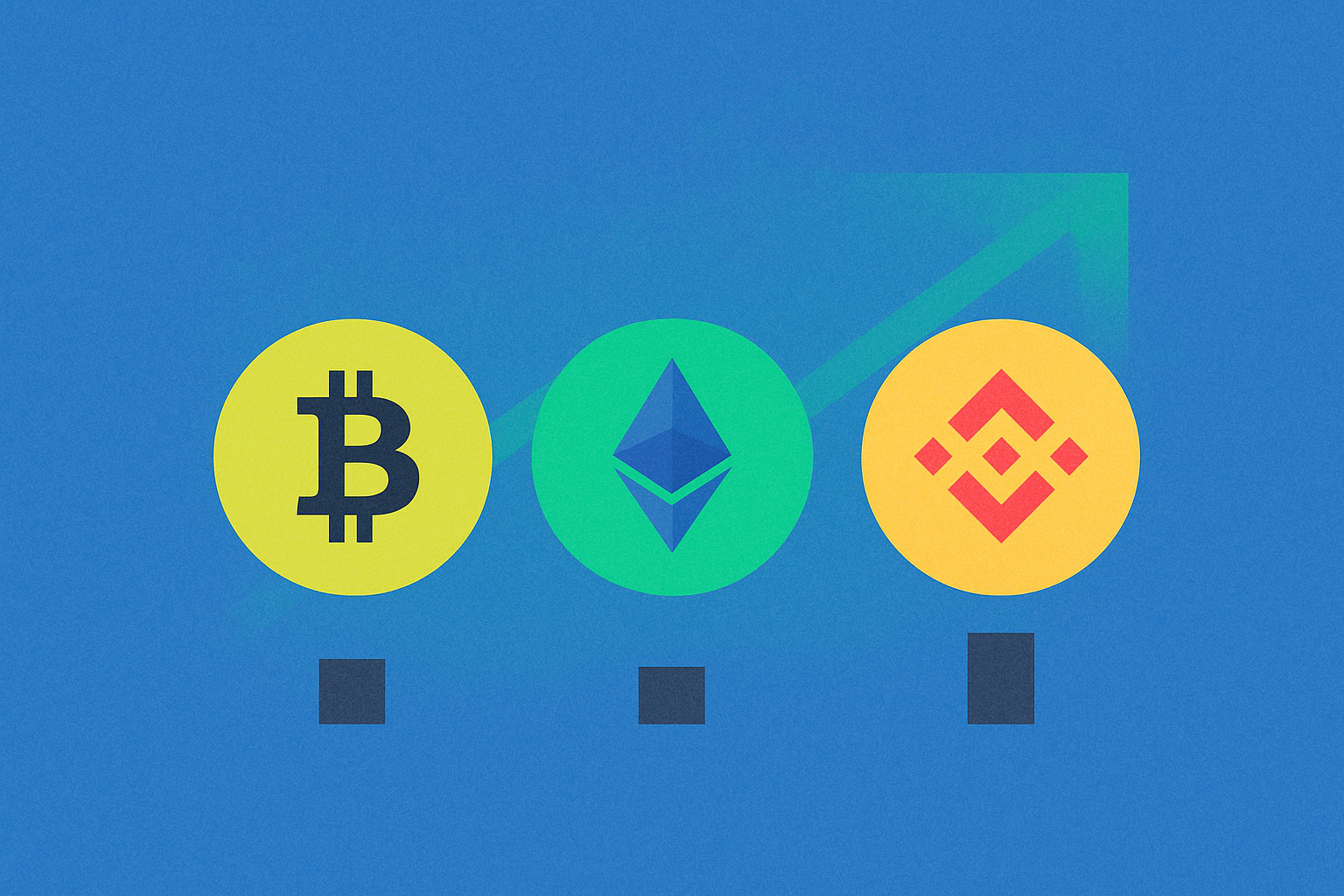
Top Crypto Projects by Market Cap: Bitcoin, Ethereum, and BNB Lead 2026 Rankings
Bitcoin, Ethereum, and BNB have established themselves as the dominant forces in the cryptocurrency market cap rankings throughout 2026, fundamentally shaping how investors conduct competitive benchmarking analysis. Bitcoin maintains its position as the market bellwether, controlling approximately 60% of total cryptocurrency value, making it the essential reference point for market cap comparisons. This dominance reflects both its longevity as a digital store of value and the consistent institutional interest it attracts through strategic acquisitions and balance sheet integration.
Ethereum complements Bitcoin's leadership by offering distinct technological capabilities as a scalable blockchain platform. The two largest cryptocurrencies have benefited significantly from investor rotation patterns observed in 2026, with institutional capital increasingly consolidating around these proven assets. BNB, the native token of the Binance Smart Chain ecosystem, rounds out the top three by demonstrating strong utility value through its role in transaction fee settlement and ecosystem governance.
When conducting competitive benchmarking analysis, market cap serves as the primary metric for evaluating cryptocurrency rankings and relative market significance. These three projects lead by substantial margins due to their deepest liquidity pools, most established track records, and clearest regulatory classifications. The 2026 market dynamics show that Bitcoin and Ethereum specifically benefit from weekly institutional acquisitions and professional trading activity, supporting their positions as the most stable and liquid cryptocurrency assets for serious competitive analysis.
Performance Metrics Showdown: Transaction Speed, Gas Fees, and User Growth Rates Compared
When analyzing competing blockchain platforms, three performance dimensions emerge as critical differentiators: transaction throughput, cost efficiency, and adoption momentum. Understanding how these metrics interact reveals why no single network dominates every use case. Transaction speed, measured in transactions per second (TPS), represents only part of the equation—finality matters equally, as it determines when transactions become irreversible. Theoretical speeds often mislead; practical throughput tells a different story.
| Metric | Ethereum | Solana | Polygon |
|---|---|---|---|
| TPS | 30 | 65,000+ | 2,500+ |
| Avg Gas Fee (2025) | $0.38–0.44 | $0.00025 | Significantly lower |
| Finality | Moderate | Fast | Fast |
| Validators | 700,000+ | 1,500 | High decentralization |
Ethereum's average gas fee declined dramatically—down 95% from 2024's levels—thanks to network upgrades and Layer 2 scaling solutions that reduce costs to $0.10–1.00 per transaction. Solana demonstrates extreme cost efficiency at $0.00025 per transaction, though this comes with fewer validators, raising decentralization concerns. User growth metrics reveal competitive dynamics: established protocols maintain stable bases while emerging projects like Lighter exceed 15% annual growth rates, driven by specialized use cases and superior capital efficiency. For competitive benchmarking analysis, consider that Ethereum prioritizes security and decentralization, Solana emphasizes performance and affordability, and Layer 2 solutions bridge both paradigms. These tradeoffs determine which platform suits specific applications and user profiles.
Market Share Evolution: How Layer-2 Solutions and Alternative Blockchains Captured 35% of Total Value Locked in 2026
The dramatic redistribution of value across blockchain ecosystems demonstrates how competitive benchmarking reveals market dynamics beyond simple price movements. By 2026, Layer-2 solutions and alternative blockchains collectively captured approximately 35% of total value locked across decentralized finance, representing a fundamental shift in how capital allocates across competing infrastructure platforms.
Base emerged as the dominant Layer-2 network, commanding $4.45 billion in total value locked and surpassing traditional competitors like Arbitrum. This leadership reflects more than technical superiority—it illustrates how effective incentive programs and developer ecosystems drive competitive positioning in this space. Meanwhile, alternative blockchains including Solana and BNB Chain gained substantial ground, each attracting billions in TVL and challenging Ethereum's historical dominance.
For competitive benchmarking purposes, this evolution matters significantly. When analyzing crypto projects by market cap and performance, observers must account for how value distribution across competing blockchains affects protocol valuations and user adoption rates. The cumulative Layer-2 total value locked reached $39.39 billion, while Ethereum's mainnet simultaneously expanded tenfold, indicating that market share capture doesn't necessarily mean absolute value loss for incumbents. This paradox—where Layer-2 and alternative solutions grow market share while absolute values increase across platforms—requires nuanced competitive analysis and demonstrates why direct market cap comparison alone misses the broader ecosystem picture.
Differentiation Strategies: Native Features, Ecosystem Strength, and Adoption Advantages That Set Winners Apart
Winning crypto projects in 2026 differentiate themselves through a combination of native technical capabilities, robust ecosystem development, and strategic market positioning. Projects that implement AI-native architectures, advanced containerization through Kubernetes, and edge computing infrastructure create measurable performance advantages over competitors. A protocol's differentiation strategy extends beyond raw speed—it encompasses developer experience through type-safe backends and compiler-first frameworks that reduce maintenance burden and accelerate innovation cycles.
Ecosystem strength serves as a critical differentiator, reflected in metrics such as developer activity, code quality benchmarks, and funding velocity. Leading projects demonstrate this through significant partnerships, robust tooling infrastructure, and substantial application traction across their networks. For instance, platforms implementing zero-knowledge proof technology for on-chain verifiability establish trust advantages that resonate with both retail and professional users seeking transparent, non-custodial solutions.
Adoption advantages emerge from deliberate go-to-market strategies combining enhanced incentive structures, streamlined distribution channels, and improved user retention mechanisms. Projects that invest in channel partnerships while maintaining simplified benefit structures create sustainable growth momentum. Critically, winning platforms balance capital efficiency with accessibility—offering free-tier access for retail participants while monetizing professional-grade features, thereby expanding total addressable market while building engaged user communities that fuel network effects.
FAQ
What is competitive benchmarking analysis for crypto projects and why is it important for investors?
Competitive benchmarking analysis compares crypto projects' performance, market cap, and user base to identify strengths and opportunities. It helps investors make informed decisions, assess risks, and evaluate project viability against competitors.
How to compare different crypto projects through market cap (Market Cap), and what does market cap ranking indicate?
Market cap ranking reflects the market's valuation consensus of crypto projects. Top-ranked projects typically have higher liquidity, stronger adoption, and greater market influence. Market cap equals current price multiplied by circulating supply, serving as a key metric for comparing project scale and market recognition.
What are the key metrics for evaluating crypto project performance (such as transaction speed, TPS, Gas fees, etc.)?
Key performance metrics include transaction speed, transactions per second (TPS), and Gas fees. TPS measures throughput capacity, transaction speed indicates confirmation time, and Gas fees reflect network efficiency. These indicators determine blockchain scalability and user experience quality.
How to analyze a crypto project's user base and activity, what are reliable data sources?
Analyze user base through social media metrics like Twitter followers and Telegram members for community engagement. For activity, use blockchain analytics platforms to track active addresses and transaction volume. Cross-reference on-chain data with GitHub commits for development activity to assess project health comprehensively.
When comparing encrypted projects, how should you evaluate team background, technical innovation, and community health?
Assess team expertise and past achievements, examine technical innovation like consensus algorithms and transaction speed, and evaluate community engagement levels. Strong fundamentals across these three areas indicate project potential and sustainability.
What is the relationship between market cap, trading volume, and liquidity, and how to conduct comparative analysis by integrating these indicators?
Market cap, trading volume, and liquidity are interconnected. High trading volume and liquidity typically correlate with market cap, but high market cap doesn't guarantee high volume. Comprehensive analysis of these three metrics together reveals true asset health and market efficiency.
What tools and platforms can help with competitive benchmarking analysis of crypto projects (such as CoinMarketCap, Messari, etc.)?
Key platforms include CoinMarketCap, Messari, DeFiLlama, TokenTerminal, Nansen, and Glassnode. These provide market metrics, project fundamentals, TVL data, transaction volume, and competitive performance comparisons for comprehensive crypto project analysis.
What are the development trends of the crypto market in 2026, and how do they affect the competitive benchmarking of projects?
In 2026, Bitcoin dominates with price potential exceeding $150,000, while Ethereum strengthens smart contract leadership and Solana captures market share through superior performance. Competition intensifies based on transaction speed, security, technology innovation, and user adoption. Multi-chain ecosystem fragmentation accelerates, with specialized platforms emerging in DeFi, enterprise services, and high-frequency trading sectors.
FAQ
What is LIT coin and what is its purpose?
LIT coin is a peer-to-peer digital currency designed for fast, low-cost transactions. It serves as a payment method, investment asset, and value store. With fixed supply and rapid transaction processing, LIT enables efficient global transfers while offering scarcity-driven appreciation potential in the crypto market.
How to buy and hold LIT coin? Which exchanges support it?
Purchase LIT coin through major cryptocurrency exchanges via spot trading pairs. Transfer to a secure wallet for long-term holding. Ensure you enable two-factor authentication and follow exchange security protocols for asset protection.
LIT coin的团队背景和项目进展如何?
Lit Protocol team possesses cryptography and blockchain expertise. CEO David Sneider leads decentralized identity projects; CTO Chris Cassano specializes in distributed systems. The project raised $16.7 million in funding and manages over $340 million in assets across 1.66 million wallets, focusing on decentralized key management through MPC-TEE technology.
What risks should I be aware of when investing in LIT coin?
LIT coin investment involves price volatility, regulatory changes, and market demand fluctuations. Monitor market trends closely and invest prudently based on your risk tolerance and research.
What are the differences between LIT coin and other similar cryptocurrencies?
LIT coin offers faster transaction speeds and lower fees compared to Bitcoin. Unlike Ethereum, which focuses on smart contracts, LIT coin is primarily designed as a payment tool, providing a more efficient and cost-effective solution for everyday transactions.
What are the technical principles and consensus mechanism of LIT coin?
LIT coin utilizes Proof of Work (PoW) consensus mechanism with the scrypt algorithm. It operates on a decentralized network where PoW ensures security and validates transactions through distributed mining, providing robust network protection and transaction integrity.
What is the total supply of LIT coin? How is the token allocation distributed?
LIT coin has a total supply of 1 billion tokens. The allocation is split equally at 50% for the ecosystem and 50% for the team and investors, with a 3-year linear vesting schedule.
What is LIT coin's future development roadmap?
LIT coin's roadmap focuses on infrastructure upgrades, institutional investment channels through ETF approval, and privacy enhancements via MWEB protocol. These initiatives aim to expand beyond the digital silver positioning and strengthen market presence through 2026-2027.
Share
Content
Top Crypto Projects by Market Cap: Bitcoin, Ethereum, and BNB Lead 2026 Rankings
Performance Metrics Showdown: Transaction Speed, Gas Fees, and User Growth Rates Compared
Market Share Evolution: How Layer-2 Solutions and Alternative Blockchains Captured 35% of Total Value Locked in 2026
Differentiation Strategies: Native Features, Ecosystem Strength, and Adoption Advantages That Set Winners Apart
FAQ
FAQ
Trending Cryptocurrencies


How Does Cryptocurrency Competitive Landscape Compare in 2025: Market Share, Performance, and Key Advantages

Moonshot Crypto Coins

Leveraged Trading in Crypto

Crypto Bull Run and How to Ride the Wave

Live Crypto Prices in AUD

What Does Asynchronous Mean?

TradFi Inflows Into Crypto ETFs Drive Renewed Confidence in Bitcoin and Ethereum
Pi Network Price Outlook for January 2026: What Investors Should Watch

Simon's Cat: A Web3 Community-Driven IP Brand Token

What is UNO: A Comprehensive Guide to the Classic Card Game and Its Global Impact

Pi Coin Faces Security Test as Payment Requests Are Temporarily Disabled