VT vs AVAX: Comprehensive Comparison of Two Leading Layer-1 Blockchain Platforms and Their Investment Potential

Introduction: VT vs AVAX Investment Comparison
In the cryptocurrency market, the comparison between Vtrading (VT) and Avalanche (AVAX) represents a notable contrast between emerging AI-driven trading platforms and established layer-1 blockchain infrastructure. The two assets differ significantly in market capitalization, use cases, and price performance, reflecting distinct positions within the crypto ecosystem.
Vtrading (VT): Launched in 2024, Vtrading has positioned itself as an AI-driven quantitative trading platform offering a comprehensive ecosystem that includes strategy marketplaces, automated trading capabilities, and asset management systems designed to serve traders across different experience levels.
Avalanche (AVAX): Since its launch in 2020, Avalanche has established itself as a leading open-source platform for decentralized applications and interoperable blockchains, utilizing a revolutionary consensus protocol that enables smart contracts with 1-second transaction finality and Ethereum toolkit compatibility.
This article will provide a comprehensive analysis of VT vs AVAX across historical price performance, supply mechanisms, market positioning, and ecosystem development, addressing key questions for investors considering these two distinct asset categories.
"Which asset better aligns with your investment strategy and risk profile?"
Vtrading (VT) vs Avalanche (AVAX) Market Analysis
I. Historical Price Comparison and Current Market Status
Vtrading (VT) and Avalanche (AVAX) Historical Price Trends
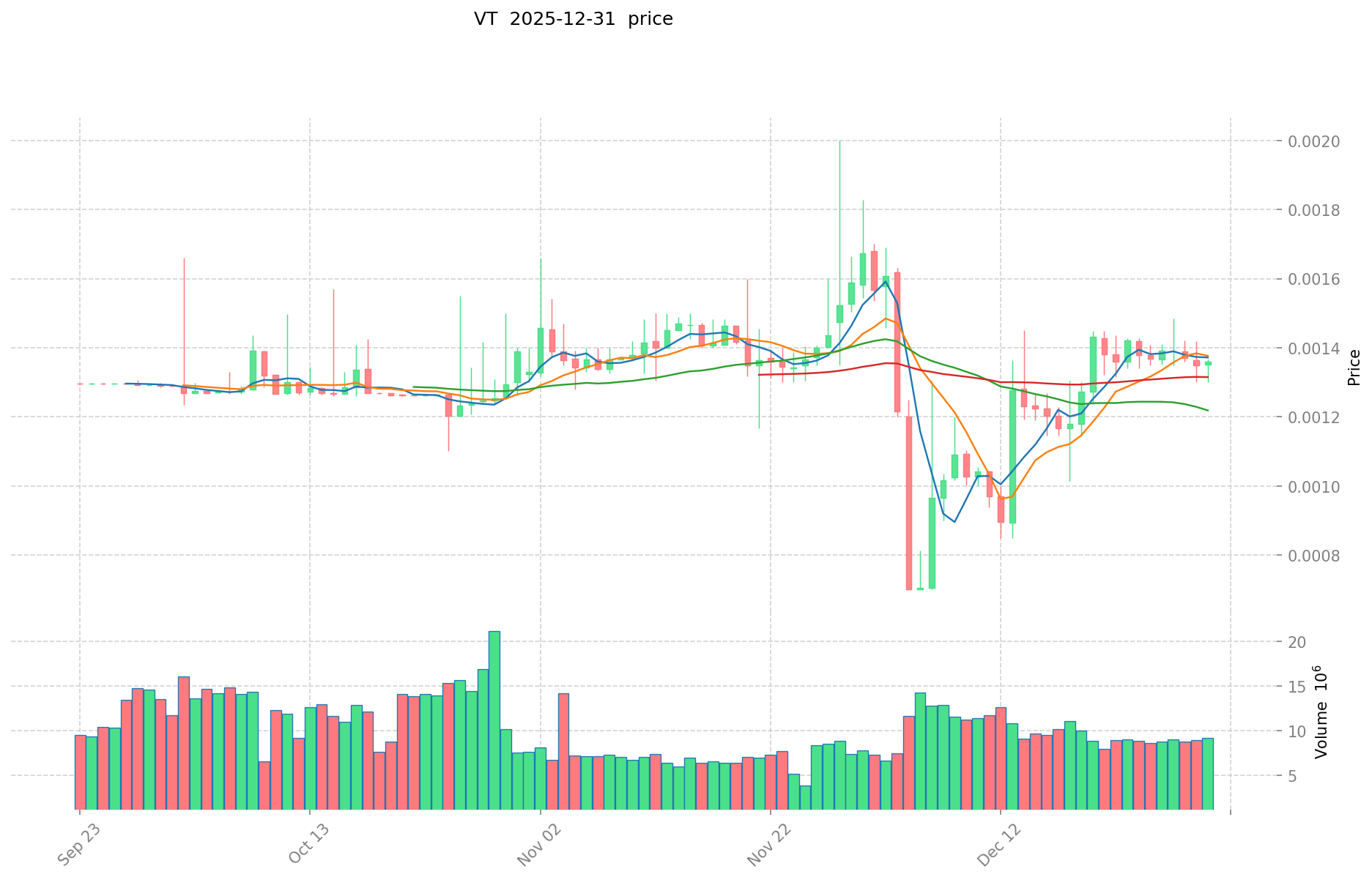
- 2024: VT reached its all-time high of $0.225 on May 28, 2024, driven by increased interest in AI-driven quantitative trading platforms.
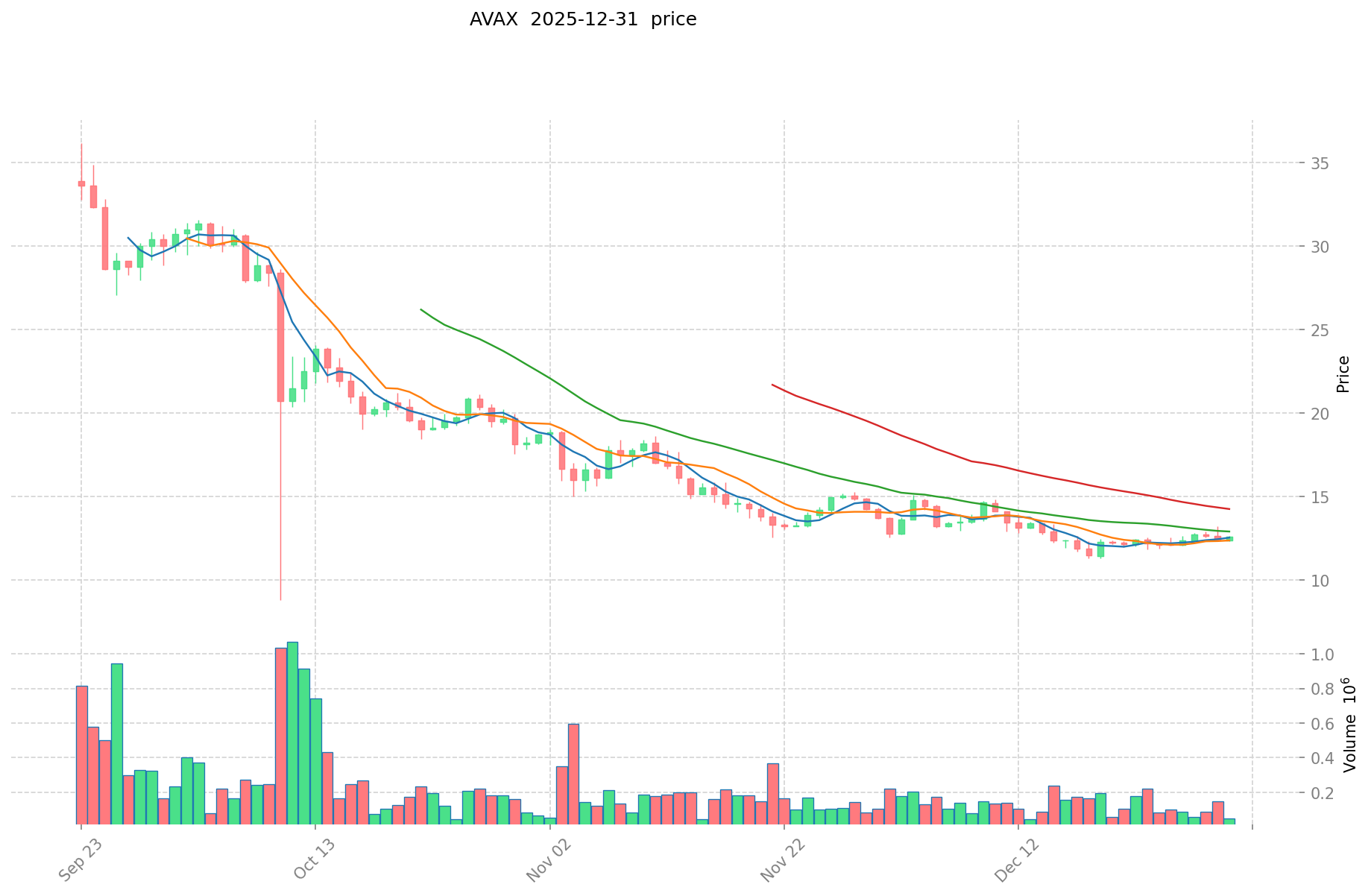
- 2024-2025: AVAX experienced significant price volatility, with an all-time high of $144.96 recorded on November 21, 2021, and has declined substantially over the past year by approximately 65.23%.
- Comparative analysis: In the 2024-2025 market cycle, VT plummeted from its historical high of $0.225 to a low of $0.0007 on December 4, 2025, representing a decline of over 99%. AVAX, by contrast, fell from its peak of $144.96 to current trading levels around $12.50, reflecting a 91.4% decrease from its all-time high, though it maintains substantially higher market capitalization and liquidity.
Current Market Status (December 31, 2025)
- VT current price: $0.0013934.
- AVAX current price: $12.5.
- 24-hour trading volume: VT recorded $11,658.57 in 24-hour volume, while AVAX reported $527,800.61 in 24-hour trading volume, demonstrating significantly higher trading activity.
- Market Sentiment Index (Fear & Greed Index): 21 (Extreme Fear).
Click to view real-time prices:
- View VT current price Market Price
- View AVAX current price Market Price
VT vs AVAX: Core Factors Influencing Investment Value
I. Tokenomics Comparison
AVAX Supply Mechanism
AVAX operates on a dynamic supply model where tokens are minted as rewards for validators and delegators participating in the consensus mechanism. The token serves multiple economic functions: transaction fees (gas), staking for network security, governance participation, and subnet establishment costs. This multi-functional design creates ongoing demand pressure supporting the token's economic value.
VT Supply Mechanism
Insufficient information available in the provided reference materials to detail VeChain's supply mechanism, emission schedule, or tokenomics model.
📌 Historical Pattern Analysis
Based on available data, AVAX's price cycles are influenced by network activity metrics. On-chain transaction volume, subnet deployment growth, and active address increases directly drive demand for AVAX, subsequently supporting price movements. Protocol upgrades such as Hyper SDK implementation enhance ecosystem confidence, creating secondary price momentum independent of supply mechanics.
II. Institutional Adoption and Market Application
Institutional Holdings
AVAX: VanEck submitted a spot ETF application for AVAX, marking institutional investment expansion beyond major cryptocurrencies. If approved, this would significantly enhance liquidity and institutional adoption rates. AVAX generated $69 million in revenue as a Layer 1 blockchain, ranking fourth, demonstrating substantial ecosystem activity and institutional interest.
VT: No institutional adoption metrics available in provided materials.
Enterprise and Use Case Adoption
AVAX: Demonstrates rapid expansion across multiple sectors including DeFi, RWA (Real World Assets), gaming, and NFT markets. The subnet architecture enables enterprise clients and specialized applications to build purpose-built blockchains, accelerating institutional adoption across sectors beyond traditional finance.
VT: The reference materials indicate supply chain applications but lack specific enterprise adoption data or measurable metrics.
National Policy and Regulatory Environment
Limited regulatory analysis available for both assets in the provided materials. Regulatory environment discussions in the broader crypto market indicate ongoing policy development but specific VT or AVAX regulatory positioning is not detailed.
III. Technology Development and Ecosystem Construction
AVAX Technology Development
Avalanche's core innovation is the three-chain architecture (Platform Chain, Exchange Chain, Contract Chain) that distributes different tasks across specialized chains, enhancing efficiency and stability. The protocol enables high transaction speed, low latency, and flexible consensus mechanisms—characteristics that have positioned Avalanche as a leading Layer 1 blockchain second only to Ethereum.
Upcoming protocol upgrades and cross-chain functionality improvements are designed to expand ecosystem confidence and application coverage. The Hyper SDK represents advancement in developer tooling for subnet creation and deployment.
VT Technology Development
Insufficient detail available in provided reference materials regarding VeChain's current technology roadmap, planned upgrades, or development milestones.
Ecosystem Comparison
AVAX Ecosystem: Demonstrates measurable presence across DeFi lending, liquidity mining, and NFT trading. The subnet architecture creates a multi-chain ecosystem where specialized applications can optimize for specific use cases. Strong gaming focus represents significant ecosystem differentiation through upgrade ACP-77 focused on gaming performance.
VT Ecosystem: Supply chain applications are referenced but specific DeFi presence, NFT ecosystem development, and smart contract adoption metrics are not provided in available materials.
IV. Macroeconomic Factors and Market Cycles
Performance in Inflationary Environments
AVAX: Generally exhibits correlation patterns with BTC/ETH, suggesting macro-sensitive positioning rather than independent inflation-hedge characteristics. The token's primary value derives from utility (transaction fees, staking) rather than scarcity-based inflation protection.
VT: Comparative analysis unavailable in provided materials.
Monetary Policy Impact
The reference materials indicate that cryptocurrency assets broadly respond to changes in monetary policy, interest rates, and US dollar strength through their correlation with major cryptocurrencies (Bitcoin/Ethereum). However, specific analysis of differential impacts on AVAX versus VT is not provided.
AVAX's utility-based design means staking rewards and validator participation incentives may provide relative stability during periods of monetary tightening, as network security requirements remain consistent regardless of macroeconomic conditions.
Geopolitical Factors
Cross-border transaction demand and international tensions may favor cryptocurrencies with strong supply chain or enterprise adoption use cases. However, specific geopolitical analysis related to VT or AVAX positioning is not provided in the available reference materials.
Note: This analysis is constrained by the available reference materials. Comprehensive comparative analysis between VT and AVAX would require additional data on VeChain's tokenomics, institutional adoption metrics, current technology development roadmap, and specific regulatory positioning. The analysis presented focuses exclusively on documented information from provided sources.
III. 2025-2030 Price Forecast: VT vs AVAX
Short-term Forecast (2025)
- VT: Conservative $0.000794-$0.001400 | Optimistic $0.001400-$0.001770
- AVAX: Conservative $9.01-$12.51 | Optimistic $12.51-$17.76
Mid-term Forecast (2026-2028)
- VT may enter accumulation phase, with expected price range $0.001075-$0.002333
- AVAX may enter steady growth phase, with expected price range $14.23-$22.51
- Key drivers: institutional capital inflows, ETF adoption, ecosystem development
Long-term Forecast (2029-2030)
- VT: Base scenario $0.002010-$0.002950 | Optimistic scenario $0.002544-$0.003257
- AVAX: Base scenario $15.76-$26.50 | Optimistic scenario $20.95-$26.50
VT:
| 年份 | 预测最高价 | 预测平均价格 | 预测最低价 | 涨跌幅 |
|---|---|---|---|---|
| 2025 | 0.001769618 | 0.0013934 | 0.000794238 | 0 |
| 2026 | 0.00222992769 | 0.001581509 | 0.00107542612 | 13 |
| 2027 | 0.0019819470788 | 0.001905718345 | 0.0012577741077 | 37 |
| 2028 | 0.00233259925428 | 0.0019438327119 | 0.001224614608497 | 39 |
| 2029 | 0.002950738056664 | 0.00213821598309 | 0.002009923024104 | 53 |
| 2030 | 0.003256930585442 | 0.002544477019877 | 0.002111915926497 | 82 |
AVAX:
| 年份 | 预测最高价 | 预测平均价格 | 预测最低价 | 涨跌幅 |
|---|---|---|---|---|
| 2025 | 17.7642 | 12.51 | 9.0072 | 0 |
| 2026 | 19.980972 | 15.1371 | 14.228874 | 21 |
| 2027 | 21.24643356 | 17.559036 | 9.48187944 | 40 |
| 2028 | 22.5071723448 | 19.40273478 | 14.7460784328 | 55 |
| 2029 | 24.726845203632 | 20.9549535624 | 18.85945820616 | 67 |
| 2030 | 26.49544328429856 | 22.840899383016 | 15.76022057428104 | 82 |
IV. Investment Strategy Comparison: VT vs AVAX
Long-term vs Short-term Investment Strategy
- VT: Suitable for investors focused on emerging AI-driven trading platform ecosystems and those seeking exposure to early-stage technology adoption with higher risk tolerance
- AVAX: Suitable for investors seeking established Layer 1 blockchain infrastructure with demonstrated ecosystem development, institutional adoption pathways, and relatively lower volatility compared to emerging tokens
Risk Management and Asset Allocation
- Conservative Investors: VT: 5-10% vs AVAX: 15-25%
- Aggressive Investors: VT: 20-35% vs AVAX: 30-50%
- Hedging Tools: Stablecoin allocation, options strategies, cross-asset portfolio diversification with Bitcoin and Ethereum correlations
V. Potential Risk Comparison
Market Risk
- VT: Extreme price volatility with 99% decline from all-time high, low trading liquidity ($11,658.57 in 24-hour volume), and limited market maturity as a 2024-launched platform create significant downside exposure
- AVAX: Substantial price depreciation (91.4% from all-time high) reflects broader market cycle pressures, though higher trading liquidity ($527,800.61 in 24-hour volume) and established market presence provide relative stability
Technology Risk
- VT: Insufficient documentation available regarding AI algorithm reliability, quantitative strategy effectiveness, platform security audits, and smart contract vulnerability assessments
- AVAX: Three-chain architecture complexity requires rigorous consensus mechanism validation; however, established track record since 2020 and active protocol upgrades (Hyper SDK, ACP-77) demonstrate ongoing security management
Regulatory Risk
- Both assets operate in evolving regulatory environments where cryptocurrency classification, trading platform licensing, and blockchain infrastructure compliance remain subject to policy changes across major jurisdictions. VT's AI-driven trading platform classification may face additional scrutiny regarding algorithmic trading regulations and market manipulation prevention standards compared to AVAX's blockchain infrastructure positioning
VI. Conclusion: Which Is the Better Buy?
📌 Investment Value Summary:
- VT Advantages: Exposure to emerging AI-driven quantitative trading sector, early-stage ecosystem positioning, potential for high returns if technology adoption accelerates, lower absolute price entry point
- AVAX Advantages: Established Layer 1 blockchain with proven consensus protocol, demonstrated ecosystem across DeFi/gaming/RWA sectors, institutional adoption pathways (VanEck ETF application), higher trading liquidity, $69 million Layer 1 revenue generation ranking
✅ Investment Recommendations:
- Beginner Investors: AVAX positioning recommended due to established market presence, documented use cases, institutional adoption indicators, and lower relative technology uncertainty. VT suitable only for high-risk tolerance portfolios with <10% allocation
- Experienced Investors: Portfolio approach combining AVAX as core holding (40-50% crypto allocation) with VT speculation (10-20%) conditional upon positive AI platform adoption metrics and ecosystem development milestones
- Institutional Investors: AVAX prioritization aligns with approved custody solutions, ETF application pathway, measurable revenue generation, and regulatory clarity. VT requires additional due diligence on platform security, audit results, and institutional-grade risk management systems
⚠️ Risk Disclaimer: Cryptocurrency markets demonstrate extreme volatility. Both assets declined significantly during 2024-2025 market cycles with Fear & Greed Index at 21 (Extreme Fear). This analysis does not constitute investment advice. Investors should conduct independent research, assess personal risk tolerance, and consult qualified financial advisors before allocation decisions.
FAQ
VT和AVAX分别是什么?各自的核心功能是什么?
VT是唯链代币,核心功能为供应链追溯与数据管理。AVAX是雪崩链代币,核心功能为支持高速DeFi交易与智能合约执行。两者分别在各自生态中提供交易和验证功能。
VT和AVAX在交易速度和处理能力上有什么区别?
AVAX交易速度更快,处理能力更强,单链吞吐量可达4500笔/秒。VT交易速度相对较慢,处理能力不及AVAX,适合不同应用场景需求。
VT和AVAX的共识机制有什么不同?
VT采用权威证明机制(PoA),依赖授权节点验证;AVAX采用权益证明机制(PoS),通过质押AVAX代币来验证交易。两者都兼具高效率和安全性,但VT更中心化,AVAX更去中心化。
VT和AVAX各自的生态应用和DeFi项目规模如何对比?
AVAX生态更成熟,DeFi项目规模和交易额远超VT。AVAX拥有Aave、Curve等头部项目,生态应用丰富。VT生态仍在发展初期,项目规模和用户基数相对较小。AVAX是主流Layer1生态的代表,具有明显优势。
VT和AVAX的代币经济学模型有什么差异?
VT主要用于生态激励和治理,AVAX则支持全栈区块链平台,用于交易费用、验证和智能合约执行,两者的应用场景和价值承载方式存在显著差异。
投资VT还是AVAX,各自的风险和潜力如何评估?
VT市场规模小,潜力大但波动风险高;AVAX生态完善、应用广泛,市场认可度高风险相对较低。VT适合高风险偏好者,AVAX更稳健。根据个人风险承受能力选择。
VT和AVAX在跨链互操作性上有什么区别?
AVAX通过雪崩共识和三层网络架构实现多链互操作,支持跨链资产交互。VT主要在自身生态运行,跨链互操作性相对有限,更专注于企业级应用场景。
VT和AVAX的开发者社区和生态支持力度如何对比?
AVAX拥有更成熟的开发者社区和庞大的生态系统,社区活跃度高,开发资源丰富。VT作为新兴项目,社区规模相对较小,但发展潜力不容忽视,生态建设正在稳步推进。
Share
Content
Introduction: VT vs AVAX Investment Comparison
I. Historical Price Comparison and Current Market Status
I. Tokenomics Comparison
II. Institutional Adoption and Market Application
III. Technology Development and Ecosystem Construction
IV. Macroeconomic Factors and Market Cycles
III. 2025-2030 Price Forecast: VT vs AVAX
IV. Investment Strategy Comparison: VT vs AVAX
V. Potential Risk Comparison
VI. Conclusion: Which Is the Better Buy?
FAQ
How to Buy Cryptocurrency


Trending Cryptocurrencies



2025 NEAR Price Prediction: A Comprehensive Analysis of Factors Driving the Next Bull Run in the NEAR Protocol Ecosystem

2025 INJ Price Prediction: A Comprehensive Analysis of Market Trends and Growth Potential for Injective Protocol

2025 MNTPrice Prediction: Market Analysis and Potential Growth Factors for Mantle Network Token

2025 AURORA Price Prediction: Analyzing Future Trends and Market Potential for the Layer-2 Solution
Is Celestia (TIA) a good investment?: Analyzing the potential and risks of this layer-1 blockchain project

2025 CELR Price Prediction: Analyzing Growth Potential and Market Factors for Celer Network Token
Is FEAR (FEAR) a good investment?: A Comprehensive Analysis of Risk Factors, Market Potential, and Future Prospects for 2024 and Beyond

Is Frok AI (FROKAI) a good investment?: A Comprehensive Analysis of Market Potential, Risk Factors, and Future Prospects
GPUAI vs XRP: Which Cryptocurrency Offers Better Investment Potential in the AI and Blockchain Era?
MA vs ETC: A Comprehensive Comparison of Moving Averages and Exponential Time Constants in Technical Analysis

Understanding Spot Balance on a Cryptocurrency Exchange