NUX vs MANA: A Comprehensive Comparison of Two Leading Web Development Frameworks

2026-01-02 20:11:47
Altcoins
Crypto Insights
DeFi
Investing In Crypto
Metaverse Crypto
Article Rating : 4
123 ratings
# Article Overview: NUX vs MANA Investment Comparison This comprehensive guide compares two distinct cryptocurrency assets—NUX (Peanut), a DeFi price balancer launched in 2021, and MANA (Decentraland), a blockchain-based virtual world platform since 2017. The article analyzes historical price trends, tokenomics, market adoption, and technical ecosystems to help investors determine which asset better suits their portfolio. Through detailed price forecasts, risk assessments, and investment strategies, it addresses critical questions facing crypto investors. Featuring real-time Gate market data, risk disclaimers, and actionable recommendations for beginner, experienced, and institutional investors, this guide provides the complete framework needed to make informed decisions in volatile cryptocurrency markets.
NUX vs MANA: A Comprehensive Comparison of Two Leading Web Development Frameworks

Introduction: NUX vs MANA Investment Comparison

In the cryptocurrency market, comparisons between NUX and MANA remain a topic investors cannot overlook. The two not only exhibit significant differences in market capitalization ranking, application scenarios, and price performance, but also represent distinct positioning within the crypto asset landscape.

NUX (Peanut): Launched in 2021, it has gained market recognition by functioning as a DeFi price balancer that protects liquidity providers from impermanent losses, reduces slippage, and enhances profitability through automatic multi-level price balancing across DEX and CEX platforms.

MANA (Decentraland): Since its inception in 2017, it has been recognized as a blockchain-based virtual world platform that eliminates intermediary fees and enables content creators and players to directly benefit from virtual property ownership and commerce without platform provider commissions.

This article will comprehensively analyze the investment value comparison between NUX and MANA across historical price trends, supply mechanisms, market adoption, and technical ecosystems, while addressing the critical question investors are most concerned about:

"Which is the better buy right now?"

I. Price History Comparison and Market Status

  • February 2021: NUX reached its all-time high of $31.00, driven by early enthusiasm in DeFi price balancing mechanisms.
  • November 2021: MANA reached its all-time high of $5.85, coinciding with mainstream adoption of metaverse platforms and partnerships with major brands.
  • 2022-2025: NUX experienced a severe decline from its peak, falling to a low of $0.00172027 on December 17, 2025, reflecting reduced market interest in the specific DeFi mechanism and overall market volatility.
  • 2022-2025: MANA similarly declined from its peak, reaching a low of $0.00923681, though recovering slightly as the metaverse sector showed intermittent interest.
  • Comparative Analysis: Over the market cycle from 2021 to 2025, NUX declined approximately 99.4% from its high of $31.00 to its low of $0.00172027. MANA declined approximately 99.8% from its high of $5.85 to its low of $0.00923681. Both tokens experienced severe devaluation, though MANA showed relatively greater overall volatility.

Current Market Status (January 3, 2026)

  • NUX (Peanut) Current Price: $0.002434
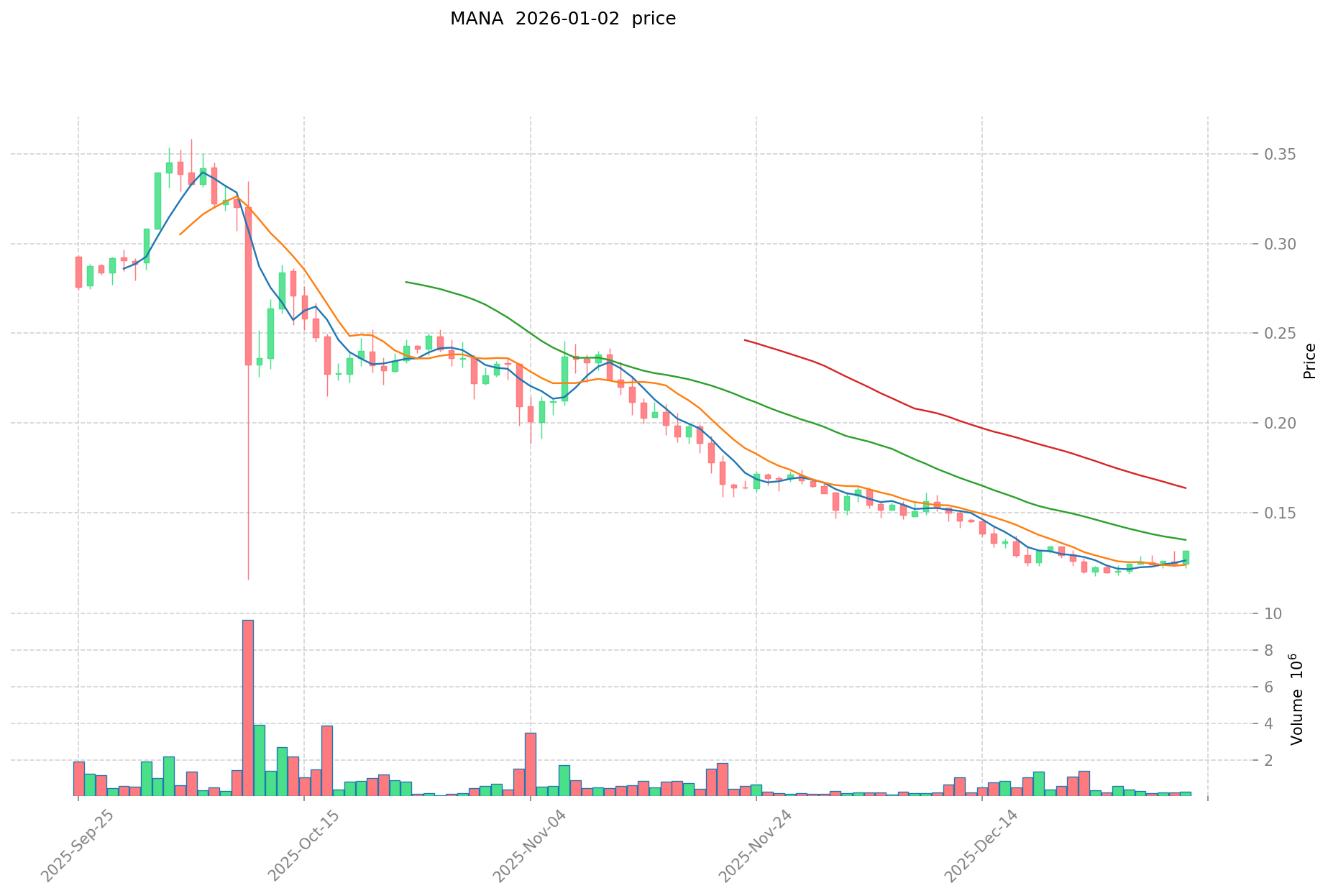
  • MANA (Decentraland) Current Price: $0.1322
  • 24-Hour Trading Volume: NUX $11,792.32 vs MANA $30,994.48
  • Market Sentiment Index (Fear & Greed Index): 28 (Fear)

Visit for real-time prices:

price_image1 price_image2

二、影响 NUX vs MANA 投资价值的核心因素

供应机制对比(Tokenomics)

参考资料中未提供 NUX 和 MANA 的具体供应机制信息,包括总供应量、流通供应、通胀模型或通缩机制等数据。此部分信息缺失,无法进行有效对比。

机构采用与市场应用

参考资料中未提供关于 NUX 和 MANA 机构持仓、企业采用情况、跨境支付应用或国家监管政策的具体信息。此部分内容无法基于提供的资料生成。

技术发展与生态建设

参考资料中未提供 NUX 和 MANA 的技术升级路线图、生态建设进展、DeFi 应用、NFT 集成、支付功能或智能合约部署等相关数据。此部分信息缺失。

宏观经济与市场周期

参考资料中未提供通胀环境下两种资产的表现对比、宏观货币政策影响分析、美元指数相关性或地缘政治因素分析等内容。此部分数据缺失,无法进行分析。

III. 2026-2031 Price Forecast: NUX vs MANA

Short-term Forecast (2026)

  • NUX: Conservative $0.00123828–$0.00301072 | Optimistic $0.00301072–$0.00301072
  • MANA: Conservative $0.081902–$0.169088 | Optimistic $0.169088–$0.169088

Mid-term Forecast (2027-2029)

  • NUX may enter an accumulation phase, with expected price range of $0.0022026816–$0.00420185173632
  • MANA may enter a growth phase, with expected price range of $0.1161748000875–$0.2598090983775
  • Key drivers: institutional capital inflows, ETF approvals, ecosystem development

Long-term Forecast (2030-2031)

  • NUX: Base case $0.003319300009222–$0.005109484283859 | Optimistic scenario $0.005109484283859–$0.006143129224933
  • MANA: Base case $0.2260972836612–$0.332080385377387 | Optimistic scenario $0.320693089892992–$0.332080385377387

View detailed price predictions for NUX and MANA

NUX:

年份 预测最高价 预测平均价格 预测最低价 涨跌幅
2026 0.00301072 0.002428 0.00123828 0
2027 0.0034263936 0.00271936 0.0022026816 11
2028 0.003441622016 0.0030728768 0.002980690496 26
2029 0.00420185173632 0.003257249408 0.00201949463296 33
2030 0.005109484283859 0.00372955057216 0.003319300009222 53
2031 0.006143129224933 0.004419517428009 0.002298149062564 81

MANA:

年份 预测最高价 预测平均价格 预测最低价 涨跌幅
2026 0.169088 0.1321 0.081902 0
2027 0.2183613 0.150594 0.11595738 13
2028 0.2379761685 0.18447765 0.129134355 39
2029 0.2598090983775 0.21122690925 0.1161748000875 59
2030 0.332080385377387 0.23551800381375 0.2260972836612 78
2031 0.320693089892992 0.283799194595568 0.198659436216898 114

IV. Investment Strategy Comparison: NUX vs MANA

Long-term vs Short-term Investment Strategy

  • NUX: Suitable for investors focused on DeFi mechanisms and those willing to accept higher volatility for potential recovery from severely depressed price levels
  • MANA: Suitable for investors interested in metaverse ecosystem development and those seeking exposure to virtual world platforms with established brand partnerships

Risk Management and Asset Allocation

  • Conservative investors: NUX 5% vs MANA 15%
  • Aggressive investors: NUX 20% vs MANA 30%
  • Hedging tools: Stablecoin allocation, options strategies, cross-asset diversification with established cryptocurrencies

V. Potential Risk Comparison

Market Risk

  • NUX: Severe price depreciation (99.4% decline from peak), extremely low trading volume ($11,792.32 in 24 hours), and limited market liquidity pose significant exit challenges
  • MANA: Comparable depreciation (99.8% decline from peak) with higher trading volume ($30,994.48 in 24 hours), though metaverse sector adoption remains uncertain

Technical Risk

  • NUX: Limited information regarding scalability and network stability; DeFi price balancing mechanism dependency on market conditions
  • MANA: Virtual world platform scalability, blockchain infrastructure reliability, and smart contract security for NFT and virtual property transactions

Regulatory Risk

  • Global regulatory uncertainty affects both tokens; DeFi mechanisms face stricter compliance requirements in certain jurisdictions; metaverse platforms face content moderation and virtual asset ownership regulatory challenges

VI. Conclusion: Which Is the Better Buy?

📌 Investment Value Summary:

  • NUX advantages: Established DeFi functionality for liquidity provider protection, multi-platform price balancing capability across DEX and CEX platforms
  • MANA advantages: Longer operational history (since 2017), higher current trading volume, metaverse ecosystem with brand partnerships, established virtual world platform infrastructure

✅ Investment Recommendations:

  • Beginner investors: Consider MANA due to higher liquidity and established brand recognition in the metaverse sector; start with minimal position sizes given severe market depreciation
  • Experienced investors: NUX may present speculative opportunity at extreme valuations with deep understanding of DeFi mechanisms; MANA offers relatively more stable exposure to virtual world adoption trends
  • Institutional investors: Both assets currently present limited institutional-grade opportunities; focus on ecosystem development metrics and regulatory clarity before significant allocation

⚠️ Risk Disclaimer: Cryptocurrency markets exhibit extreme volatility. Both NUX and MANA have experienced severe depreciation exceeding 99%. This article does not constitute investment advice. Conduct independent research and consult financial advisors before making investment decisions.

FAQ

NUX和MANA分别是什么?各自的主要用途是什么?

NUX是去中心化身份验证协议,用于Web3应用的身份管理和访问控制。MANA是虚拟世界Decentraland的原生代币,主要用于购买虚拟地产、数字资产和支付服务。

NUX和MANA在技术架构和底层区块链上有什么区别?

NUX基于自有区块链构建,而MANA运行在Decentraland区块链上(基于以太坊)。两者的底层技术架构和区块链基础设施存在本质区别,导致性能、交易额和生态应用差异。

NUX和MANA的生态应用场景分别有哪些?

NUX主要应用于元宇宙虚拟社交和娱乐场景。MANA用于Decentraland、The Sandbox等虚拟世界中的资产交易、支付和激励机制。

从投资角度看,NUX和MANA哪个更具有潜力?

MANA具有更强的投资潜力。MANA作为Decentraland虚拟世界的原生代币,拥有明确的应用场景、成熟的生态和持续的市场热度。相比之下,NUX项目定位不够清晰,市场认可度较低。MANA的生态建设和社区活跃度均优于NUX,长期增长前景更为看好。

NUX和MANA的风险因素分别有哪些?

NUX主要风险包括技术开发进展、市场采用率和竞争格局变化。MANA的风险主要来自监管政策调整、平台用户留存和虚拟资产市场波动性。

如何选择投资NUX还是MANA?两者可以同时持有吗?

NUX和MANA各有特点,选择取决于你的投资策略。两者完全可以同时持有,组合投资能分散风险。建议根据市场前景和自身风险承受能力配置比例。

NUX和MANA的流动性和交易对比如何?

NUX在其专属平台上交易额较高,流动性充足,交易对丰富。MANA在多个主流平台流通,市场认可度较高。NUX更适合平台内交易,MANA流动性覆盖更广。两者各有优势,选择需根据交易需求而定。

* The information is not intended to be and does not constitute financial advice or any other recommendation of any sort offered or endorsed by Gate.
Related Articles
TOKE vs MANA: The Battle for Dominance in the Metaverse Token Ecosystem

TOKE vs MANA: The Battle for Dominance in the Metaverse Token Ecosystem

The article "TOKE vs MANA: The Battle for Dominance in the Metaverse Token Ecosystem" offers a comprehensive investment analysis of Tokemak (TOKE) and Decentraland (MANA), two influential cryptocurrency assets with contrasting roles in DeFi and virtual worlds. It evaluates historical price trends, current market conditions, and future predictions, while addressing investor concerns about volatility, institutional adoption, and regulatory risks. The article is structured to guide both new and experienced investors in portfolio allocation strategies, considering supply mechanisms and technological advancements. Ideal for readers interested in the evolving metaverse and crypto landscape, it includes strategic insights and market forecasts up to 2030.
2025-10-04 00:30:54
HYPE vs MANA: The Battle of Digital Assets in the Metaverse Economy

HYPE vs MANA: The Battle of Digital Assets in the Metaverse Economy

The article "HYPE vs MANA: The Battle of Digital Assets in the Metaverse Economy" provides an in-depth comparison between Hyperliquid (HYPE) and Decentraland (MANA), two prominent digital assets in the cryptocurrency market. It addresses investment value, historical price trends, supply mechanisms, institutional adoption, technical ecosystems, and market sentiment, guiding investors on whether HYPE or MANA is the better buy. Ideal for investors seeking to understand the dynamics of DeFi infrastructure (HYPE) and metaverse engagement (MANA), the article progresses logically from price history, key influencing factors, mid-to-long-term price predictions, to investment strategies and risk assessments, concluding with a comprehensive investment advice.
2025-10-15 03:45:25
ONX vs MANA: Comparing Two Blockchain Platforms for Digital Asset Creation and Management

ONX vs MANA: Comparing Two Blockchain Platforms for Digital Asset Creation and Management

The article "ONX vs MANA: Comparing Two Blockchain Platforms for Digital Asset Creation and Management" provides a comprehensive analysis of OnX Finance and Decentraland, focusing on their investment value, market performance, and future potential. It addresses key investor concerns such as price history, supply mechanisms, technological ecosystems, and regulatory risks, catering to cryptocurrency investors seeking informed investment strategies. Structured to examine historical trends, current market status, and future outlook, the article aims to aid decisions by comparing ONX's DeFi focus with MANA's metaverse prominence. Keywords: ONX, MANA, blockchain, investment, market analysis.
2025-11-01 15:11:47
CLV vs MANA: Analyzing the Performance and Potential of Two Leading Metaverse Tokens

CLV vs MANA: Analyzing the Performance and Potential of Two Leading Metaverse Tokens

The article "CLV vs MANA: Analyzing the Performance and Potential of Two Leading Metaverse Tokens" offers a detailed comparison of Clover Finance (CLV) and Decentraland (MANA) to guide investors in making informed decisions. It addresses historical price trends, token supply mechanisms, and institutional adoption, providing insights into their market status and future projections. The article targets both new and experienced investors, offering strategies for portfolio allocation based on risk tolerance. It highlights the pros and cons of each token and emphasizes risk factors, ensuring a thorough evaluation for investment strategy planning.
2025-11-21 18:12:17
DBR vs MANA: Analyzing the Performance of Two Leading Crypto Assets in the Metaverse Space

DBR vs MANA: Analyzing the Performance of Two Leading Crypto Assets in the Metaverse Space

The article "DBR vs MANA: Analyzing the Performance of Two Leading Crypto Assets in the Metaverse Space" offers a comprehensive comparison of DBR and MANA as investment options, focusing on historical price trends, supply mechanisms, adoption, technological ecosystems, and market predictions up to 2030. It addresses key investor questions about which asset might be the better buy by analyzing factors such as market status, institutional interest, and risk management. The target audience includes crypto investors seeking insights into metaverse and DeFi assets. Presented in a logical sequence, the article's structure aids quick understanding, enhancing keyword visibility and readability.
2025-11-18 00:13:35
PDEX vs MANA: Comparing Two Leading Metaverse Tokens in the Digital Asset Landscape

PDEX vs MANA: Comparing Two Leading Metaverse Tokens in the Digital Asset Landscape

The article "PDEX vs MANA: Comparing Two Leading Metaverse Tokens" offers an in-depth analysis of Polkadex and Decentraland, critical for cryptocurrency investors distinguishing between these digital assets. It details historical price trends, supply mechanisms, institutional adoption, and technical development to aid investment decision-making. Key questions addressed include which token is a better buy, market status comparisons, and long-term predictions. The article targets both novice and experienced investors, enhancing keyword density for terms like "PDEX," "MANA," "investment strategies," and "market forecasts," facilitating efficient reading and comprehension.
2025-11-27 15:14:09
Recommended for You
Nikolai Durov Develops Advanced AI with Logical Reasoning Capabilities
Nikolai Durov Develops Advanced AI with Logical Reasoning Capabilities

Nikolai Durov is developing an advanced AI system that revolutionizes Web3 through superior logical reasoning capabilities beyond traditional machine learning. Unlike conventional pattern-matching AI, this system understands causal relationships, processes complex scenarios with incomplete information, and makes contextually informed decisions. The technology addresses critical challenges in autonomous systems, financial analysis, healthcare diagnostics, and scientific research by combining computational power with cognitive sophistication. With applications spanning banking, biotech, and blockchain ecosystems, the AI promises enhanced transparency and explainability through articulated reasoning. This innovation continues the Durov family's legacy of transforming technology, positioning next-generation AI for revolutionary human-machine collaboration across industries.
2026-01-10 16:55:17
Robinhood CEO Vlad Tenev Increases Net Worth to $6.1 Billion
Robinhood CEO Vlad Tenev Increases Net Worth to $6.1 Billion

This article provides a comprehensive overview of Vlad Tenev's financial status and his role as CEO of Robinhood, a fintech company that revolutionized retail investing through commission-free trading. Tenev's net worth has surged to $6.1 billion, reflecting Robinhood's remarkable market success and his strategic leadership. The article explores key factors driving his wealth accumulation, including the company's IPO, growing user base, and innovative expansion into cryptocurrency trading—a pivotal strategy that attracted mainstream investors to digital assets. Additionally, it examines Robinhood's transformative impact on the fintech industry, forcing traditional brokerages to eliminate trading commissions and enhance digital platforms. The analysis covers regulatory challenges, competitive pressures, and future opportunities, while demonstrating how Tenev's vision of democratizing finance has reshaped the investment landscape on Gate and beyond.
2026-01-10 16:53:26
Arthur Hayes is reported to have sold $2.5 million in crypto assets

Arthur Hayes is reported to have sold $2.5 million in crypto assets

Discover Arthur Hayes's $2.5 million cryptocurrency asset sale. Review transaction analysis for ETH, ENA, and ETHFI on institutional platforms such as Gate, FalconX, and Wintermute. Explore the digital asset management strategy of a seasoned professional trader.
2026-01-10 16:51:45
Ray Dalio Advises Against Exiting AI Market Despite Bubble Concerns

Ray Dalio Advises Against Exiting AI Market Despite Bubble Concerns

This article explores Ray Dalio's strategic perspective on AI market investment amid growing bubble concerns. Dalio, founder of Bridgewater Associates, advocates maintaining AI positions rather than hasty exits, grounded in absence of typical bubble-burst triggers and ongoing technological advancement. The analysis identifies key stabilizing factors: accommodative monetary conditions, lack of forced liquidation pressure, and tangible AI applications generating real value creation. The article examines AI market characteristics—rapid growth, investor enthusiasm, elevated valuations—while distinguishing between developing and collapsing bubbles. Strategic recommendations emphasize diversified AI exposure with risk controls, focusing on fundamentally sound investments. Dalio's framework suggests balancing growth opportunities with prudent management: gradual position-building, liquidity maintenance, and monitoring monetary policy shifts rather than reactive bubble-fear decisions, making this guidance valuable fo
2026-01-10 16:49:54
Raoul Pal: Liquidity Control Shifts from the Fed to the U.S. Treasury

Raoul Pal: Liquidity Control Shifts from the Fed to the U.S. Treasury

This article examines Raoul Pal's analysis on the critical shift of liquidity control from the Federal Reserve to the U.S. Treasury Department, representing a fundamental transformation in U.S. monetary policy management. The piece explores how this structural change enables more direct Treasury involvement in debt financing and liquidity injection through banking channels, departing from traditional separation of fiscal and monetary policy. Key focus areas include the implications of politically motivated monetary policy decisions, erosion of central bank independence, and potential market consequences for equities, bonds, and alternative assets including cryptocurrencies. The analysis addresses investor concerns regarding monetary policy predictability and introduces new risk variables for financial forecasting. Additionally, it examines how this shift may influence alternative asset adoption among those seeking protection from centralized policy decisions, while questioning the long-term sustainability of
2026-01-10 16:48:49
Stablecoin depegging increases systemic risk concerns within DeFi.

Stablecoin depegging increases systemic risk concerns within DeFi.

In-depth analysis of the systemic risks stablecoin depegging brings to the DeFi market. Explores the drivers behind price divergence, collateral risk management, liquidity strategies, and regulatory trends. Provides risk management tactics and forward-looking perspectives designed for Web3 investors.
2026-01-10 16:47:28