2025 VDR Price Prediction: Expert Analysis and Market Forecast for Virtual Data Room Solutions in the Coming Year


Introduction: VDR's Market Position and Investment Value
Vodra (VDR) is a blockchain-based content creator platform designed to enable creators to receive fair compensation directly from their audiences while pursuing their passion. Since its inception, Vodra has established itself as a unique solution addressing the gap between content creators and fair remuneration in the digital entertainment space. As of January 2026, VDR boasts a market capitalization of approximately $1.73 million, with a circulating supply of 143.14 million tokens and a current price of $0.0008635. This innovative protocol is increasingly playing a pivotal role in the creator economy and decentralized content monetization landscape.
This article provides a comprehensive analysis of VDR's price trajectory and market dynamics, incorporating historical performance data, supply and demand factors, ecosystem developments, and broader macroeconomic conditions to deliver professional price forecasts and practical investment guidance for the 2026-2031 period.
Vodra (VDR) Market Analysis Report
I. VDR Price History Review and Current Market Status
VDR Historical Price Evolution Trajectory
-
November 2021: Peak market performance, VDR reached its all-time high (ATH) of $0.078702 on November 18, 2021, representing the project's strongest market valuation period.
-
October 2023: Market downturn phase, VDR declined to its all-time low (ATL) of $0.00018002 on October 28, 2023, marking a significant depreciation from peak levels.
-
2021-2026: Extended bear market cycle, VDR has experienced a cumulative decline of approximately 50.03% over the past year, reflecting sustained downward pressure on the token's valuation.
VDR Current Market Stance
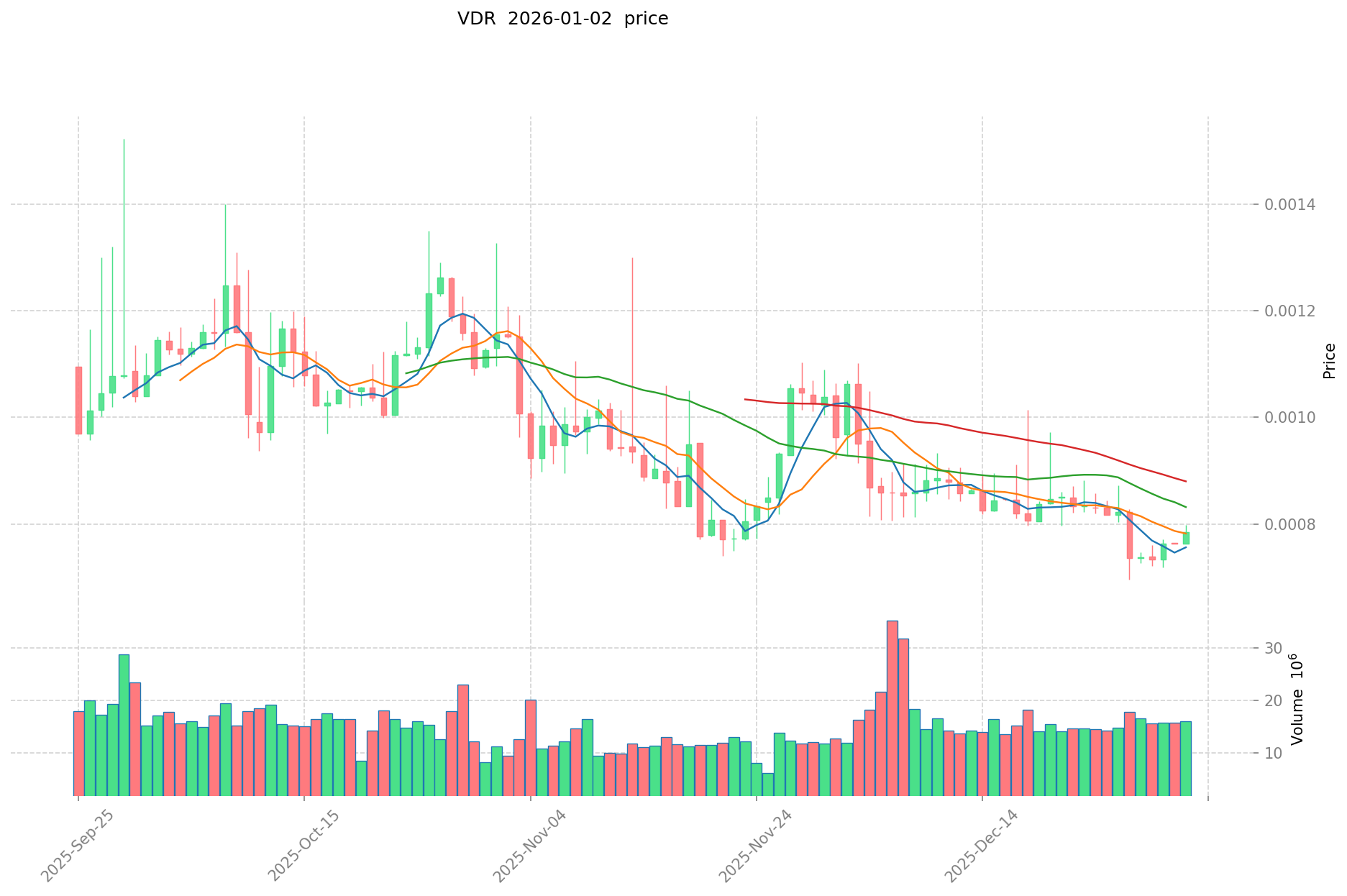
As of January 3, 2026, VDR is trading at $0.0008635 with a 24-hour trading volume of $12,288.54. The token demonstrates recent momentum with a 10.12% increase over the past 24 hours and a 4.87% gain over the 7-day period. However, the 30-day performance shows a -14.34% decline, indicating near-term volatility.
VDR maintains a market capitalization of $123,604.88 with a fully diluted valuation (FDV) of $1,726,999.82. The circulating supply stands at 143,144,036 VDR out of a maximum supply of 2 billion tokens, representing a circulation ratio of 7.16%. The token ranks 4,672 by market cap, with a market dominance of 0.000052%.
The token exhibits a holder base of 746 addresses and operates on the Solana blockchain, with the contract address 5a6LTLwdMJBY2JDLjw8B1w4JwFRdZszGF9W56ZzrriS1. VDR is currently tradable on Gate.com, providing liquidity for market participants.
Market sentiment data from January 2, 2026 shows a "Fear" indicator (VIX: 28), suggesting cautious market conditions during the current trading period.
Click to view current VDR market price
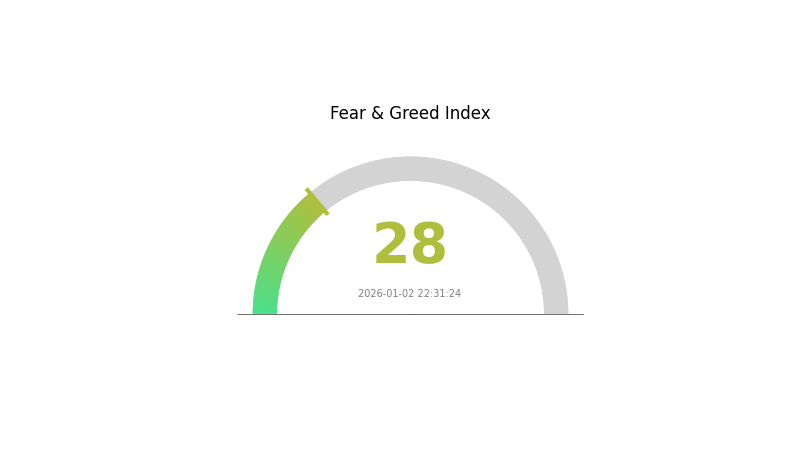
VDR Market Sentiment Index
2026-01-02 Fear and Greed Index: 28 (Fear)
Click to view current Fear & Greed Index
The cryptocurrency market is currently showing strong fear sentiment with a Fear and Greed Index reading of 28. This indicates investors are increasingly cautious and risk-averse in their trading decisions. Market participants are experiencing heightened concerns about potential downside risks, leading to reduced buying pressure and conservative positioning. When the index reaches fear levels like this, it often presents contrarian opportunities for long-term investors who maintain conviction in their investment thesis. However, traders should remain vigilant to market developments and implement appropriate risk management strategies during periods of elevated fear.
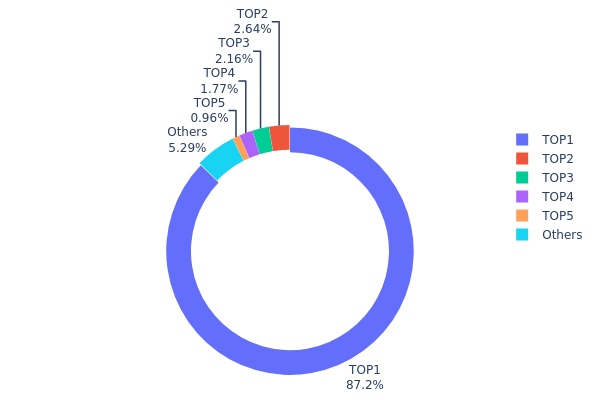
VDR Holdings Distribution
The holdings distribution map illustrates how VDR tokens are allocated across different blockchain addresses, serving as a critical indicator of token concentration and decentralization. By analyzing the proportional ownership of top holders versus the broader address base, this metric reveals the structural composition of the token ecosystem and potential risks associated with wealth concentration.
VDR exhibits pronounced concentration characteristics, with the top holder commanding 87.18% of total supply—a level that indicates highly centralized token distribution. The cumulative holdings of the top five addresses account for 94.68% of all tokens, while the remaining 5.32% is dispersed across numerous other addresses. This extreme concentration dynamic suggests that token liquidity and market movements are disproportionately influenced by a small number of wallet holders, creating substantial structural imbalances within the ecosystem.
The dominance of a single address holding nearly nine-tenths of the circulating supply presents considerable implications for market stability and investor protection. Such concentration patterns typically correlate with heightened price volatility and increased susceptibility to coordinated movements, as large holders possess significant discretionary power over token supply dynamics. The decentralized nature of the blockchain ecosystem is substantially compromised when decision-making capacity becomes concentrated among minimal stakeholders, potentially undermining the security and resilience of the protocol's on-chain governance structures and market mechanisms.
Click to view current VDR Holdings Distribution
| Top | Address | Holding Qty | Holding (%) |
|---|---|---|---|
| 1 | 3t5rQJ...8DTxpW | 1743707.82K | 87.18% |
| 2 | FVq589...ZWx6QW | 52859.40K | 2.64% |
| 3 | u6PJ8D...ynXq2w | 43181.06K | 2.15% |
| 4 | GpMZbS...TvxFbL | 35325.94K | 1.76% |
| 5 | DpAuex...fXtoLD | 19197.88K | 0.95% |
| - | Others | 105718.88K | 5.32% |
II. Core Factors Affecting VDR's Future Price
Market Sentiment and News Impact
-
Adoption announcements: When market announcements emerge regarding widespread VDR adoption or major technical breakthroughs, they typically trigger optimistic market sentiment, driving VDR price increases.
-
Negative catalysts: Conversely, regulatory crackdowns, security vulnerabilities, and other adverse news may trigger market panic, leading to price declines.
-
Market dynamics: Market trends and technological innovation serve as primary driving factors influencing VDR's price trajectory.
Supply Mechanism and Scarcity
-
Supply dynamics: VDR's future price is influenced by its supply mechanism and market demand factors. Supply scarcity characteristics play a role in determining long-term price movements.
-
Current market focus: Investors currently focus on macroeconomic conditions and regulatory environments when evaluating VDR investment potential.
Macroeconomic Environment
-
Economic policy impact: Broader macroeconomic conditions and monetary policy expectations influence VDR's price performance in the cryptocurrency market.
-
Market correlation: VDR price movements are sensitive to general cryptocurrency market trends and investor risk appetite shifts.
III. 2026-2031 VDR Price Forecast
2026 Outlook
- Conservative Forecast: $0.0080-$0.0097
- Neutral Forecast: $0.0086 (average price)
- Bullish Forecast: $0.0097 (requires sustained market stability)
2027-2029 Medium-term Outlook
- Market Phase Expectation: Consolidation with gradual upward momentum, characterized by incremental growth and increasing market adoption
- Price Range Forecast:
- 2027: $0.00088-$0.00094
- 2028: $0.00077-$0.00113
- 2029: $0.00071-$0.00153
- Key Catalysts: Expanding ecosystem development, increased institutional participation, and strengthened fundamental utility metrics
2030-2031 Long-term Outlook
- Base Case Scenario: $0.00107-$0.00147 (assumes steady market growth and consistent project execution)
- Bullish Case Scenario: $0.00132-$0.00154 (contingent on accelerated adoption and positive regulatory environment)
- Transformational Case Scenario: $0.00154+ (under conditions of breakthrough technological advancement and mainstream institutional adoption)
- 2031-12-31: VDR projected at $0.00154 (potential cycle peak under optimal conditions)
Note: Price predictions are subject to significant market volatility and emerging macro-economic factors. Investors should conduct independent research and consider risk management strategies when trading on platforms such as Gate.com.
| 年份 | 预测最高价 | 预测平均价格 | 预测最低价 | 涨跌幅 |
|---|---|---|---|---|
| 2026 | 0.00097 | 0.00086 | 0.0008 | 0 |
| 2027 | 0.00094 | 0.00092 | 0.00088 | 6 |
| 2028 | 0.00113 | 0.00093 | 0.00077 | 7 |
| 2029 | 0.00153 | 0.00103 | 0.00071 | 19 |
| 2030 | 0.00147 | 0.00128 | 0.00107 | 48 |
| 2031 | 0.00154 | 0.00137 | 0.00132 | 59 |
Vodra (VDR) Professional Investment Strategy and Risk Management Report
IV. VDR Professional Investment Strategy and Risk Management
VDR Investment Methodology
(1) Long-term Holding Strategy
- Suitable for: Content creator ecosystem believers and patient capital investors seeking exposure to creator economy platforms
- Operation suggestions:
- Accumulate VDR during price consolidation phases, particularly when the asset trades below $0.001
- Set a long-term holding horizon of 2-3 years minimum to capture potential ecosystem adoption growth
- Maintain a diversified portfolio where VDR represents no more than 5-10% of total cryptocurrency holdings
(2) Active Trading Strategy
- Technical analysis tools:
- Support and Resistance Levels: Monitor the $0.0008635 current price level against the 24-hour range ($0.0007841 - $0.0008655) to identify breakout opportunities
- Volume Analysis: Track the 24-hour trading volume of $12,288.54 to assess liquidity conditions before executing trades
- Wave operation key points:
- Capitalize on short-term momentum, as VDR demonstrated a 10.12% 24-hour increase as of January 3, 2026
- Set profit targets at 15-20% gains and stop-losses at 8-10% below entry points given historical volatility
VDR Risk Management Framework
(1) Asset Allocation Principles
- Conservative investors: 2-3% allocation
- Active investors: 5-8% allocation
- Professional investors: 8-12% allocation
(2) Risk Hedging Approach
- Portfolio diversification: Combine VDR holdings with established cryptocurrencies and stablecoins to mitigate concentrated risk
- Dollar-cost averaging: Implement systematic purchase schedules rather than lump-sum investments to reduce timing risk
(3) Secure Storage Solutions
- Hot wallet option: Gate.com Web3 Wallet for frequent trading and accessibility
- Cold storage consideration: For long-term holdings exceeding 6 months, utilize hardware-based solutions for enhanced security
- Security precautions: Never share private keys, enable multi-factor authentication, verify contract addresses before token transfers, and regularly audit wallet activity
V. VDR Potential Risks and Challenges
VDR Market Risks
- High volatility exposure: VDR has declined 50.03% over the past year (from ~$0.0018 to current $0.0008635), reflecting extreme price fluctuations typical of low-liquidity tokens
- Low market liquidity: With only 1 exchange listing (Gate.com) and 24-hour volume of $12,288.54, trading VDR carries significant slippage risk for larger orders
- Small market capitalization: At approximately $1.73 million fully diluted valuation, VDR remains highly susceptible to pump-and-dump schemes and whale manipulation
VDR Regulatory Risks
- Creator economy regulatory uncertainty: Government frameworks for content creator compensation platforms remain evolving and inconsistent across jurisdictions
- Securities classification risk: If regulatory authorities classify VDR as a security rather than utility token, it may face operational restrictions or delisting
- Platform compliance challenges: Vodra must navigate varying content creator labor laws and tax regulations across different countries where its platform operates
VDR Technology Risks
- Solana blockchain dependency: VDR operates solely on the Solana network, exposing token holders to network-specific technical failures or consensus issues
- Smart contract vulnerabilities: As a relatively obscure token with limited audits, VDR faces elevated risks from undetected code vulnerabilities or exploits
- Ecosystem adoption risk: Failure to achieve meaningful creator adoption could render the token economically obsolete
VI. Conclusion and Action Recommendations
VDR Investment Value Assessment
Vodra presents a speculative opportunity targeting the underserved creator economy segment, where traditional social media platforms inadequately compensate content producers. However, the token's severe decline of 50% annually, minimal market capitalization of $1.73 million, and single-exchange liquidity present substantial risk factors that outweigh speculative upside potential for most investors. Success depends critically on achieving meaningful creator adoption and network effects, which currently remain unproven. The project's technical foundation on Solana provides scalability advantages, but extreme volatility and limited market depth render VDR unsuitable for risk-averse portfolios.
VDR Investment Recommendations
✅ Newcomers: Allocate only 1-2% of cryptocurrency portfolio as high-risk speculative exposure; prioritize understanding creator economy dynamics before investing
✅ Experienced investors: Consider accumulating positions only during significant price corrections below $0.0005; implement strict stop-loss discipline at 10% below entry
✅ Institutional investors: Exercise extreme caution; current market depth insufficient for meaningful position sizing; monitor for signs of ecosystem adoption before substantive allocation
VDR Trading Participation Methods
- Gate.com spot trading: Execute buy/sell transactions for VDR/USDT pairs with attention to the asset's thin order book
- Long-term staking: If Vodra protocol implements yield-bearing mechanisms, participate in staking programs to enhance returns on held positions
- Dollar-cost averaging program: Establish automated recurring purchases of small VDR amounts to smooth entry costs and reduce timing risk
Cryptocurrency investment carries extreme risk. This report does not constitute investment advice. Investors should make decisions based on personal risk tolerance and consult professional financial advisors. Never invest capital you cannot afford to lose.
FAQ
How is the price of VDR services expected to change in the coming years?
VDR service prices are projected to increase significantly, driven by rising demand from M&A activities, legal services, and financial transactions. The global market, valued at approximately 2.37 billion USD in 2023, is expected to experience substantial growth through 2033.
What are the main factors affecting VDR price?
VDR price is primarily influenced by supply scarcity, institutional investment adoption, macroeconomic environment, technology development, market demand fluctuations, and ecosystem expansion. These factors collectively drive price movements and long-term growth potential.
What is the relationship between VDR price and company size and data volume?
VDR pricing directly correlates with company size and data volume. Larger enterprises with greater data volumes typically incur higher costs. Pricing structures usually include subscription fees, usage-based charges, and custom solutions tailored for enterprise clients requiring enhanced scalability and support services.
What are the main factors behind price differences among different VDR providers?
Price differences stem from feature complexity, user interface quality, customer support levels, security standards, customization options, storage capacity, and transaction volume. Premium providers charge more for advanced analytics, faster performance, and dedicated account management services.
How will VDR market price competition trends develop?
VDR market shows robust growth with 25% CAGR through 2028. Competitive pricing pressure continues intensifying as market matures. By early 2026, prices stabilize amid consolidation, with North America leading at 31.3% market share. Competition drives innovation and efficiency gains.
Share
Content
Introduction: VDR's Market Position and Investment Value
I. VDR Price History Review and Current Market Status
II. Core Factors Affecting VDR's Future Price
III. 2026-2031 VDR Price Forecast
IV. VDR Professional Investment Strategy and Risk Management
V. VDR Potential Risks and Challenges
VI. Conclusion and Action Recommendations
FAQ
Trending Cryptocurrencies



2025 SLN Price Prediction: Analyzing Market Trends and Potential Growth for Solana's Future

2025 SLN Price Prediction: Analyzing Market Trends and Potential Growth Factors for Solana

2025 SLC Price Prediction: Analyzing Market Trends and Expert Forecasts for the Future of Solana

How to convert SOL to USD: Real-time Solana price calculator

2025 LUNC Price Prediction: Analyzing Terra Luna Classic's Potential Recovery and Market Outlook in the Post-Crash Era

2025 HTX Price Prediction: Analyzing Market Trends and Growth Potential for the Digital Asset Exchange Token

What is ENSO? New Infrastructure for Web3 and Smart Contract Automation
Michael Saylor: The Path to Leadership in the Cryptocurrency Sphere

What is a Bitcoin hardware wallet
Introduction to Phantom Wallet and How to Use It

What is LYP: A Comprehensive Guide to Understanding Lymphocyte Yield Protocol in Modern Medical Testing