
Futures
Access hundreds of perpetual contracts
TradFi
Gold
One platform for global traditional assets
Options
Hot
Trade European-style vanilla options
Unified Account
Maximize your capital efficiency
Demo Trading
Introduction to Futures Trading
Learn the basics of futures trading
Futures Events
Join events to earn rewards
Demo Trading
Use virtual funds to practice risk-free trading
Launch
CandyDrop
Collect candies to earn airdrops
Launchpool
Quick staking, earn potential new tokens
HODLer Airdrop
Hold GT and get massive airdrops for free
Pre-IPOs
Unlock full access to global stock IPOs
Alpha Points
Trade on-chain assets and earn airdrops
Futures Points
Earn futures points and claim airdrop rewards


Promotions
AI
Gate AI
Your all-in-one conversational AI partner
Gate AI Bot
Use Gate AI directly in your social App
GateClaw
Gate Blue Lobster, ready to go
Gate for AI Agent
Gate MCP
Gate Skills Hub
10K+ Skills
From office tasks to trading, the all-in-one skill hub makes AI even more useful.
GateRouter
Smartly choose from 30+ AI models, with 0% extra fees


Who is Satoshi Nakamoto? The documentary "Finding Satoshi": There are two founders of Bitcoin.
Author: Max, Crypto City
Unveiling the financial fog, the documentary claims Satoshi Nakamoto is a duo
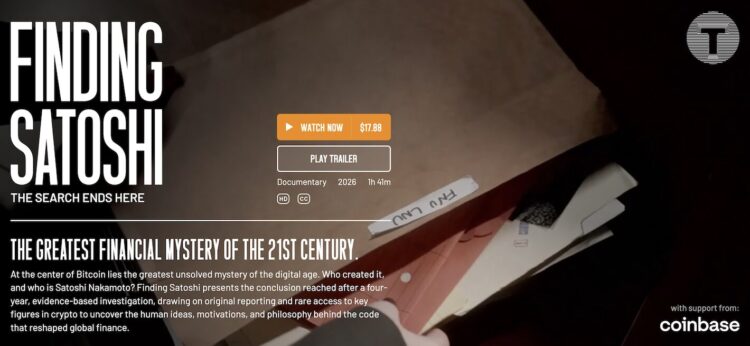
Since the birth of Bitcoin in 2009, the true identity of its creator “Satoshi Nakamoto” has remained the greatest financial mystery of the 21st century. Despite countless investigative reports, academic analyses, and speculations over the years, this enigmatic figure who changed the global financial landscape still hides behind digital mist. On April 22, 2026, a brand new documentary, “Finding Satoshi,” was officially released.
The production team claims that through four years of meticulous investigation, they have provided the “definitive answer” to this decade-long mystery. This work, co-produced by renowned investigative journalist William D. Cohan and private detective Tyler Maroney, and directed by Tucker Tooley and Matthew Miele, skips traditional film distribution channels and is exclusively released on FindingSatoshi.com. This distribution approach aims to echo Bitcoin’s core spirit of “decentralization,” allowing the work to connect directly with the public.
Image source: FindingSatoshi.com | “Finding Satoshi” skips traditional film distribution channels and is exclusively released on FindingSatoshi.com. This mode of release aims to resonate with Bitcoin’s core principle of “decentralization.”
The core argument of the documentary challenges the previous common belief that Satoshi is a “single individual.” The investigation team asserts that Satoshi Nakamoto was actually a technical team composed of two late senior cryptographers, Hal Finney and Len Sassaman. These two legendary figures are highly esteemed in the cryptography community and both deeply participated in the development of PGP (Pretty Good Privacy) encryption software, possessing top-tier technical foundations necessary for creating Bitcoin.
The documentary points out that Bitcoin’s creation combined Finney’s superb coding skills with Sassaman’s outstanding academic logic and writing talent. This division of labor explains why Bitcoin’s core code is extremely rigorous, and why the white paper exhibits a highly professional academic discourse, with the fusion creating an impeccable digital financial prototype.
Four years of in-depth investigation and forensic analysis, revealing the division of development work
To support this shocking conclusion, the team conducted extensive cross-industry evidence collection. They not only explored the origins of cryptography but also conducted in-depth interviews with over 20 key figures in the cryptocurrency industry. Interviewees include Strategy Chairman Michael Saylor, Ethereum co-founder Joseph Lubin, former SEC Chairman Gary Gensler, and Bitcoin security expert Jameson Lopp.
Additionally, the team even interviewed C++ language developer Bjarne Stroustrup, attempting to find traces of Bitcoin code evolution from programming language development. They also hired former FBI behavioral analyst Kathleen Puckett, who participated in the arrest of the Unabomber and is skilled in analyzing the behavioral patterns of anonymous creators.
Puckett’s forensic analysis of Satoshi’s white paper and early emails indicated that Satoshi frequently used the plural pronoun “we” in communication, which aligns with group writing behavior. The analysis also showed that Satoshi referenced the 1950s probability theory book “Introduction to Probability and Its Applications,” indicating the creator’s strong mathematical background and academic heritage, consistent with Len Sassaman’s academic career.
On a technical level, the investigation team precisely compared Satoshi’s early online activity times. Data showed that Satoshi’s active hours closely matched Eastern Standard Time (EST), ruling out many European or Asian candidates.
Data scientist Alyssa Blackburn’s stylistic analysis and server log comparisons further confirmed that Finney’s and Sassaman’s writing habits and coding styles are statistically highly correlated with Satoshi’s records. This theory resolves the professional differences observed in Satoshi’s coding and textual discourse, redefining Bitcoin as a product of interdisciplinary collective intelligence.
The key to solving the case isn’t alibi evidence; the testimonies of widows boost credibility
In previous community discussions, Hal Finney was often considered the most likely candidate for Satoshi, but Bitcoin developer Jameson Lopp pointed out a crucial “alibi.” He noted that during the email exchanges between Satoshi and other developers, Finney was participating in a marathon in Santa Barbara.
In response, “Finding Satoshi” offers an explanation, suggesting this precisely demonstrates the division of labor within the Satoshi team. While Finney focused on running the marathon, another team member, Len Sassaman, was handling textual information maintenance and replies, allowing “Satoshi” to maintain a 24/7 operational appearance.
The documentary interviewed the widows of two candidates: Fran Finney, Hal Finney’s wife, admitted she believes her husband played a core role in Bitcoin’s creation. Meredith L. Patterson, Sassaman’s wife, described her husband’s passionate obsession with anonymity and privacy technology during his lifetime. These humanized perspectives add emotional depth to the dry technical narrative.
It’s worth noting that these findings contrast sharply with recent media discoveries. For example, The New York Times previously conducted an 18-month investigation claiming that British cryptographer Adam Back was Satoshi. Back has repeatedly denied this, stating that although he invented Hashcash, he is not the creator of Bitcoin.
The “Finding Satoshi” team believes that although Back’s technology is a crucial foundation of Bitcoin, his activity timeline cannot fully cover all of Satoshi’s footprints. The documentary also mentions that in 2021, the team interviewed SBF, the then-dominant founder of FTX. Although this 90-minute interview was ultimately not included due to his subsequent fraud scandal and the documentary’s focus, it reflects the team’s comprehensive investigative approach.
With Finney and Sassaman passing away in 2014 and 2011 respectively, this “deceased” conclusion reassures many industry leaders. Satoshi’s holding of 1.1 million Bitcoins may remain forever sealed, reducing market fears of large-scale sell-offs, and allowing the legend of this “god” to continue in the technological realm.
Industry leaders’ reactions are polarized, dialogue between anonymous legends and technical faith
After the documentary’s release, the crypto community responded with great enthusiasm. Coinbase CEO Brian Armstrong stated that he believes the production team has found the “correct answer.” Vijay Boyapati, author of “The Principles of Bitcoin,” called the film the best documentary about Satoshi and the underlying technical spirit.
However, not everyone thinks uncovering the truth is necessary.
Cardano founder Charles Hoskinson pointed out that Bitcoin’s greatest fortune lies in the “absence of a founder.” He believes that if Bitcoin were tied to a specific individual, the project would be limited by that person’s reputation risk.
Satoshi Nakamoto chose to step away when Bitcoin first gained popularity, handing control back to the community. This demonstrates a genius political and sociological arrangement, giving Bitcoin an almost mythic purity. For many pure technologists, Satoshi’s identity may no longer matter. The documentary explores that Bitcoin was originally born as a privacy tool to counter surveillance capitalism, rooted in cryptopunk culture.
Even though “Finding Satoshi” reveals a dual-structure of Finney and Sassaman, Bitcoin’s decentralized nature still grants the protocol an independent vitality beyond its creators.
As regulations like the U.S. “CLARITY Act” continue to advance, and various active virtual asset ETFs are listed, Bitcoin has transformed from a mysterious digital experiment into an indispensable asset class within the global financial system. Satoshi Nakamoto’s legendary identity leaves an eternal literary charm in this process, and the world remembers those pioneers fighting for freedom through code in the digital wilderness.