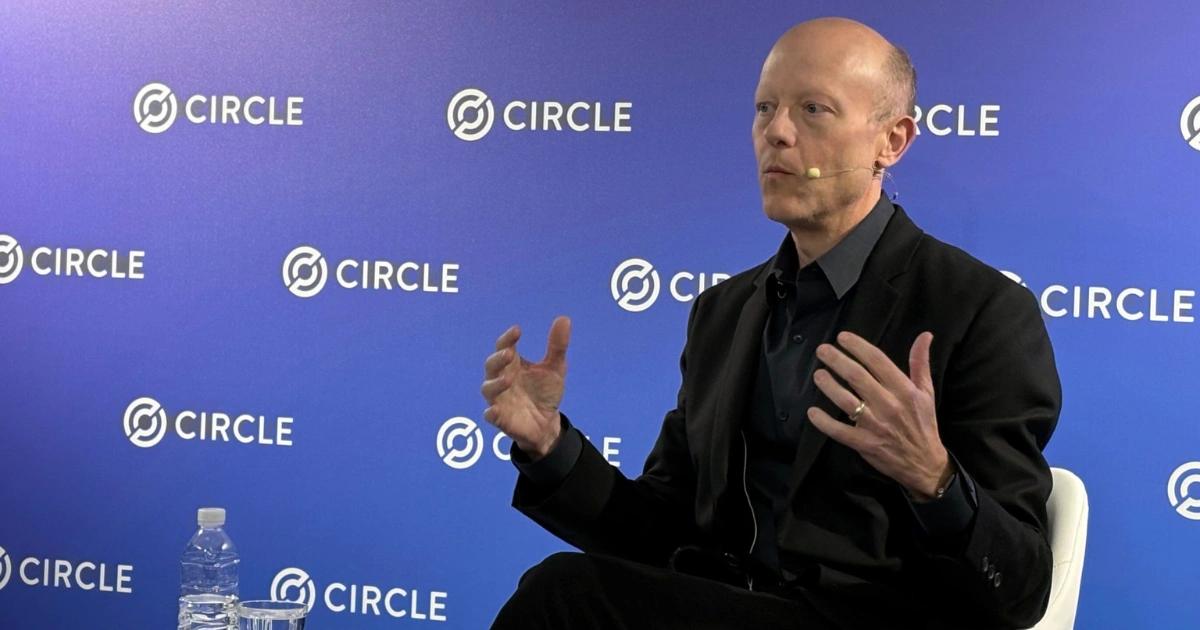
Circle CEO Jeremy Allaire said that, unless the company receives a court order or is required by law enforcement, it will not proactively freeze wallet addresses. Even amid hacker-related money-laundering controversies and community backlash, Circle continues to insist on operating in line with the rule of law.
Jeremy Allaire sets Circle’s law-enforcement bottom line
As the global cryptocurrency market swirls with activity, Circle’s CEO Jeremy Allaire addressed the most sensitive market issue—“asset freezes”—at a press conference in Seoul, South Korea. He noted that while Circle has the technical means to freeze specific wallet addresses, it will not intervene and freeze $USDC assets unless it receives a court order or an official directive from law enforcement authorities.
Jeremy Allaire stressed that the purpose of $USDC is a regulated financial product, and its operation must strictly follow the rule of law (Rule of Law).
When a hacker attack occurs, Circle should carry out intervention according to legal procedures. These remarks tied Circle’s actions to legal compliance obligations, establishing that when facing unlawful flows of funds, companies should prioritize adherence to legal procedures—not moral discretion—as a basic guideline.
According to existing operating data, in 2026 Circle has frozen only 122 addresses so far, most of them concentrated in February. Compared with its main competitor Tether ($USDT), which has a more aggressive intervention style, Circle’s approach looks rather restrained.
Jeremy Allaire believes that stablecoin issuers do not have the authority to dispose of users’ assets at will outside the legal framework; if such power is abused, it will harm the integrity of the entire financial system.
He views $USDC as part of the traditional financial system and believes that the seizure of assets or blacklist actions should be handled the same way as bank accounts under judicial supervision—following established legal processes. Although the market has debated the speed of these legal procedures, Jeremy Allaire insists this is the only path to maintaining long-term stability and trust in a regulated stablecoin.
On-chain sleuths and the community’s fury! Performance questions sparked by a $420 million loss
However, this insistence by Circle on “doing things according to the law” has been viewed by the fast-response on-chain security community as a protection shield for hacker money laundering. The well-known blockchain sleuth ZachXBT has repeatedly criticized Circle’s handling publicly. He pointed out that since 2022, because Circle failed to take timely action against known hacker addresses, an estimated $420 million in $USDC inflows into illicit industries has resulted.
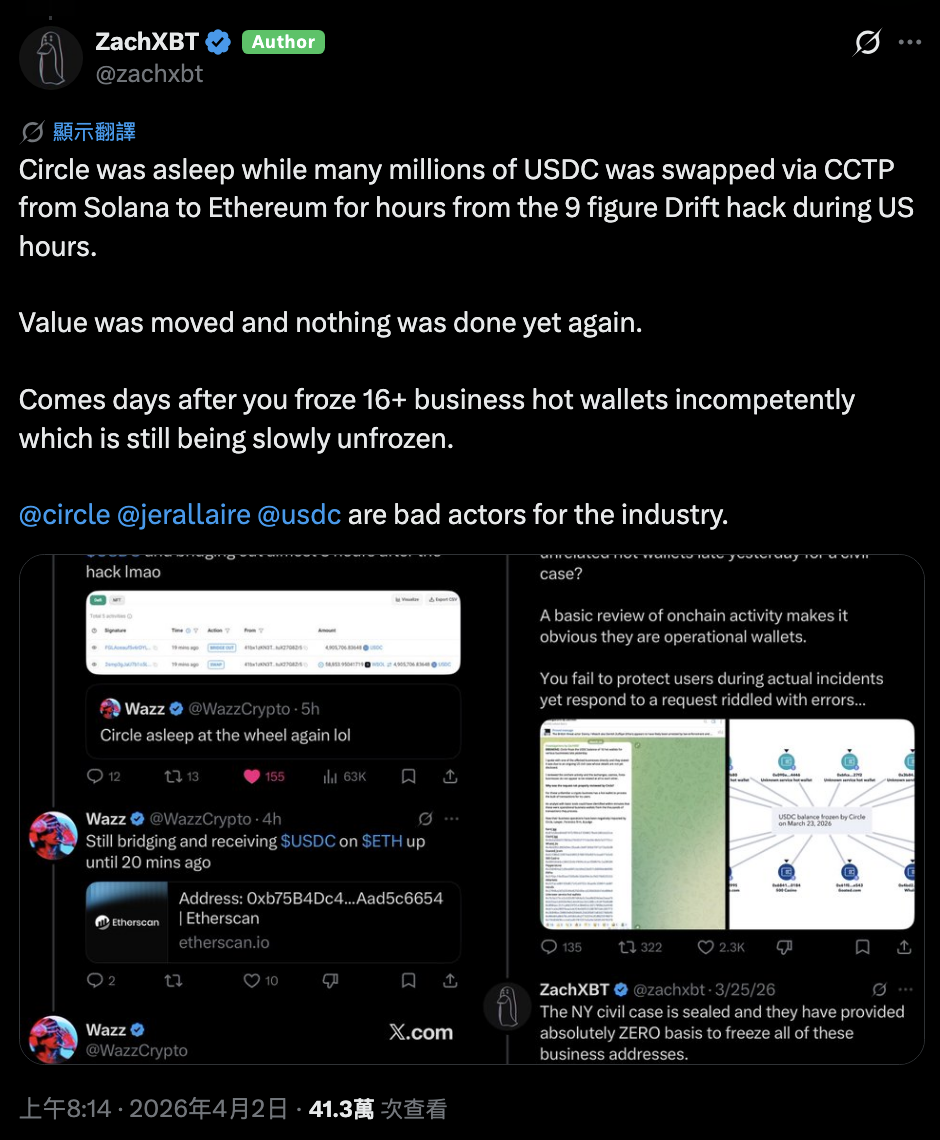
Image source: X/@zachxbt ZachXBT has repeatedly criticized Circle’s handling, accusing Circle of failing to take timely action against known hacker addresses
A recent major case involved an attack on Drift Protocol. The protocol suffered losses as high as $280 million, including $230 million in $USDC that was transferred frequently within just a few hours. Even though the community had identified the attacker’s wallet immediately, Circle refused to freeze the assets because it had not received a court order. In the end, the hacker converted $USDC into Ether ($ETH) through a decentralized exchange (DEX) and used mixing tools to evade tracking.
Market data analysis also reflects a notable difference in enforcement efficiency between Circle and Tether. To date, $USDC has frozen 602 addresses, while $USDT has cumulatively frozen as many as 2,886 wallets. Analysts warn that Circle’s decision-making process and lengthy waiting times may make $USDC a more attractive target for hackers.
Especially in early 2026, DeFi protocols became a hotbed for attacks. Because these protocols usually lack strict regulation, hackers often take advantage of $USDC ’s high liquidity and widely available lending pools to quickly carry out cross-chain money laundering. Although some in the community have proposed creating “exception mechanisms” for hacker attacks, the well-known commentator Nic Carter believes the real solution is to build a digital court (Chancery Court) that can keep up with network speed in order to counter hackers’ transfer velocity.
Further reading
DeFi platform Drift hacked on April Fools’ Day! Hackers drained $270 million in assets; admin’s key was the vulnerability
Who’s at fault for the Drift hack? Hackers cross-chained assets but weren’t frozen—ZachXBT slams Circle for negligence
A conflict between corporate discretion and the trust foundation of DeFi
On the controversy over whether Circle should have the power to freeze immediately, academia and industry experts hold sharply different views. Omid Malekan, an adjunct professor at Columbia Business School, warned that if stablecoin issuers are allowed to carry out arbitrary freezing or confiscation functions outside legal requirements, it would seriously undermine the foundation of decentralized finance (DeFi).
He believes that if a company’s executives can cut off fund flows at will based on personal judgment or social sentiment, then the principles of “code is law” and “law is law” would both cease to exist.
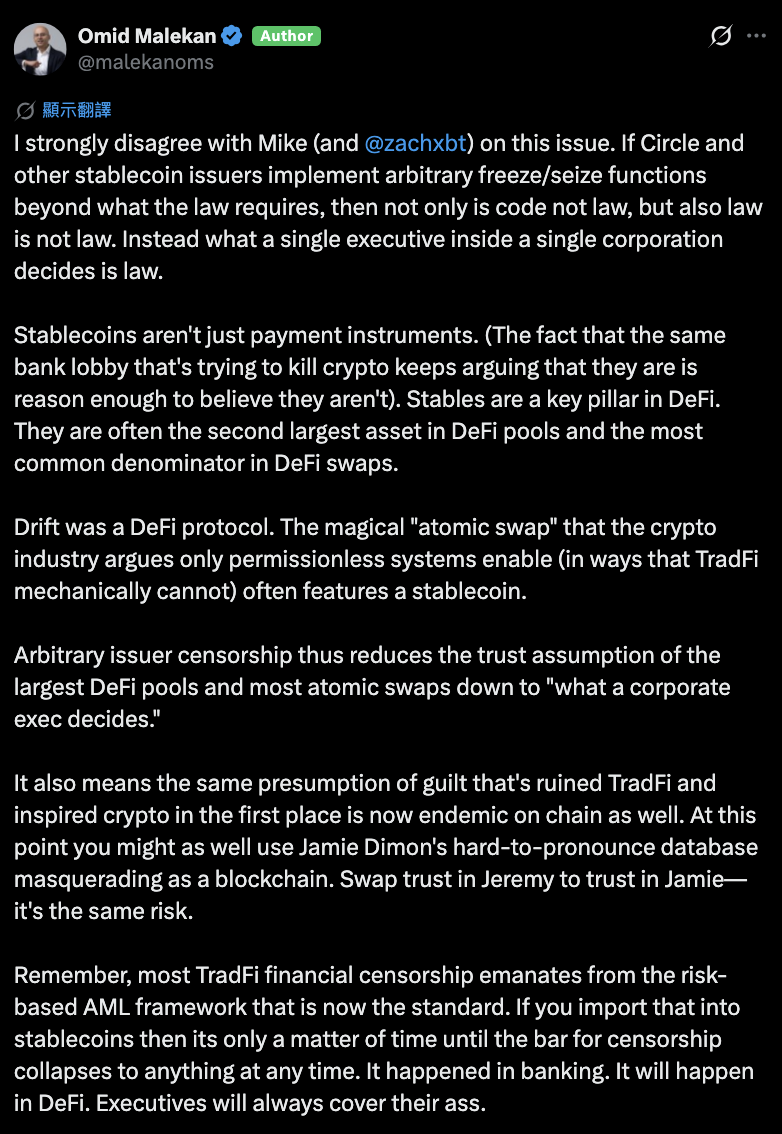
Image source: X/@malekanoms Adjunct professor Omid Malekan of Columbia Business School warns that if stablecoin issuers are allowed to carry out arbitrary freezing or confiscation functions outside legal requirements, it will seriously undermine DeFi’s foundation
In this situation, the personal will of a single company executive would override the law. Such overly centralized power would cause users to lose trust in DeFi systems, because the safety of assets would no longer depend on mathematics and protocols, but on the issuer’s administrative decisions.
This viewpoint echoes Circle’s core internal strategy: positioning itself as a compliant, institutionalized tool. Circle’s technical architecture allows it to freeze specific addresses quickly, but the exercise of this power must be highly transparent and constitutional. At present, Circle relies on an ad hoc notification and decision system to avoid automated AI scanning mechanisms, precisely to prevent harming innocent users.
However, this also means that in multiple cases Circle only blacklisted addresses months after an attack occurred, by which time illicit funds had already been laundered clean. This debate reflects a long-standing contradiction in the blockchain industry: how to balance the trust derived from extreme decentralization with the need to protect users’ asset security.
Why sanctioned parties avoid $USDC and turn elsewhere
Besides hacker attacks, $USDC ’s geopolitical role has also drawn significant attention. In response to a recent report by the Financial Times claiming that Iran may ask to use cryptocurrencies to pay tolls through the Strait of Hormuz, Jeremy Allaire explicitly denied in a press conference in Seoul the possibility of $USDC being used for such purposes. He said this scenario is extremely unlikely, because Circle strictly enforces global regulatory standards and sanctions lists.
- Related news: The Strait of Hormuz is open! Iran demands Bitcoin for tolls—Persian Gulf still seeing “Big Tanker traffic”
Because $USDC has a highly transparent technical structure and can be subject to judicial oversight at any time, for entities or individuals trying to evade sanctions, $USDC is not an ideal choice. Instead, those sanctioned parties typically prefer alternative options with lower regulatory oversight and poorer transparency, or offshore stablecoins.
Jeremy Allaire’s comments highlight Circle’s determination to walk the path of “traditional financialization.” As the adoption rate of $USDC keeps increasing, it shows vulnerability when facing new kinds of scams such as Address Poisoning and Dusting attacks.
Even so, Circle firmly believes that only through close cooperation with governments and law-enforcement agencies worldwide can stablecoins secure a place in mainstream economic systems. For Circle, maintaining consistency in the rule of law takes priority over intercepting losses in the short term. This stance has subjected it to enormous public-opinion pressure in 2026, while also making $USDC the digital dollar asset most aligned with regulatory requirements in the eyes of institutional investors.


