Germany’s second-largest bank DZ Bank obtains MiCAR authorization and launches the meinKrypto platform, enabling partner banking systems to directly offer cryptocurrency trading services to retail customers within a compliant framework.
Regulatory green light, Germany’s second-largest bank moves toward retail cryptocurrency
The German financial sector reaches a significant milestone as DZ Bank, the country’s second-largest bank, officially receives approval from the Federal Financial Supervisory Authority (BaFin) to operate under the EU’s Markets in Crypto-Assets Regulation (MiCAR). This license, issued at the end of December 2025, symbolizes that this Frankfurt-based financial giant has completed a key shift from institutional services to the mass retail market.
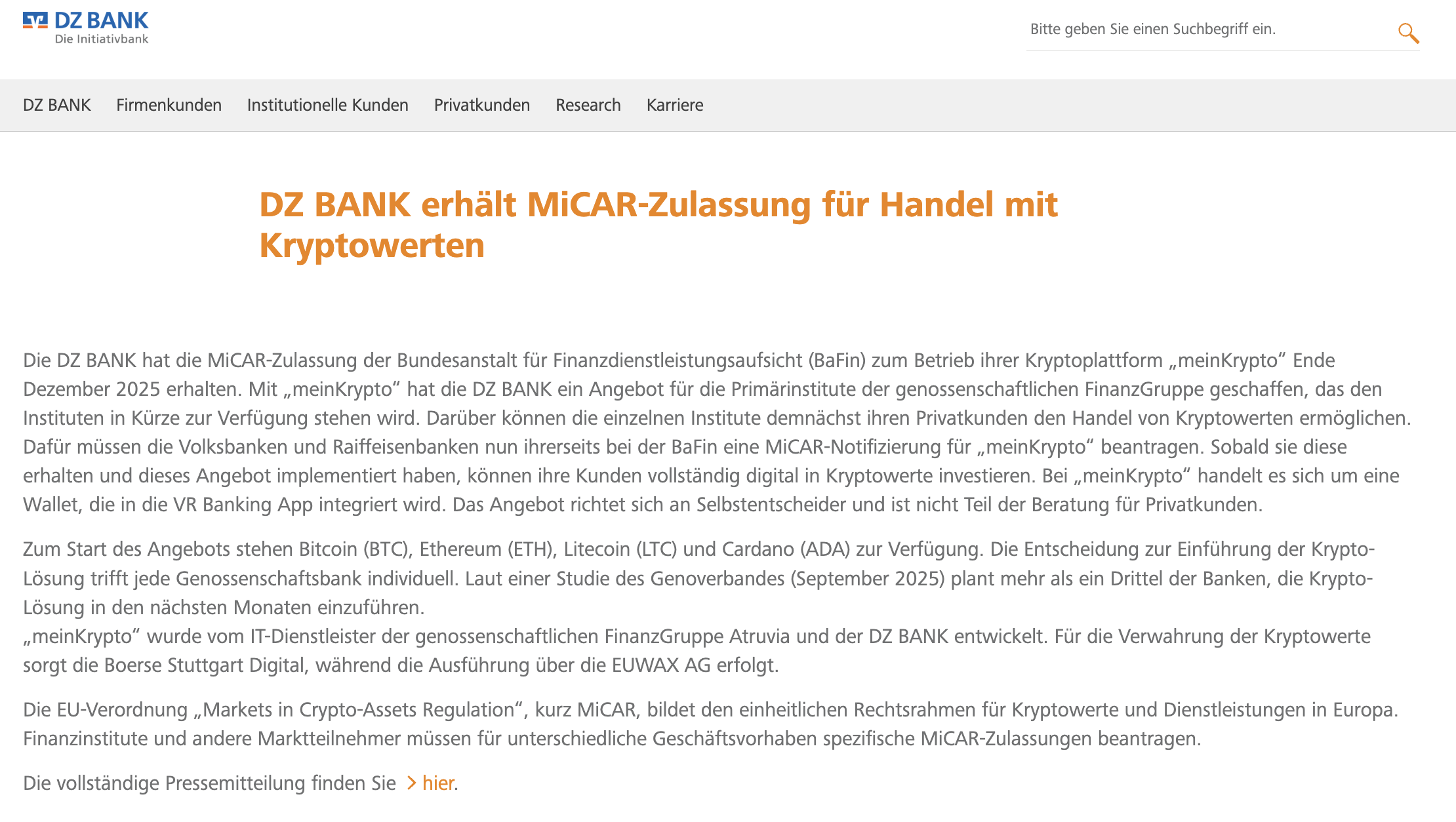
Image source: DZ Bank DZ Bank officially approved by BaFin to operate under the EU’s Markets in Crypto-Assets Regulation (MiCAR)
As the core institution of Germany’s cooperative banking network, DZ Bank’s move will pave the way for approximately 700 partner banks across Germany, allowing them to provide digital asset trading services to a broad base of individual clients within a regulated framework. The establishment of the MiCAR framework offers European financial institutions a unified supervisory standard, replacing the previously fragmented national regulations. DZ Bank is among the first large banking groups to translate this regulation into a practical operational blueprint.
This approval not only reflects years of regulatory preparation but also signifies that cryptocurrency trading is shedding its fringe status and becoming an integral part of mainstream banking app functionalities.
Building the meinKrypto platform, embedded wallets seamlessly integrated with existing banking experiences
DZ Bank announced the launch of “meinKrypto,” a digital asset trading platform designed entirely digitally and deeply integrated into the existing VR Banking App. This means that millions of Volksbanken and Raiffeisenbanken customers will soon be able to buy and sell digital assets directly within their familiar banking interface, without needing to go through external cryptocurrency exchanges.
Technically, meinKrypto was developed jointly by DZ Bank and the IT service provider Atruvia, part of the cooperative banking system, with asset custody managed by the Digital division of Stuttgart Stock Exchange (Boerse Stuttgart Digital), ensuring all assets meet high standards of security in accordance with German and EU regulations.
Initially supporting four major cryptocurrencies:** Bitcoin ($BTC)****, Ethereum ($ETH), Litecoin ($LTC), and Cardano ($ADA), with plans to expand the asset list gradually as regulatory approvals progress.**
It is noteworthy that meinKrypto is positioned as a “self-directed” investment tool, aimed at investors who prefer independent decision-making, with no personalized investment advisory services provided by the bank.
Decentralized promotion model, local banks hold the power to activate crypto services
Although DZ Bank has obtained the core license, the overall onboarding process will follow the decentralized tradition of Germany’s cooperative banking system. Each local cooperative bank has autonomous decision-making authority and must evaluate its own strategy and risk before activating cryptocurrency trading features for its customers.
Before officially launching the service, each local bank must submit an independent MiCAR notification to BaFin. After approval and integration into the VR Banking App, meinKrypto can be officially opened to local customers. This model allows smaller banks to share the regulatory framework and compliance technology provided by DZ Bank without the need to build independent infrastructure.
According to a survey published by Genoverband in September 2025, interest in digital assets among German cooperative banks is significantly increasing, with about 71% considering launching crypto services, up from 54% in 2024. The survey further indicates that approximately one-third of these banks plan to go live within five months of obtaining authorization, demonstrating that market demand is propagating from local branches to central institutions.
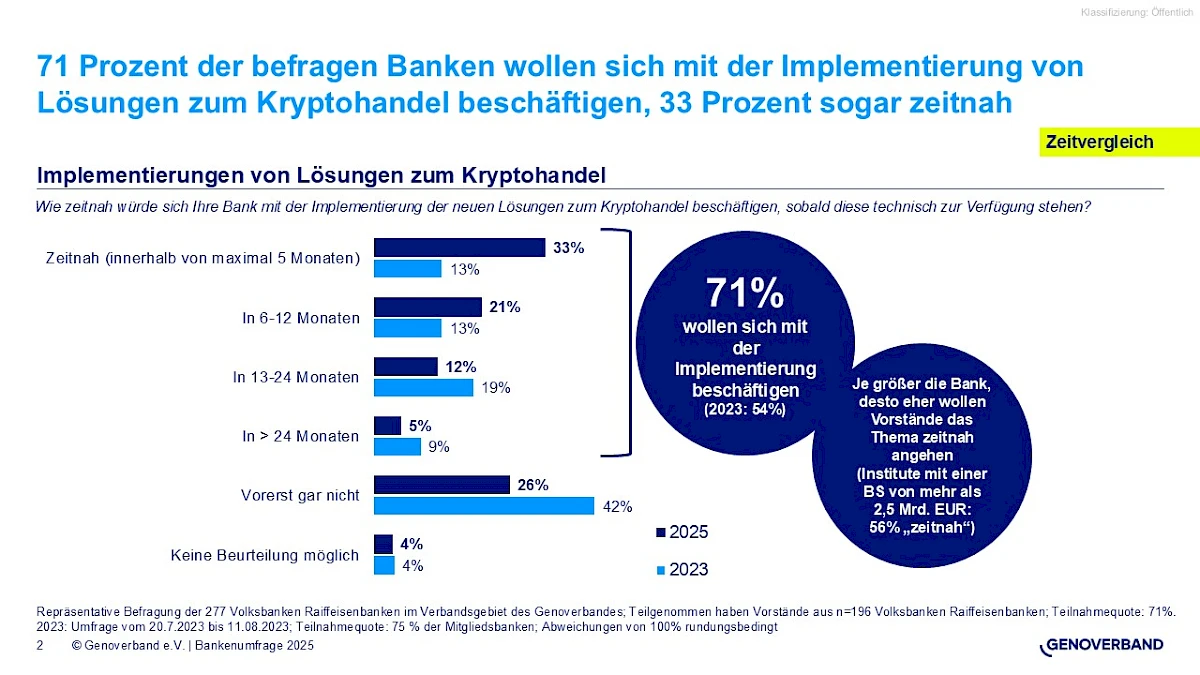
Image source: Genoverband Data from Genoverband shows that interest in digital assets among German cooperative banks is rising sharply, with about 71% considering launching crypto services
From institutional custody to stablecoin deployment, building a comprehensive digital financial ecosystem
DZ Bank’s deep involvement in the crypto industry has not been achieved overnight. As early as November 2023, the bank launched an institutional-grade crypto custody platform via Ripple’s Metaco infrastructure, initially serving corporate and institutional clients.
With the acquisition of the MiCAR license, this strategic initiative has now extended into the private retail sector. In addition to the meinKrypto platform, DZ Bank is also active in the payments industry, announcing participation in a European banking consortium called Qivalis to jointly develop a regulated euro-denominated stablecoin.
This consortium, composed of 11 banks, is currently applying for an electronic money institution (e-money) license from the Dutch Central Bank, with plans to enter the market in the second half of 2026, aiming to optimize payment settlement processes between European businesses and consumers.
Meanwhile, other German financial giants such as Deutsche Bank and LBBW are actively collaborating with crypto firms like Bitpanda to develop custody services. DZ Bank’s comprehensive involvement is undoubtedly accelerating the integration of Germany’s traditional financial system with digital assets, transforming cryptocurrencies from experimental fringe products into a regulated, everyday service comparable to conventional financial operations.
Disclaimer: The information on this page may come from third parties and does not represent the views or opinions of Gate. The content displayed on this page is for reference only and does not constitute any financial, investment, or legal advice. Gate does not guarantee the accuracy or completeness of the information and shall not be liable for any losses arising from the use of this information. Virtual asset investments carry high risks and are subject to significant price volatility. You may lose all of your invested principal. Please fully understand the relevant risks and make prudent decisions based on your own financial situation and risk tolerance. For details, please refer to
Disclaimer.


