The U.S. Supreme Court will resume operations on January 9th after a four-week recess, with a potentially landmark economic ruling: whether the Trump administration’s broad tariffs imposed under emergency authority are lawful, or if these measures have exceeded Congress’s limits.
Market platforms currently estimate only a 23–30% chance of the government winning the case. Meanwhile, the U.S. Treasury Department has indicated the possibility of having to refund tens of billions of dollars in taxes, while missing out on hundreds of billions over the next decade if the tariffs are overturned.
Contrary to the event’s significance, Bitcoin derivatives markets almost do not reflect defensive sentiment. The 7-day implied volatility is near multi-month lows, with 25-delta skew slightly favoring calls. The funding rate for perpetual futures oscillates around 0.0076–0.0094% every 8 hours, significantly lower than during periods of excessive leverage.
In this context, the USD index has fallen about 9.5% year-over-year, 10-year U.S. Treasury yields hover around 4.2%, and stock markets closed 2025 near historic highs.
The disconnect is clear: Washington and prediction platforms view the upcoming ruling as a binary macro event, but both multi-asset markets and Bitcoin derivatives have yet to price in a clear “tariff shock.”
No clear trend, but high volatility risk
Trump’s “Liberation Day” tariffs, imposed in April 2025, are based on the International Emergency Economic Powers Act (IEEPA) of 1977—a law primarily designed for national security threats.
Two lower courts have ruled that these tariffs are unlawful, arguing that IEEPA has been interpreted beyond Congress’s original intent. During November hearings, judges from different political leanings expressed skepticism about the government’s arguments.
Tariffs under IEEPA currently account for about half of the total U.S. customs revenue and are seen as a factor contributing to inflationary pressure, making 2025 the worst year for the USD since 2017. If overturned, the refund and revenue shortfalls over the next decade could reach hundreds of billions of dollars.
On Polymarket, traders estimate a 77% probability that the Supreme Court will rule against the Trump administration, while Kalshi’s figure is lower, around 69%.
The gap between predictions and real money
Data from prediction markets show only a 23–31% chance of the Supreme Court supporting the tariffs. However, in a niche market where importers sell rights to claim refunds to hedge funds, these are traded around 20–30 cents/USD, implying a roughly 40–45% actual probability.
The discrepancy between the implied probability in prediction markets and the trading prices of refund claims indicates significant uncertainty. This creates an ideal environment for event-driven volatility to explode if the ruling goes against expectations.
Bitcoin derivatives also show no clear trend bias, although volatility could spike sharply after the decision is announced.
Deribit’s DVOL index rose from 43 on January 1 to a local peak of 46.4 on January 5, but remains within the lowest range since late November. The 25-delta call–put skew remains around -1.3 for both 1-week and 1-month maturities, indicating short-term put options are still slightly more expensive, reflecting a modest demand for downside protection rather than a strong bullish bet.
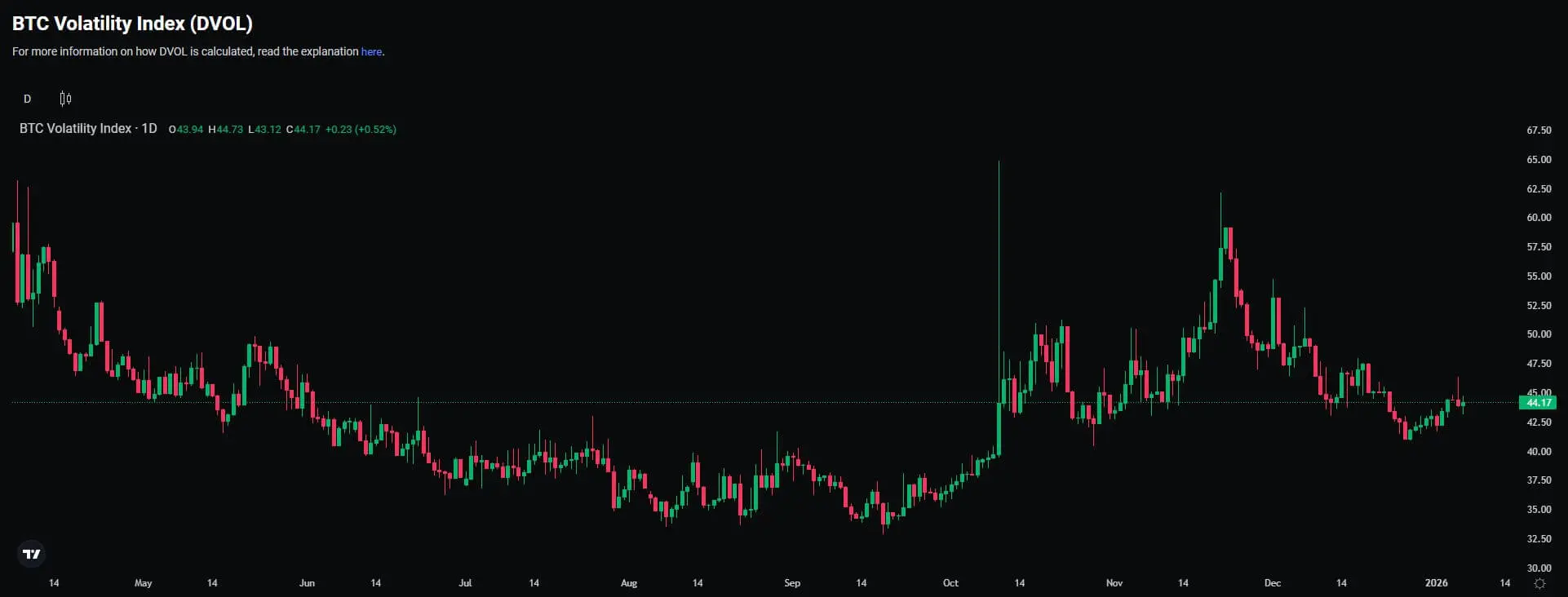 Deribit’s volatility index increased from 43 on January 1 to 46.4 on January 5, near the lowest levels since late November | Image: DeribitThe funding rate for futures remains moderate, while open interest has surpassed $60 billion, indicating significant leverage in the system, though both tail-risk hedging and “bullish lottery tickets” are not heavily sought after.
If the Supreme Court surprises, volatility is more likely to stem not from “new information,” but from the need to reprice the current $60 billion position.
Two scenarios, two diffusion mechanisms
If the Court maintains the tariffs, it would contradict market expectations and surprise macro analysts. The initial interpretation would be: higher and more persistent import prices, difficulty returning inflation to target, a stronger USD, and rising real yields.
This scenario is typically unfavorable for equities, and Bitcoin is likely to react as a high-beta asset, declining alongside stocks in the initial response. However, in the medium term, prolonged tariffs could reinforce the narrative of policy risks and U.S. fiscal fragility—an environment where “digital gold” and “off-system assets” could re-emerge after a leverage reduction phase.
Conversely, if the Court overturns the tariffs—currently the baseline scenario—this affirms current Wall Street expectations. Canceling tariffs would be akin to a supply-side disinflation shock and could boost corporate profits if refunds are processed.
Immediate reactions would likely be a weaker USD, lower long-term yields, narrower credit spreads, and rising stocks. Bitcoin often benefits in risk-on environments, especially if lower yields revive liquidity and carry strategies that previously fueled ETF flows and basis trading in 2025.
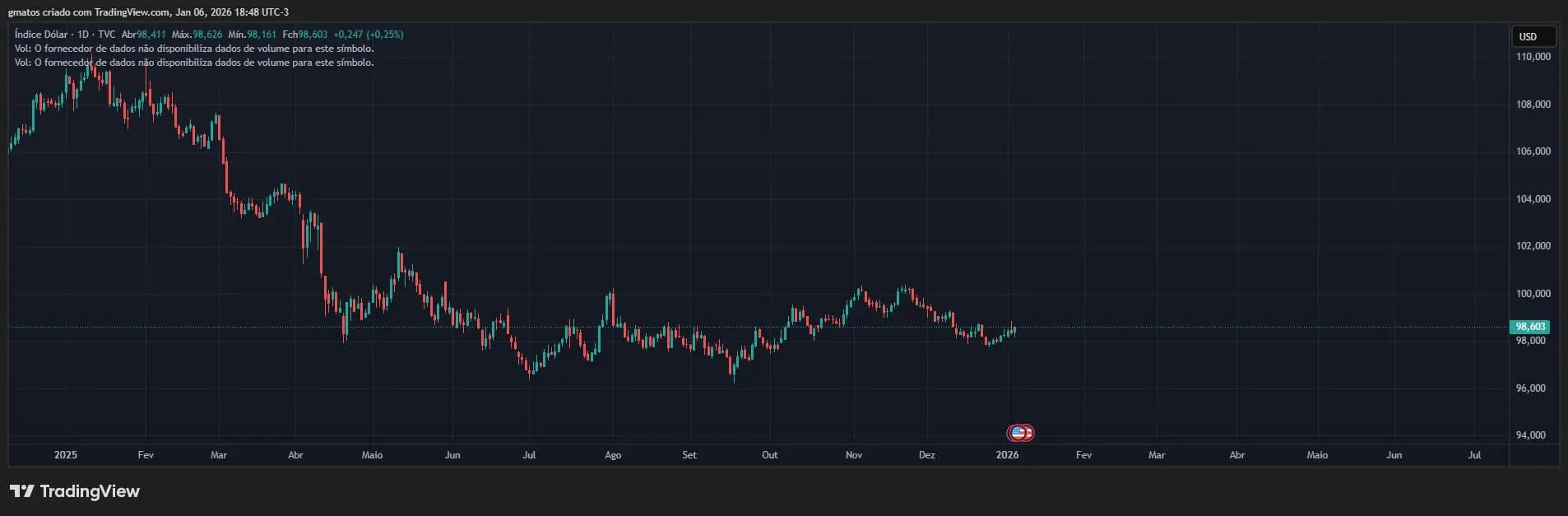 *The dollar index trades around 98, about 9.5% below its peak earlier in 2025.*The key point lies in market positioning. If on January 9th, volatility remains low, funding is moderate, and skew is not too tilted, Bitcoin has room to gradually rise as investors become more risk-tolerant. Conversely, if long positions are overly crowded, a “good news but sell the fact” scenario could occur, with a short-lived rally followed by a correction.
What does “priced in” really mean?
Prediction markets suggest the decision’s direction has been somewhat reflected, but both multi-asset markets and Bitcoin derivatives have yet to price in a large volatility premium for a tariff shock.
This does not mean the ruling will not impact the market. It only indicates that price reactions will depend more on the degree of surprise than on the outcome itself.
If tariffs are maintained, volatility could spike as markets reprice inflation and USD strength. If overturned, reactions will depend on how much the market has “front-run” the good news.
Current setup shows Bitcoin is in a zone where both scenarios could create trading opportunities, but neither is preordained to turn Friday into an insignificant event.
This ruling is unlikely to alter Bitcoin’s long-term trajectory, but it will clarify which macro story dominates the market in the coming weeks: re-inflation and a strong USD if tariffs stay, or disinflation and risk-on flows if tariffs are canceled.
The fact that derivatives markets have not yet “screamed” about this risk suggests that timely attention could still generate alpha.
Thach Sanh


