
Купить криптовалюту
Оплатить в

USD
Купить и Продажа
HOT
Покупайте и продавайте криптовалюту через Apple Pay, карты, Google Pay, банковские переводы и т. д
P2P
0 Fees
Нулевые комиссии, более 400 способов оплаты и простая покупка и продажа криптовалюты
Gate Card
Криптовалютная платежная карта, обеспечивающая бесперебойные глобальные транзакции.
Торговля
Основа
Спот
Торгуйте криптовалютой свободно
Маржа
Увеличьте свою прибыль с помощью кредитного плеча
Конвертация и блочная торговля
0 Fees
Торгуйте любым объемом без комиссий и проскальзываний
Токены с кредитным плечом
Получите простой доступ к позициям с кредитным плечом
Премаркет
Торгуйте новыми токенами до их официального листинга
Фьючерсы
Фьючерсы
Сотни контрактов, рассчитанных в USDT или BTC
Опционы
HOT
Торги опционами Vanilla в европейском стиле
Единый счет
Увеличьте эффективность вашего капитала
Демо-торговля
Начало фьючерсов
Подготовьтесь к торговле фьючерсами
Фьючерсные события
Участвуйте в мероприятиях и выигрывайте щедрые награды
Демо-торговля
Используйте виртуальные средства для торговли без риска
Earn
Запуск
CandyDrop
Собирайте конфеты, чтобы заработать аирдропы
Launchpool
Быстрый стейкинг, заработайте потенциальные новые токены
HODLer Airdrop
Удерживайте GT и получайте огромные аирдропы бесплатно
Launchpad
Будьте готовы к следующему крупному токен-проекту
Alpha Points
NEW
Торгуйте ончейн активами и получайте награды аирдропа!
Фьючерсные баллы
NEW
Зарабатывайте баллы и получайте награды аирдропа
Инвестиции
Simple Earn
Зарабатывайте проценты с помощью неиспользуемых токенов
Автоинвест.
Автоинвестиции на регулярной основе.
Бивалютные инвестиции
Покупайте дешево и продавайте дорого, чтобы получить прибыль от колебаний цен
Мягкий стейкинг
Получайте вознаграждения с помощью гибкого стейкинга
Криптозаймы
0 Fees
Заложите одну криптовалюту, чтобы занять другую
Центр кредитования
Единый центр кредитования
VIP-центр богатства
Настроенное вами управление капиталом способствует росту ваших активов
Управление частным капиталом
Индивидуальное управление активами для роста ваших цифровых активов
Количественный фонд
Лучшая команда по управлению активами поможет вам получить прибыль без лишних хлопот
Стейкинг
Делайте стейкинг криптовалюты, чтобы заработать на продуктах PoS
Умное плечо
NEW
Без принудительной ликвидации до погашения, беззаботный прирост с кредитным плечом
Минтинг GUSD
Используйте USDT/USDC чтобы минтить GUSD для доходности на уровне казначейских облигаций

Еще

Результаты поиска для "SAY"
Мысли о рынке прогнозов: когда вероятность заменяет страх, мы действительно можем быть свободными.
Исходный заголовок: Когда отец использует рынок прогнозов для снижения родительской тревоги
Автор оригинала: Polyfactual
Исходный текст:
Перепечатка: Дейзи, Mars Finance
В прошлый вторник утром я стоял в очереди на вход в начальную школу, опираясь на рюкзак сына, застыв на месте. На выходных снова произошла стрельба в школе, и это заняло первые страницы новостей.
Когда он с восторгом вбежал в школьное здание, я почувствовал знакомое напряжение в груди — болезненное чувство, как будто с их растущей независимостью в этом враждебном мире могло произойти что угодно.
По пути на работу я слушал длинную аудиокнигу: «Безмолвное признание» (Say Nothing), историческую запись конфликта в Северной Ирландии (The Troubles) — от 1969 года до конца 1990-х, продолжавшуюся тридцать лет антиколониальных.
MarsBitNews·2025-10-15 13:26
Майкл Сейлор: Протокол Биткойн может справиться с потенциальными рисками от угрозы Квантовых вычислений ликвидности с помощью обновлений программного обеспечения.
Techub News сообщает, что, по данным CoinDesk, основатель Strategy Майкл Сэйлор недавно в интервью снизил угрозу квантовых вычислений для Биткойна, считая, что когда угроза станет актуальной, протокол Биткойна сможет справиться с потенциальными рисками путем обновления программного обеспечения. Он сказал: "Это в основном маркетинговый ход тех, кто хочет продать вам следующий квантовый концептуальный Токен. Google и Microsoft не будут продавать компьютеры, способные взламывать современные шифрования, потому что это разрушит Google и Microsoft — также это разрушит правительство США и банковскую систему."
В настоящее время существует несколько исследований, как сделать работу Биткойн с доказательством работы (PoW) устойчивой к квантовым атакам, включая анти-квантовое шифрование оборудования, разработанное стартапами, такими как BTQ. Один из разработчиков Биткойн представил предложение по улучшению (BIP), предлагающее переместить адреса кошельков на квантово-устойчивые адреса через хард-форк. Say
BTC-0,58%
TechubNews·2025-06-09 01:08
Федеральный судья только что отверг SEC. Вот что это означает. - BlockTelegraph
*
*
*
*
*
If the SEC were a sports team measured by its “win” rate, it would be a runaway champ.
But that win-loss record suffered a mild hit — and its first ever loss in an “ICO” case — one that refers to the controversial method of crowd fundraising and that borrows from the public company “IPO” or initial public offering.
A federal judge denied the SEC a preliminary injunction against Blockvest after he granted a temporary restraining order on the same issue. We chat with Amit Singh, attorney and shareholder in Stradling’s corporate and securities practice group about the SEC’s fresh loss.
His take? They’ll be out for blood, next.
**For those not in the know, share the legal background leading up to this case.**
In October of this year, the Securities Exchange Commission filed a complaint against Blockvest LLC and its founder, Reginald Buddy Ringgold III. According to the complaint, Blockvest falsely claimed its planned December initial coin offering was “registered” and “approved” by the SEC and created a fake regulatory agency, the Blockchain Exchange Commission, which included a phony logo that was nearly identical to that of the SEC. The SEC also alleged Blockvest conducted pre-sales of its digital token, BLV, ahead of the ICO and raised more than $2.5 million.
The SEC’s complaint alleged violations of the anti-fraud provisions of the Securities Exchange and the Securities Act and violations of the Securities Act’s prohibitions against the offer and sale of unregistered securities in the absence of an exemption from the registration requirements.
U.S. District Judge Gonzalo Curiel issued a temporary restraining order “freezing assets, prohibiting the destruction of documents, granting expedited discovery, requiring accounting and order to show cause why a preliminary injunction should not be granted” on October 5, 2018.
On Tuesday, November 27, in the SEC’s first loss in stopping an ICO, judge Gonzalo Curiel stated that the SEC had not shown at this stage of the case that the BLV tokens were securities under the Howey Test, a decades-old test established by the U.S. Supreme Court for determining whether certain transactions are investment contracts and thus securities. If the tokens weren’t securities, all the SEC’s other allegations automatically fail Under the Howey Test, a transaction is an investment contract (or security) if:
– It is an investment of money;
– There is an expectation of profits from the investment;
– The investment of money is in a common enterprise; and
– Any profit comes from the efforts of a promoter or third party
Later cases have expanded the term “money” in the Howey Test to include investment assets other than money.
The judge said that the SEC failed to show investors had an expectation of profits. “While defendants claim that they had an expectation in Blockvest’s future business, no evidence is provided to support the test investors’ expectation of profits,” the judge wrote. Blockvest argued that the pre-ICO money came from 32 “test investors” and said the BLV tokens were only designed for testing its platform. It presented statements from several investors who said they either did not buy BLV tokens or rely on any representations that the SEC has alleged are false. The SEC responded by noting that various individuals wrote “Blockvest” or “coins” on their checks and were provided with a Blockvest ICO white paper describing the project and the terms of the ICO. Judge Curiel said that evidence, by itself, wasn’t enough: “Merely writing ‘Blockvest or coins’ on their checks is not sufficient to demonstrate what promotional materials or economic inducements these purchasers were presented with prior to their investments. Accordingly, plaintiff has not demonstrated that ‘securities’ were sold to [these] individuals.”
**Won’t the case proceed? Why is the denial of an injunction important here?**
This does not mean that the SEC cannot pursue an action against the defendants Rather it just means that the SEC didn’t meet the high burden required to receive a preliminary injunction of proving “(1) a prima facie case of previous violations of federal securities laws, and (2) a reasonable likelihood that the wrong will be repeated.”
The court determined that, at this stage, without full discovery and disputed issues of material facts, the Court could not decide whether the BLV token were securities. Since the SEC didn’t meet its burden of proving the tokens were securities in the first place, it couldn’t have shown that there was a previous violation of the federal securities laws So, the first prong was not met Further, the defendants agreed to stop the ICO and provide 30 days’ prior notice to the SEC if they intend to move forward with the ICO So, the court determined that there was not a reasonable likelihood that the wrong will be repeated As a result, the SEC’s motion for a preliminary injunction was denied.
Nonetheless, this is an important case as it is the first time the SEC went after an ICO issuer and the issuer pushed back and won (if only temporarily) It reminds us that, though most people think of the SEC as judge and jury in securities actions, that isn’t the case Ultimately, an issuer that pushes back may have a chance if it has the wherewithal to fight and if it has good arguments However, this does not mean that the SEC is done with them and we may very well see this case continue.
**Won’t media coverage of this case ultimately impair Blockvest’s ability to raise funds — its ultimate goal?**
That may very well be the case.
Unfortunately, unsophisticated investors could ultimately merely remember the Blockvest name and decide that it must be a good investment since they’ve heard of it (ala PT Barnum – “I don’t care what the newspapers say about me as long as they spell my name right.”). But I may be too cynical (hopefully I am). In any case, I would be surprised if Blockvest attempts to pursue an ICO without either registering the tokens or utilizing an exemption from the registration requirements. They clearly have a target on their back, so the SEC would love another crack at them I’m sure.
Plus, even though a preliminary injunction was denied here, the SEC still got what it wanted as Blockvest agreed not to pursue the ICO without giving the SEC 30 days’ prior notice of its intent to do so. So, the investing public was ultimately protected.
**What is the SEC’s current stance on what constitutes a security based on this case?**
The SEC will still point to the Howey Test Further, as stated in recent speeches by Hinman and others, the SEC seems to be focused not only on the utility of any tokens (i.e., they can be used on the platform for which they were created), but also on decentralization (that the efforts of the promoters are no longer required to maintain the value/utility of the tokens/platform).
However, the court in this case looked at the investment of money prong differently than has historically been the case Normally, the investment of money prong is assumed with little analysis as any consideration is considered “money” for purposes of the test But this case looked at the investment not from the purchaser’s subjective intent when committing funds, but instead based the analysis on what was offered to prospective purchasers and what information they relied on So, issuers are well advised to be very careful in how they advertise an offering.
Further, the expectation of profits prong wasn’t met because, according to Blockvest, these were just test investors So, it wasn’t clear these folks invested for a profit The tokens were never even used or sold outside the platform.
**Where does the Ninth Circuit sit in regards to what is a security?**
The Ninth Circuit follows the Howey Test.
However, the common enterprise element has received extensive and varied analysis in the federal circuit courts For example, while all circuits accept “horizontal” commonality as satisfying the common enterprise prong of the Howey Test, a minority of circuits (including the ninth) also accept “vertical” commonality in this analysis.
Horizontal commonality involves the pooling of assets, profits and risks in a unitary enterprise, while vertical commonality requires that profits of investors be “interwoven with and dependent upon the efforts and success of those seeking the investment or of third parties” (narrow verticality), or “that the well-being of all investors be dependent upon the promoter’s expertise” (broad commonality). SEC v. SG Ltd., 265 F.3d 42, 49 (1st Cir. 2001).
The Ninth Circuit is the only one to accept the narrow vertical approach (though it also accepts horizontal commonality), which finds a common enterprise if there is a correlation between the fortunes of an investor and a promoter.” Sec. & Exch. Comm’n v. Eurobond Exchange, Ltd., 13 F.3d 1334, 1339 (9th Cir., 1994). Under this approach a common enterprise is a venture “in which the ‘fortunes of the investor are interwoven with and dependent upon the efforts and success of those seeking the investment….'” Investors’ funds need not be pooled; rather the fortunes of the investors must be linked with those of the promoters, which suffices to establish vertical commonality. So, a common enterprise exists if a direct correlation has been established between success or failure of the promoter’s efforts and success or failure of the investment.
**Which Federal Circuits might offer an equal or even bigger split with the SEC?**
I wouldn’t really say that any courts split with the SEC as the SEC’s decisions take precedent over any decisions of those courts. However, there is a split among the circuits as described above with respect to what type of commonality is sufficient to find a common enterprise.
**What impact could the outcome of this case have on ICOs at large?**
This case may embolden companies who have already conducted ICOs to push back on any SEC actions that they might not otherwise fight as it shows that the SEC will always have to meet the burden of proving all factors of the Howey Test are met before the SEC has jurisdiction over the offering in the first place.
**Has the Supreme Court addressed anything crypto, crypto related, or analogous?**
The only case I know of where the Supreme court has addressed crypto currencies is Wisconsin Central Ltd. v. United States.
That was a case about whether stock counts as “money remuneration” The dissent in that case talked about how our concept of money has changed over time and said that perhaps “one day employees will be paid in bitcoin or some other type of cryptocurrency.” This goes against the IRS’s position that cryptocurrencies are property and should be taxed as such But, it was just a passing comment in the dissent. So, it has no precedential value. But, it may embolden someone to fight the IRS’s position.
BlockTelegraph·2024-12-19 05:53

Бизнес по производству майнинговых машин сложен Bitmain перестала выплачивать заработную плату
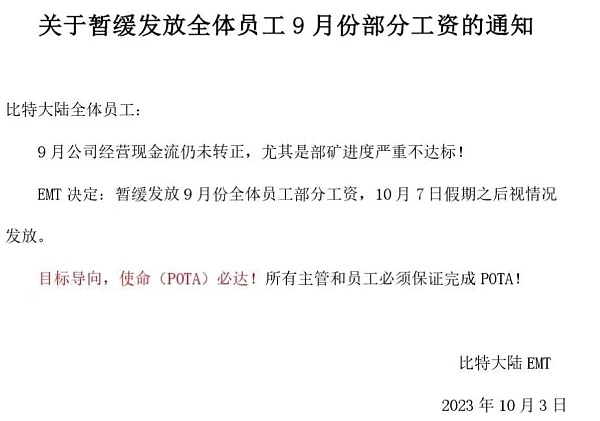
Bitmain, которая долгое время молчала, вызвала бурные дискуссии в кругу из-за объявления о задержке выплаты заработной платы, в условиях медвежьего рынка Bitmain, которая когда-то была в центре внимания, не сможет нести денежный поток?
Согласно отчету Wu Say Blockchain, ряд внутренних сотрудников Bitmain подтвердили, что Bitmain выпустила уведомление: операционный денежный поток компании в сентябре не стал положительным, особенно прогресс рудника (имеется в виду майнинговая машина, размещенная в шахте) серьезно не соответствует стандартам, EMT решила приостановить выплату части зарплаты всем сотрудникам в сентябре, и выплачивать ее по ситуации после праздника 7 октября. Ряд работников сообщили, что вся заработная плата всех сотрудников в сентябре была вычтена, и их основная заработная плата также была вычтена наполовину, и вычтенная заработная плата не знала, когда она будет выплачена. По состоянию на 8 октября работники не получили невыплаченную заработную плату, а премия по итогам 2022 года не выплачена.
Когда-то Bitmain монополизировала более семидесяти процентов мирового рынка машин для майнинга биткойнов, а затем из-за того, что два основателя Ву Джихан и Чжан Кетуань конкурировали за контроль над «внутренним...
金色财经_·2023-10-11 13:37
Загрузить больше